

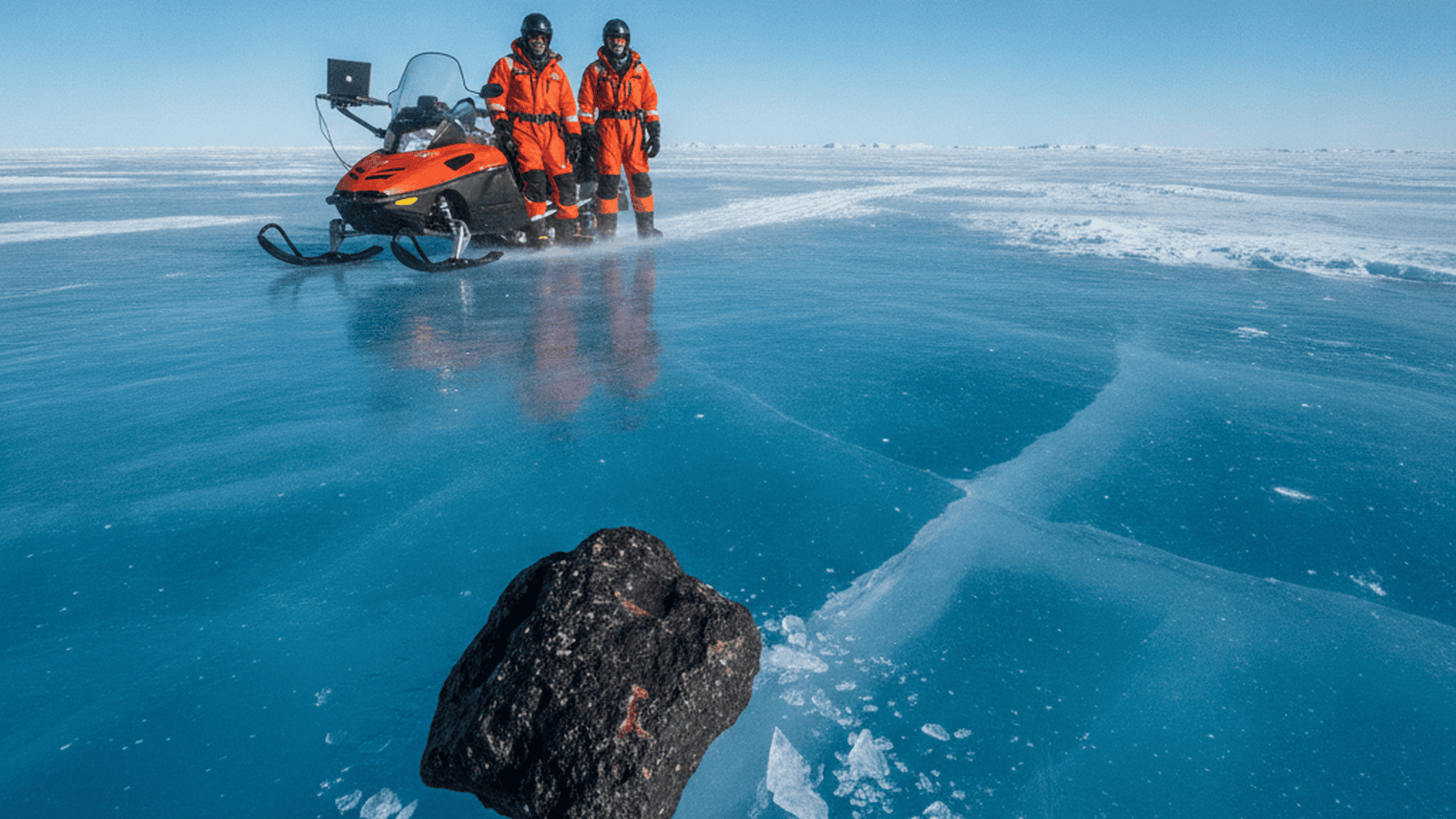
An international research team used a machine learning algorithm to locate five new meteorites in Antarctica, including a rare 7.6-kilogram specimen. The AI analyzed satellite data to identify high-probability “blue ice” zones, significantly increasing the efficiency of field searches in the harsh polar environment.
TLDR: Scientists have successfully integrated artificial intelligence with polar exploration to discover five meteorites in Antarctica. By analyzing satellite imagery and ice dynamics, a machine learning model directed researchers to a massive 7.6-kilogram space rock, demonstrating how AI can accelerate the discovery of rare geological samples in the world’s most extreme environments.
An international research team has successfully utilized artificial intelligence to locate five new meteorites in the Antarctic interior, including a rare specimen weighing 7.6 kilograms. The expedition, which took place during the austral summer of 2022-2023, was guided by a machine learning algorithm designed to identify high-probability “treasure maps” across the frozen continent. This breakthrough marks one of the first times that satellite-driven AI has been directly responsible for a major geological discovery in such an extreme environment. The integration of data science and field geology allowed the team to bypass traditional, less efficient search methods that often rely on visual scanning of vast, featureless ice sheets.
The predictive model was developed by researchers at the Université Libre de Bruxelles and ETH Zurich. It processed vast amounts of satellite data, including surface temperature, ice slope, and the velocity of ice flow. By cross-referencing these variables with the locations of previous meteorite finds, the AI identified specific regions where the natural movement of the ice sheet likely concentrates space rocks. These areas, known as blue ice fields, occur where strong winds strip away snow and sublimation exposes ancient ice and the debris trapped within it. The algorithm specifically looked for zones where the ice flow is obstructed by subglacial mountains, forcing meteorites to the surface.
Fieldwork in Antarctica remains a grueling endeavor despite the technological assistance. The team, led by Vinciane Debaille, spent several weeks traversing the Princess Elisabeth Antarctica station’s surrounding regions on snowmobiles. They navigated treacherous terrain and endured sub-zero temperatures to reach the coordinates flagged by the algorithm. The AI’s predictions proved remarkably accurate, boasting an estimated 80% success rate in identifying productive search zones. Researchers noted that while the AI provided the coordinates, the physical reality of the Antarctic environment required traditional survival skills and expert navigation to ensure the safety of the crew.
The discovery of the 7.6-kilogram meteorite is particularly noteworthy for the scientific community. While more than 45,000 meteorites have been recovered from the Antarctic ice over the past century, the vast majority are micrometeorites or small fragments the size of pebbles. Only about 100 of the recovered specimens match or exceed the mass of this new find. Large meteorites are prized because they provide a greater volume of material for chemical analysis without the risk of exhausting the sample. This specific specimen appears to be an ordinary chondrite, the most common type of meteorite, but its size allows for a much more comprehensive study of its internal structure.
Meteorites serve as time capsules from the early solar system, offering clues about the conditions that existed during the formation of the planets. By analyzing the isotopic composition and mineralogy of these rocks, researchers can trace the history of water and organic molecules in the protoplanetary disk. The five specimens recovered during this mission have been transported to the Royal Belgian Institute of Natural Sciences for detailed classification and curation. Once cataloged, they will be made available for international study, potentially revealing new data about the asteroid belt’s composition.
The success of this AI-guided expedition suggests a paradigm shift in how scientists approach exploration in remote regions. By narrowing down thousands of square kilometers of ice to a few high-probability targets, researchers can maximize the efficiency of limited field seasons. Future iterations of the algorithm will likely incorporate higher-resolution radar data to detect meteorites buried just beneath the surface. This integration of machine learning and traditional field geology promises to accelerate the discovery of planetary materials that have remained hidden for millennia, providing a clearer picture of our cosmic origins.

Mason Reed serves as a Staff Writer for Just Right News, where he spearheads the Future Frontiers & Special Projects desk. In an era defined by rapid technological shifts and evolving social landscapes, Mason provides a steady, principled voice, examining the innovations of tomorrow through the lens of traditional American values. His work is most prominently featured in his signature series, “The Next Horizon,” where he explores the intersection of emerging technology, national sovereignty, and the preservation of individual liberty.
A native of San Diego, California, Mason’s worldview was shaped by the unique culture of his hometown. Growing up in a region defined by its strong military presence and its history of maritime industry, he developed a deep-seated respect for the institutions that provide national stability and the entrepreneurial spirit that drives the American economy. This upbringing instilled in him a belief that true progress is not found in discarding the past, but in building upon a foundation of proven principles. His reporting often reflects this San Diego influence, emphasizing the importance of a robust national defense and the necessity of maintaining a competitive edge in the global marketplace.
Now based in San Francisco, Mason operates from the heart of the world’s technological engine. Living and working in the Bay Area provides him with a front-row seat to the advancements—and the ideological challenges—emanating from Silicon Valley. While many in the region embrace a “move fast and break things” mentality, Mason’s reporting serves as a vital counterweight. He offers Just Right News readers a “boots on the ground” perspective, documenting how radical local policies and the concentration of tech power impact the everyday lives of citizens. His proximity to the industry allows him to cut through the marketing jargon of big tech to uncover the real-world implications for privacy, free speech, and the nuclear family.
In his “Future Frontiers” beat, Mason tackles complex subjects ranging from the ethics of artificial intelligence to the burgeoning private space race. He approaches these topics with a healthy skepticism toward centralized bureaucracy, championing instead the decentralized innovations that empower individuals. Through “The Next Horizon,” he highlights the pioneers and thinkers who are working to ensure that the future remains a place where human dignity and constitutional rights are protected. He believes that the rapid pace of change requires more than just technical expertise; it requires a moral compass rooted in the Western tradition.
Throughout his tenure at Just Right News, Mason has remained committed to the idea that the future is something to be shaped, not merely accepted. His writing is characterized by a rigorous defense of American exceptionalism and a belief that the country’s best days lie ahead, provided it remains true to its founding ideals. Whether he is investigating the impact of automation on the American workforce or profiling the next generation of aerospace engineers, Mason Reed ensures that his readers are equipped with the insights they need to navigate a changing world with confidence and clarity.