

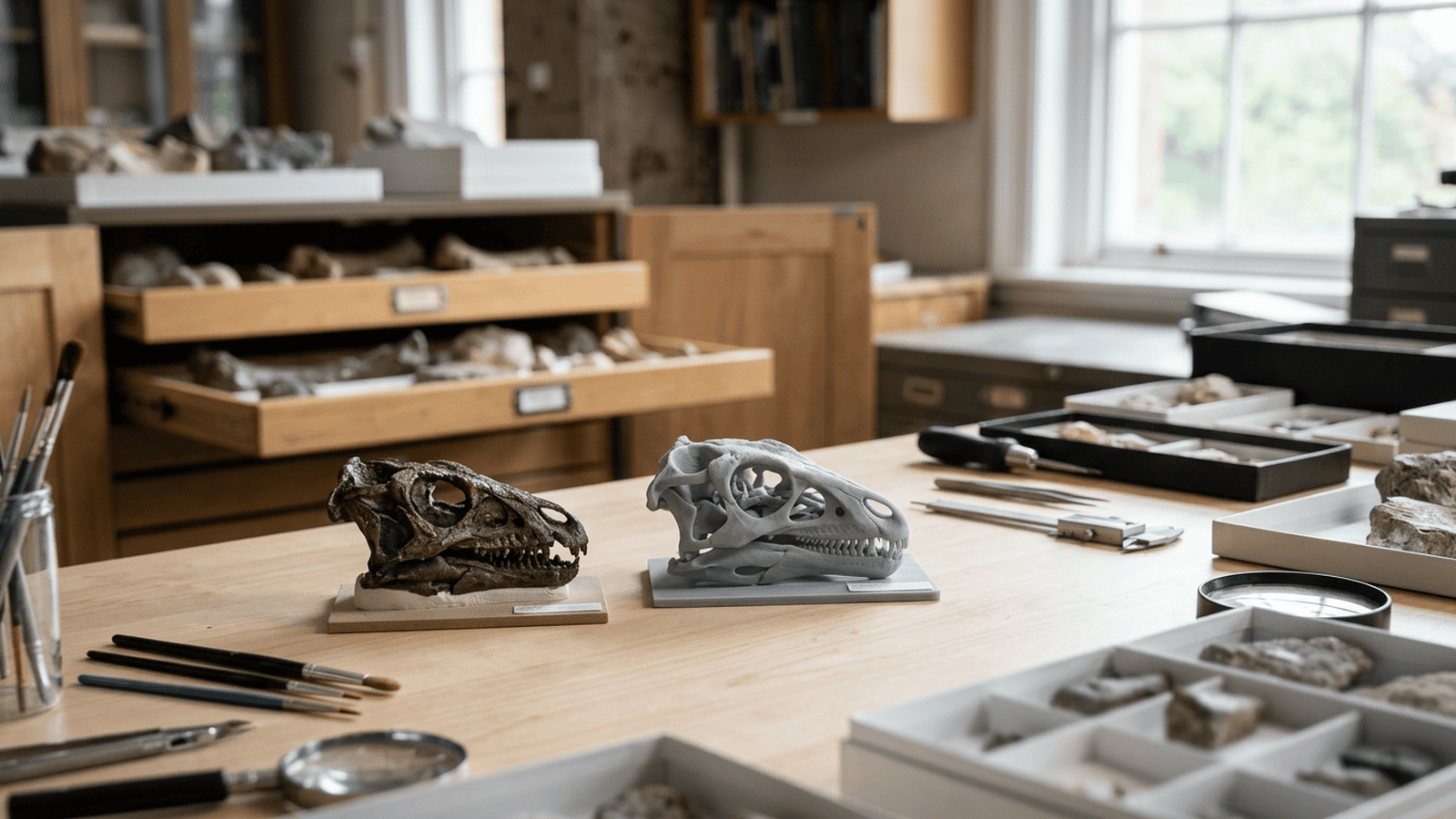
A fossil acquired by London’s Natural History Museum in 1924 has been identified as Invictibellatrix amberina, a previously unknown megaraptoran dinosaur. Researchers used a CT scan to make a three-dimensional model of the skull fragment and compared its features with fossils from tyrannosaurs, spinosaurs and raptors. They estimate the feathered animal was 10 to 13 feet long and hunted smaller dinosaurs, lizards and mammals with its long arms and curved claws. The discovery was reported in Royal Society Open Science, and the researchers say distinctive features support the classification as a new species. The report describes no fees, forms, deadlines or new rules; the next steps and oversight arrangements are not specified.
TLDR: A skull fragment stored at London’s Natural History Museum since 1924 has revealed a new megaraptoran species. CT imaging and comparisons with other dinosaur fossils supported the identification, though the report gives no costs, deadlines or further oversight plans.
A fossil held in a drawer at London’s Natural History Museum for nearly a century has yielded a newly identified dinosaur species. The animal, named Invictibellatrix amberina, was a two-legged meat-eater related to the group that includes Tyrannosaurus rex. Researchers describe it as a long-clawed predator about the size of a tiger.
There is no government policy or official policy rationale in this story. The researchers’ stated purpose was scientific: to identify the fossil and determine whether its features belonged to a species not previously recognized. Their common-sense method began with a CT scan and a three-dimensional model, then compared the skull fragment with fossils from other meat-eating dinosaurs.
The fossil is a piece from the back of a skull. The Natural History Museum obtained it in 1924, along with a collection of 1,000 specimens discovered by Reginald Walter Tooley on the Isle of Wight, off England’s south coast. The fragment remained overlooked until researchers examined it more recently. Lead author Cassius Morrison of University College London called the long delay a “real mystery.”
The new species belongs to the megaraptorans, a group of two-legged carnivores closely related to tyrannosaurs. Invictibellatrix lived around 120 million years ago, during the Early Cretaceous period. Researchers say it is among the smallest and earliest known members of that group. Its name combines Invictibellatrix, Latin for “unconquered female warrior,” with amberina, a reference to amber found in the rocks where the fossil was discovered.
The identification was based on a careful comparison rather than the dramatic appearance of a complete skeleton. Researchers created a three-dimensional model of the skull fragment from a CT scan. They compared its features with skulls from tyrannosaurs, spinosaurs and raptors. Distinctive features led them to conclude that the specimen represented a new species. The available account does not describe additional bones belonging to this dinosaur.
That distinction matters because the finding is based on one part of the animal, not a full set of bones. The scan let researchers examine the fragment’s shape in detail, while comparisons helped them decide how it differed from known dinosaurs. The fossil’s long time in storage also shows how new study of old collections can lead to fresh scientific findings.
Researchers estimate that the animal would have measured between 10 and 13 feet long and nearly five feet tall. Its body would have been covered in feathers. The team believes it hunted smaller dinosaurs, lizards and mammals. Unlike T. rex, which attacked with its mouth, Invictibellatrix is thought to have used its long arms and large curved claws to seize prey.
Morrison said the dinosaur was not the top predator of its time. He also wrote that it would have posed a serious danger to people had the species and humans existed at the same time. The account quotes him saying people would have been suitably sized prey, while a T. rex would not have bothered with them because they were too small. These are descriptions of a hypothetical encounter, not evidence of contact between humans and the dinosaur.
The species name also carries a message chosen by the researchers. They said they wanted it to offer hope and strength to people who are bullied, discriminated against, victimized or oppressed. That purpose accompanies the scientific naming, but the evidence for classifying the animal comes from the fossil’s features and the comparisons described in the research.
The practical impact reported here is limited to the research process and the identification. Researchers used a CT scan to make a three-dimensional model, compared it with other dinosaur skulls and reported their findings in the journal Royal Society Open Science. No fees, public forms, compliance rules, enforcement actions or deadlines are described. The directly affected parties named in the account are the researchers and the museum holding the specimen; the report does not specify costs or new duties for the museum or the public. The discovery also shows that a museum specimen can remain unidentified for decades, though the account does not say what review schedule or oversight applies to other collections.
No further deadline or formal oversight step is specified in the report. The necessary next step, as described, is the continued scientific examination of the fossil evidence and the published identification. The researchers’ conclusion rests on the scan, the comparisons and the features they found, giving the discovery a clear evidentiary basis without claiming that the remaining questions have all been settled.

Eric Nolan serves as the Senior Correspondent for Food, Water, and Environmental Health at Just Right News, where he brings a principled, common-sense perspective to the most fundamental issues facing the American public. With a career dedicated to uncovering the truth behind the policies that govern our natural resources, Eric has become a trusted voice for readers who value traditional stewardship over bureaucratic overreach. His reporting is defined by a commitment to the idea that true environmentalism is rooted in the protection of the American family and the preservation of the nation’s agricultural heritage.
Raised in Fresno, California, Eric’s worldview was shaped in the heart of the San Joaquin Valley. Growing up in one of the world’s most productive agricultural hubs, he witnessed firsthand the vital connection between the land, the water, and the dinner table. In Fresno, he saw the resilience of farmers and the devastating impact that distant, top-down regulations can have on local communities. This upbringing instilled in him a deep respect for the producers who feed the country and a lifelong skepticism toward the alarmist narratives often pushed by mainstream media. For Eric, environmental health is not an abstract political talking point; it is a matter of ensuring that the people who work the land have the freedom and the resources to do so effectively.
Now based in Eugene, Oregon, Eric operates from a unique vantage point in the Pacific Northwest. Living in a region often defined by intense environmental debate, he provides a necessary counter-narrative to the prevailing trends of the area. From his base in Eugene, he monitors the shifting tides of federal and state policies, ensuring that the voices of rural citizens and property owners are not drowned out by urban activism. His reporting often bridges the gap between the rugged realities of the outdoors and the legislative halls where decisions are made, offering a grounded perspective that prioritizes local sovereignty and practical solutions.
As the lead for the acclaimed feature series “Earth on the Table,” Eric explores the intricate journey of the American food supply. He tackles critical issues such as water rights, soil health, and food security through a lens of national stability and individual liberty. He believes that a healthy environment and a thriving economy are not mutually exclusive, but rather two sides of the same coin of national prosperity. His work consistently highlights how innovation and private-sector ingenuity are the most effective tools for ensuring clean water and a safe food supply, rather than the expansion of the administrative state.
At Just Right News, Eric’s reporting serves as a vital resource for those who seek accountability and transparency. Whether he is investigating the impact of federal land management on local economies or examining the safety of the national food infrastructure, his work remains anchored in the values of heritage and hard work. Eric Nolan continues to be a leading voice in environmental journalism, championing the belief that the best way to protect our natural resources is to empower the people who live and work closest to them.