

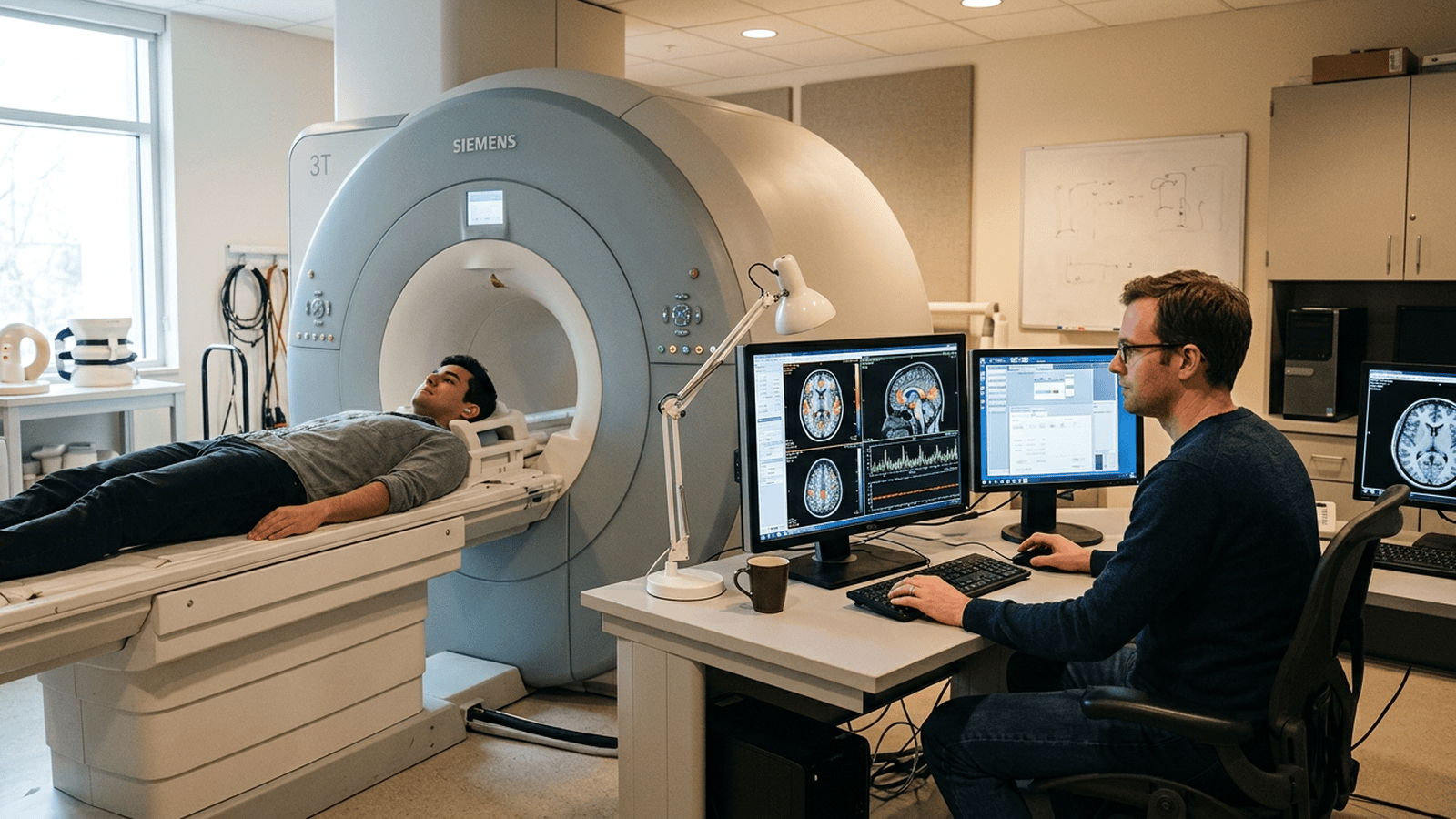
A University of Cambridge study used brain imaging and memory tasks to investigate how people preserve details of individual experiences while recognizing similarities between them. The findings add evidence about how the hippocampus and connected brain networks support both precise recall and generalization, though imaging cannot reveal activity at the level of individual neurons.
TLDR: A Cambridge laboratory study examined how people remember events that resemble one another. Brain-imaging results support the view that memory depends on balancing detailed recall with recognizing shared features. This balance helps people apply past experience to new situations, but the findings do not amount to a complete map of memory or a treatment for memory disorders.
A familiar place can feel different when a new event happens there. Research from a University of Cambridge laboratory helps explain how the brain can retain details of an experience while also recognizing that it resembles something encountered before. The work focuses on the hippocampus, a deep brain structure important for memory, and on how its activity may support both precise recall and generalization.
The study examined how people remember episodes that share features, such as a setting or objects, but are not identical. Participants learned information about scenes and later completed memory tasks while researchers measured brain activity using functional magnetic resonance imaging. This technique tracks changes in blood oxygen levels as an indirect measure of neural activity. The researchers compared the patterns associated with remembering specific details and with recognizing common elements across experiences. Tasks can distinguish memory for an exact episode from judgments based on overlapping cues.
The findings point to a division of labor within memory processing. The hippocampus can help preserve the distinctive details of individual events, while related activity across brain networks supports the extraction of shared information. That balance matters: a memory system that treated every experience as entirely new would struggle to learn from past events, while one that blended experiences too freely could confuse them.
Researchers have long studied this tension through the idea of pattern separation and pattern completion. Pattern separation refers to keeping similar experiences distinct; pattern completion is the ability to recover a memory from a partial cue. Work on the hippocampus, including research in animals and people, has connected these processes to different hippocampal subregions and interacting cortical networks. The Cambridge study adds evidence from human memory tasks about how detail and similarity can operate together, rather than as mutually exclusive outcomes. Everyday learning often depends on partial matches, not exact repetition.
The results do not mean that a single brain area stores a complete record of every experience. Memories are reconstructed from distributed activity, and fMRI cannot directly measure individual neurons or prove that a particular pattern causes a memory. The method is useful for locating broad changes in activity, but its signal is slower and less precise than the firing of nerve cells. Blood-oxygen changes unfold over seconds, limiting how precisely fMRI captures timing. The study therefore offers a way to test models of memory, not a final map of how every memory is formed.
The distinction between specific memories and general knowledge is relevant well beyond laboratory tasks. People use previous experiences to predict what may happen next, to navigate familiar environments, and to respond to situations that are similar but not identical. If the brain generalizes too little, learning may remain tied to a narrow set of circumstances. If it generalizes too much, details that should remain separate can blur together.
This balance also matters in research on memory disorders. Conditions affecting the hippocampus can make it difficult to form or retrieve episodic memories, while changes in how memories are generalized may shape anxiety and other symptoms. The findings do not establish a treatment or explain any one disorder, but clarifying the underlying processes may help researchers ask more precise questions about what changes when memory becomes less reliable.
The next step is to connect broad brain-imaging patterns with activity at finer scales and to test how memory representations change over longer periods. Researchers can also examine whether age, stress, or clinical conditions alter the balance between preserving details and drawing out similarities. A clearer account of that balance could explain how experience becomes useful knowledge without erasing the events that produced it.

Ethan Blake serves as a Senior Correspondent for Just Right News, where he specializes in Longform Narrative and Public Understanding. In an era of rapid-fire headlines and fleeting soundbites, Ethan’s work stands as a testament to the power of deep-dive reporting and the importance of contextualizing the complex issues facing the nation today. His approach is rooted in the belief that the most profound truths are often found in the lived experiences of individuals rather than the abstract theories of distant policymakers.
Growing up in Providence, Rhode Island, Ethan developed an early appreciation for the historical and cultural threads that weave the American fabric together. Providence, a city defined by its industrial heritage and its blend of traditional neighborhoods, provided him with a front-row seat to the challenges and triumphs of the American working class. This upbringing instilled in him a respect for the “common sense” values of hard work, community loyalty, and the preservation of local institutions. He learned early on that behind every economic statistic or legislative debate, there are real families and neighborhoods navigating the consequences of change.
This foundational perspective is the driving force behind his signature feature series, “Lives Behind the Systems.” Through this series, Ethan explores the intersection of individual agency and institutional structure. Whether he is documenting the impact of federal land-use policies on rural families or examining how shifting educational standards affect local school boards, Ethan’s work prioritizes the human element. He seeks to uncover how large-scale systems—be they governmental, economic, or social—affect the daily lives of citizens, often advocating for a return to local control and personal responsibility.
Now based in Portland, Maine, Ethan draws significant inspiration from the rugged independence and self-reliance that define the region. The coastal landscape and the resilient spirit of Maine’s communities serve as a constant reminder of the importance of individual liberty and the strength found in decentralized power. Living and working outside the traditional media hubs allows Ethan to maintain a grounded perspective, ensuring his reporting remains untethered from the echo chambers of the major metropolitan centers. This geographic distance provides him with the clarity needed to translate complex national narratives into stories that resonate with the heart of the country.
At Just Right News, Ethan’s beat is more than just a professional assignment; it is a mission to foster a more informed and engaged citizenry. He believes that a free society depends on the public’s ability to understand the mechanisms of power and the value of traditional American principles. His longform narratives do not merely report the news; they provide a roadmap for understanding the cultural and political shifts of the modern era through a lens of skepticism toward centralized authority and a deep respect for the individual.
Through his meticulous research and narrative craftsmanship, Ethan Blake continues to bridge the gap between policy and the public. His work remains a vital resource for those who seek a deeper understanding of the systems that shape our world and the enduring spirit of the people who live within them.