

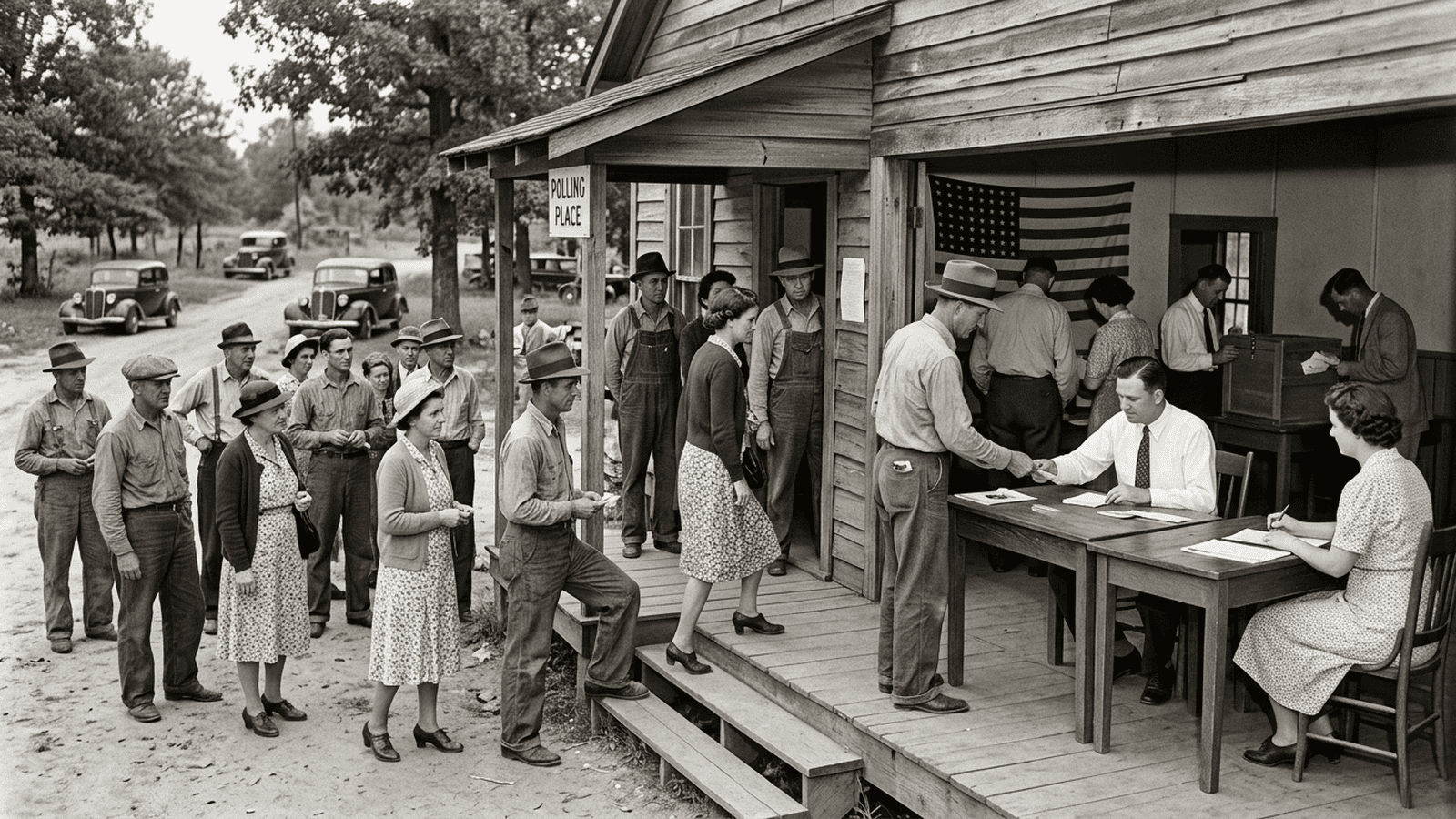
Arkansas’s 1939 adoption of a majority-vote rule for Democratic primaries created runoffs when no candidate won more than half the vote. The reform changed campaign strategy in a state where Democratic nominations carried great weight, but it did not remove the racial barriers that excluded many Black voters in the United States South.
TLDR: Arkansas adopted a majority-vote requirement for Democratic primaries in 1939. When no candidate won more than half the vote, the top two advanced to a runoff, changing campaign incentives in a state where the Democratic nomination often mattered most. The reform altered election procedure without ending racial exclusion from voting.
In 1939, Arkansas changed how candidates could win the state’s Democratic primary. A new majority requirement meant that when no candidate won more than half the vote, the top two had to face each other in a runoff. In a state where Democratic primaries often determined who would hold office, the change reshaped the route from campaigning to power.
The reform belonged to a long Southern tradition of treating party primaries as decisive elections. In much of the one-party South, Republican candidates had little chance of winning general elections. Democratic nominations therefore carried enormous weight, although Black voters were commonly excluded from the political process through discriminatory rules and practices. A primary’s rules could determine not just who led a party, but who governed.
Before a majority threshold, a candidate could prevail with a plurality: more votes than any rival, even if most voters chose someone else. A crowded field could divide the opposition and let a candidate win with a relatively small share. The runoff rule required a second contest when the first round produced no majority, giving the leading two candidates another chance to seek support. It did not guarantee a different winner, but it changed the incentives and timing of a campaign.
Arkansas’s 1939 reform came during the New Deal era, when political competition and public expectations were changing across the country. The state remained dominated by Democrats, and contests among Democrats offered the principal arena for many voters who were allowed to participate. A runoff could make a nomination look more representative by requiring a winning candidate to secure a majority in the final round. At the same time, it added the cost and work of another election.
The practical effects were especially significant in statewide contests, where several candidates might split votes across a large electorate. Candidates who survived the first round needed to build broader coalitions, attract supporters of eliminated rivals, and return to voters quickly. Party organizations and local political leaders could become important brokers between rounds. The second vote also gave campaigns an opportunity to sharpen their contrasts after the first results showed where each candidate stood.
Runoffs had limits. They did not make the primary open to people excluded by state election rules, nor did they eliminate unequal access to political influence. In Arkansas, as elsewhere in the South, white primaries and other barriers restricted Black political participation. The majority requirement changed how votes were counted toward a party nomination; it did not resolve who could vote freely or compete on equal terms. That distinction is essential to understanding the reform’s reach.
The 1939 change also illustrates how election administration can shape political outcomes without changing the electorate or replacing the party system. A plurality rule rewards a candidate’s ability to lead a divided field. A runoff instead sends the leading candidates back to voters when neither has crossed the majority line. That structure can encourage coalition-building, but it can also favor candidates with the resources and organization to sustain a second campaign.
Arkansas’s runoff system became part of the state’s enduring electoral framework. Later political debates and legal changes addressed broader questions of voting rights and access, including the dismantling of barriers that had excluded Black citizens. The runoff rule itself remained a distinct feature of the nomination process. Its history shows why election reforms must be judged both by the counting rule they establish and by the people who are permitted to take part.

Sophie Carter serves as a Staff Writer for Just Right News, where she anchors the outlet’s critical coverage of Elections, Influence, and Democracy Infrastructure. In an era where the mechanics of voting and the flow of political capital are under constant scrutiny, Sophie provides a steady, principled voice dedicated to the preservation of American institutional integrity and the rule of law.
Raised in Charlotte, North Carolina, Sophie’s perspective was forged in a community that balances rapid modern growth with a deep respect for tradition and civic duty. Growing up in the Queen City, she witnessed firsthand how a robust local culture depends on the trust between the citizen and the state. This upbringing instilled in her a foundational belief that the right to vote is a sacred trust—one that must be protected from both administrative overreach and the encroaching influence of special interest groups. Her reporting reflects these North Carolina roots, emphasizing the importance of community-led governance and the preservation of the individual’s voice in the face of nationalized political movements.
Now based in Atlanta, Georgia, Sophie operates from the heart of one of the nation’s most pivotal and contested political landscapes. Her location allows her to report from the front lines of the debate over election security, legislative reform, and the modernization of voting systems. For Sophie, the “infrastructure” of democracy is not merely a matter of machines and ballots; it is the collection of laws, people, and transparent processes required to maintain public confidence. Her work often highlights the necessity of clear, enforceable standards that ensure every legal vote is counted fairly and that the machinery of our republic remains accountable to the taxpayers who fund it.
Central to her work at Just Right News is her acclaimed feature series, “The Price of a Vote.” Through this ongoing project, Sophie explores the complex web of influence that shapes modern campaigns and policy decisions. She delves into how high-level lobbying, non-governmental organizations, and shifting bureaucratic regulations impact the weight of an individual citizen’s ballot. By examining the financial and structural pressures placed on the electoral process, she provides readers with a comprehensive look at the forces vying for control over the American political system.
Sophie’s approach to journalism is rooted in a commitment to the constitutional framework. She views her role as a watchdog for the voter, ensuring that the systems meant to serve the public remain transparent and free from corruption. Whether she is analyzing the implementation of new voting technologies or investigating the influence of outside money on state-level policy, her work is characterized by a rigorous adherence to facts and a refusal to succumb to the sensationalism that often plagues modern political reporting.
At Just Right News, Sophie Carter continues to be a vital resource for readers who value clarity, conviction, and a defense of traditional American values. Her deep ties to the Southeast and her specialized focus on the mechanics of our republic make her an essential voice in the ongoing conversation about the future of American self-governance. Through her reporting, she remains dedicated to the idea that a secure and honest electoral system is the bedrock of a free and prosperous society.