

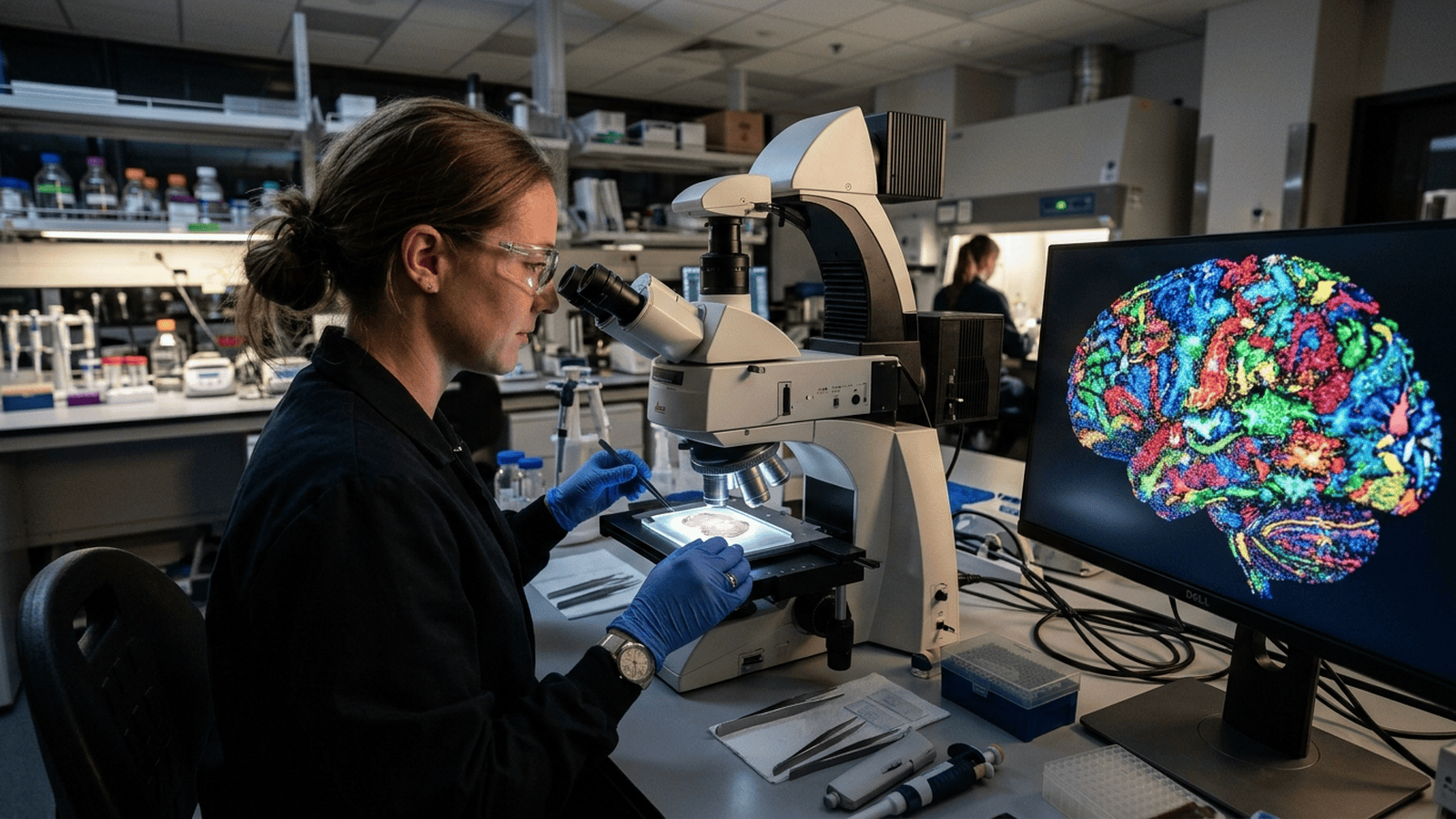
An international team in the BICCN initiative published a collection of studies mapping molecular differences among thousands of brain cell types. The reference may help researchers connect genetic findings to particular cells and brain regions, but it is a foundation for further work rather than a complete or causal explanation of brain disorders.
TLDR: An international neuroscience collaboration has catalogued thousands of molecularly distinct cell types in the human brain. The atlas helps researchers investigate where disease-linked genes are active and which cells may be involved in disorders. It is a valuable reference, but broader samples and follow-up experiments are needed to establish how these cells function.
The human brain is often described as one organ, but its cells differ widely in shape, activity and the genes they use. An international research effort has produced a molecular catalogue of many of those differences, offering scientists a way to study how the brain works and how disorders may arise.
The work was part of the U.S.-led Brain Research Through Advancing Innovative Neurotechnologies Cell Census Network, or BICCN, an international collaboration. In a collection of studies published in 2023, teams measured gene activity in individual cells and mapped where different cell populations occur. The papers examined human brain tissue alongside data from other mammals, including mice and nonhuman primates.
Rather than treating neurons as a few broad categories, researchers distinguished many cell populations by their molecular signatures. The studies described thousands of cell types across the brain, including numerous kinds of neurons and supporting cells. Some populations were found in particular brain regions, while others appeared in multiple areas with distinct patterns of gene activity.
The catalogue draws on techniques that read RNA molecules inside individual cells. RNA provides a snapshot of active genes, helping researchers distinguish cells that may look similar under a microscope. Other methods mapped gene activity in tissue, preserving information about cells’ locations and neighborhoods. Together, these approaches provide a more detailed reference than studies analyzing large pieces of brain tissue as a mixture.
That detail matters because samples containing many cell types can blur important differences. A gene may be active in one small population but not nearby cells; measuring tissue as a whole can hide that pattern. With cell-level data, researchers can ask which cells carry particular genes, how they are arranged, and how their activity compares across brain regions.
The atlas also offers clues about the biology of brain disorders. Researchers compared cell-type maps with genetic findings linked to autism, schizophrenia and Alzheimer’s disease. These comparisons can suggest which cell populations may be involved, helping narrow the search for mechanisms. They do not, by themselves, show that a cell type causes an illness or identify a treatment.
The work has limits. Human brain tissue is difficult to obtain, and samples collected after death cannot capture every feature of living brain activity. The atlas is a reference assembled from particular samples and methods, not a complete inventory of every person’s brain. Cell populations may also change with age, illness and experience. Further studies need broader samples and ways to connect molecular profiles with what cells do in functioning circuits.
Comparisons across species are useful but require care. Mouse studies allow experiments that cannot be performed in people, and shared features can help researchers test ideas. Yet a cell population in a mouse is not automatically equivalent to one in a human. Differences in brain size, organization and gene activity can affect how findings translate.
BICCN’s effort builds a foundation for targeted experiments. Scientists can use the maps to select cells for study, investigate how brain regions communicate, and test whether disease-associated genes act in specific populations. The catalogue can also guide development of better models for human conditions, though its value depends on continued validation.
The next step is to make the reference more comprehensive: adding data from more individuals, ages and brain regions, and linking cell identities to electrical activity and connections. That work could help explain how cellular variety supports thought and behavior, while giving researchers a clearer framework for investigating disease. The atlas is not a final map, but a shared starting point for neuroscience.

Ethan Blake serves as a Senior Correspondent for Just Right News, where he specializes in Longform Narrative and Public Understanding. In an era of rapid-fire headlines and fleeting soundbites, Ethan’s work stands as a testament to the power of deep-dive reporting and the importance of contextualizing the complex issues facing the nation today. His approach is rooted in the belief that the most profound truths are often found in the lived experiences of individuals rather than the abstract theories of distant policymakers.
Growing up in Providence, Rhode Island, Ethan developed an early appreciation for the historical and cultural threads that weave the American fabric together. Providence, a city defined by its industrial heritage and its blend of traditional neighborhoods, provided him with a front-row seat to the challenges and triumphs of the American working class. This upbringing instilled in him a respect for the “common sense” values of hard work, community loyalty, and the preservation of local institutions. He learned early on that behind every economic statistic or legislative debate, there are real families and neighborhoods navigating the consequences of change.
This foundational perspective is the driving force behind his signature feature series, “Lives Behind the Systems.” Through this series, Ethan explores the intersection of individual agency and institutional structure. Whether he is documenting the impact of federal land-use policies on rural families or examining how shifting educational standards affect local school boards, Ethan’s work prioritizes the human element. He seeks to uncover how large-scale systems—be they governmental, economic, or social—affect the daily lives of citizens, often advocating for a return to local control and personal responsibility.
Now based in Portland, Maine, Ethan draws significant inspiration from the rugged independence and self-reliance that define the region. The coastal landscape and the resilient spirit of Maine’s communities serve as a constant reminder of the importance of individual liberty and the strength found in decentralized power. Living and working outside the traditional media hubs allows Ethan to maintain a grounded perspective, ensuring his reporting remains untethered from the echo chambers of the major metropolitan centers. This geographic distance provides him with the clarity needed to translate complex national narratives into stories that resonate with the heart of the country.
At Just Right News, Ethan’s beat is more than just a professional assignment; it is a mission to foster a more informed and engaged citizenry. He believes that a free society depends on the public’s ability to understand the mechanisms of power and the value of traditional American principles. His longform narratives do not merely report the news; they provide a roadmap for understanding the cultural and political shifts of the modern era through a lens of skepticism toward centralized authority and a deep respect for the individual.
Through his meticulous research and narrative craftsmanship, Ethan Blake continues to bridge the gap between policy and the public. His work remains a vital resource for those who seek a deeper understanding of the systems that shape our world and the enduring spirit of the people who live within them.