

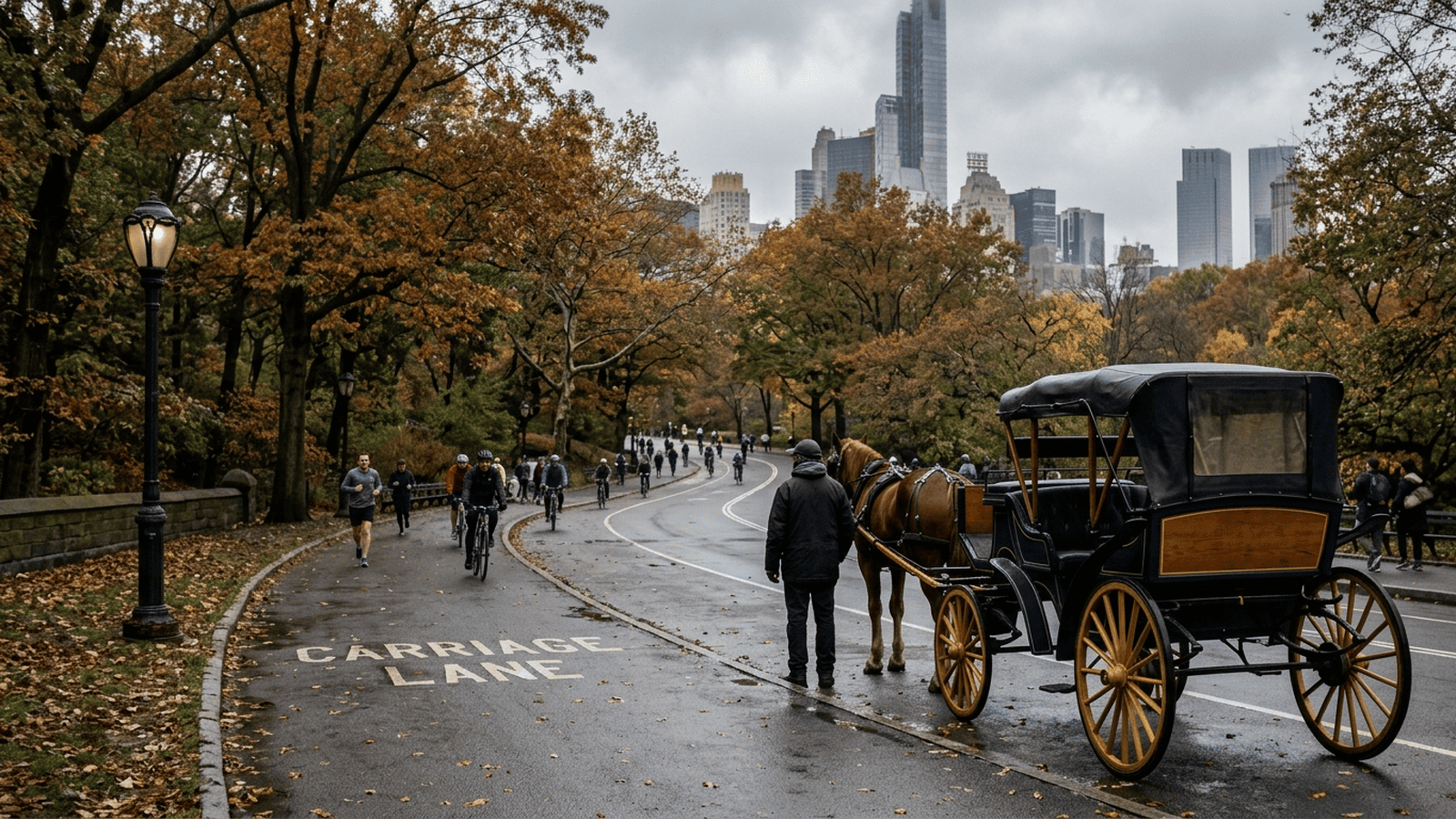
New York City’s law to end Central Park’s horse-drawn carriage rides by June 2028 is facing a federal lawsuit from the union representing drivers. The union argues that the ban is unconstitutional, violates local legal procedures and threatens workers’ livelihoods; those claims have not been decided by a court. City officials have cited safety concerns in a busy park, including a fatal runaway-carriage incident last spring and earlier cases of horses collapsing or bolting. The city already requires veterinary checks, time off for horses and a retirement age. City Hall has promised a career transition plan next April with job training, education pathways and stipends, but details on eligibility and amounts are not yet available.
TLDR: The union representing Central Park carriage drivers has sued to block New York City’s law ending the rides by June 2028. The city cites safety concerns and has promised a transition plan next April, while the lawsuit’s claims and the plan’s details remain unresolved.
New York City’s plan to end Central Park’s horse-drawn carriage rides is now facing a federal lawsuit. The Transport Workers Union, which represents carriage drivers, filed suit in Manhattan on Thursday, shortly after Mayor Zohran Mamdani signed legislation to wind down the industry. The union is asking the court to strike down the ban and argues that the city is taking away drivers’ livelihoods. The city’s law department says it is reviewing the case.
The stated rationale for the law is safety in a busy public park. Mamdani said horses should no longer carry tourists among joggers, cyclists and other passersby in Central Park. City lawmakers renewed their push for a ban after an eighteen-year-old tourist died last spring after jumping from a runaway carriage. The city’s position, as described at the bill signing, is that changing conditions in the park call for a change in law.
The law is scheduled to stop carriage rides by June 2028. That leaves time before the ban takes effect, but it does not remove the uncertainty facing drivers and others in the industry. The lawsuit disputes the city’s authority to proceed as it did and argues that the law is unconstitutional. Those are claims made by the union, not findings by a court.
The case also raises questions about how the city handled legal interests tied to the business. The lawsuit says the city violated local legal procedures when it approved the law and names the mayor and other city officials as defendants. It describes the city’s approach as threatening owners’ property interests and contracts while leaving compensation unclear. The excerpt does not establish whether owners will receive compensation or whether a court will agree with the union’s account.
The dispute follows a long-running argument over the rides. Animal welfare activists and supporters of the industry have disagreed over whether the carriages represent cruelty or a surviving link to the city’s past. The city has already imposed safety rules, including veterinary checkups, required vacation time for horses and a retirement age for the animals. Those measures show that regulation has been part of the industry for years, though the new law goes further by setting an end date for the rides.
Safety concerns include horses collapsing or becoming startled and running into cars or other objects. The death of Romanch Mahajan prompted lawmakers to renew the ban effort, and the account describes it as apparently the first fatality in a horse-carriage accident since the rides began in Central Park. That description is qualified in the source material. The reported facts explain the policy’s safety rationale, but they do not settle the separate legal dispute over the ban or its effects on workers.
City Hall has promised a career transition plan for people in the carriage industry next April. The plan is expected to include job training, educational pathways and stipends. Union leader John Samuelsen said the protections described by the mayor should have been written into the legislation, while drivers argue their future remains uncertain. The available material does not specify the amount of any stipends, who will qualify, or how the transition programs will be administered.
The practical impacts are direct: carriage rides are set to end by June 2028, and drivers and other people in the industry face a change to their work and livelihoods. Existing requirements include veterinary checks, time off for horses and an animal retirement age. The source gives no new application forms, fees, enforcement process or compliance penalties under the ban, and it does not state what compensation, if any, owners will receive. The transition plan’s promised training, education options and stipends are the stated steps for affected workers, with further details not yet provided.
The lawsuit now places the law’s constitutionality and approval process before the federal court in Manhattan. The city law department is reviewing the case, while City Hall’s transition plan is expected next April and the ban is set for June 2028. Those are the next steps identified in the account; the court’s decision and the plan’s details remain unresolved. The legal review and the coming transition plan will determine how the city proceeds and what support is available to people affected.

Deborah Cole serves as a Senior Correspondent for Just Right News, where she spearheads the network’s coverage of Housing, Infrastructure, and Mobility. With a career defined by a commitment to rigorous reporting and a focus on the fundamental pillars of American community life, Deborah brings a principled perspective to the complex issues that dictate how and where we live. Her work is grounded in the belief that sound policy, fiscal responsibility, and respect for private property are the essential foundations of a prosperous society.
Originally from Boston, Massachusetts, Deborah’s upbringing in one of the nation’s oldest and most historically significant cities deeply influenced her professional trajectory. Growing up amidst the architectural legacy and dense urban planning of New England, she developed an early appreciation for the importance of durable infrastructure and the role of local tradition in shaping neighborhoods. Her perspective is informed by the classic American values of her hometown—hard work, community cohesion, and a healthy skepticism of top-down bureaucratic mandates that often overlook the unique needs of individual citizens.
Today, Deborah operates from her base in Austin, Texas, a city that serves as a primary laboratory for her reporting. Austin’s rapid expansion and its status as a hub for innovation and migration provide her with a front-row seat to the most pressing challenges in modern infrastructure and housing. From the Lone Star State, she chronicles the tensions between rapid growth and the preservation of the American Dream, often highlighting how market-driven solutions and deregulation can address the housing shortages that plague many of the country’s metropolitan areas.
At Just Right News, Deborah is perhaps best known for her signature feature series, “Where We Live.” Through this platform, she explores the intersection of public policy and private life, moving beyond mere statistics to tell the stories of families, small business owners, and local developers. Her reporting frequently highlights the importance of mobility—not just in terms of transportation and transit, but as a vehicle for economic opportunity and social stability. She remains a staunch advocate for the taxpayer, consistently scrutinizing government spending on large-scale projects and advocating for transparency in how infrastructure dollars are allocated.
Deborah’s beat is more than just a collection of policy topics; it is an investigation into the physical and legal structures that allow families to flourish. Whether she is reporting on the impact of zoning laws on suburban development or the necessity of maintaining the nation’s highway systems, her work is characterized by a dedication to the facts and a respect for the constitutional principles that protect the rights of homeowners.
As a Senior Correspondent, Deborah Cole continues to be a vital voice for Just Right News, providing the audience with the clarity and context needed to navigate an ever-changing landscape. Her reporting ensures that the values of individual liberty and local sovereignty remain at the forefront of the national conversation regarding the future of our cities and towns. Through her tireless efforts, she remains committed to informing the public on the issues that hit closest to home.