

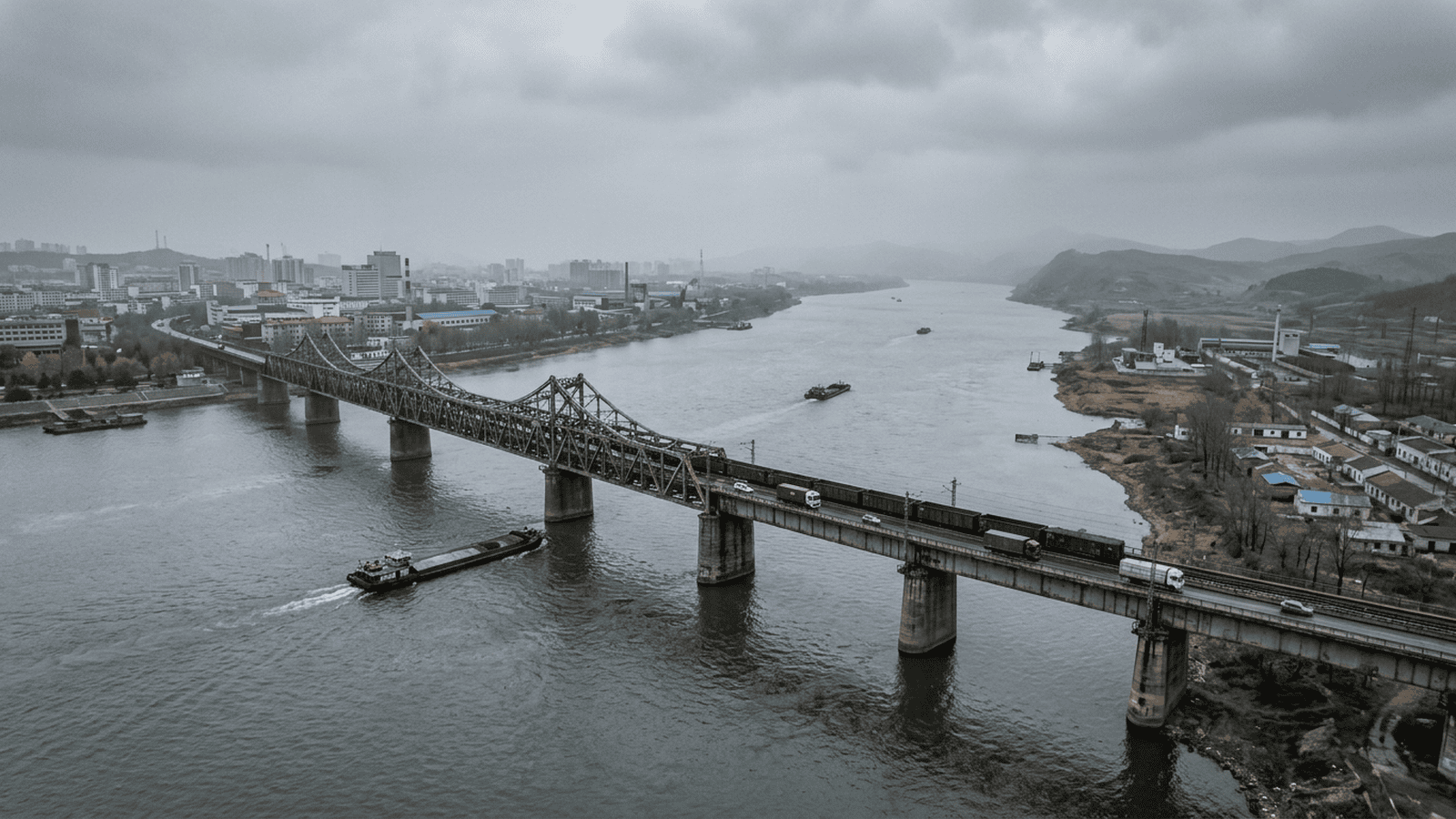
A new four-lane bridge across the Yalu River has opened between China and North Korea, creating a visible link for trucks and cars but not trains. Chinese visitors describe it as a boost to trade and friendship, while North Korea’s recent missile tests and sharp warnings have raised concern about Kim Jong Un’s intentions. Analyst Robert Carlin says a confrontation is a possibility that deserves serious attention, but no attack plan is confirmed. President Trump has said a meeting with Kim could happen during the APEC summit in China, though it is not confirmed. The report describes no new rules, fees, forms, or deadlines; the next steps are to watch for a meeting and further North Korean actions.
TLDR: The new China-North Korea bridge is a practical trade link, but it does not prove that Pyongyang is preparing to confront the United States. Missile launches, nuclear growth, and possible summit talks are the concrete developments to watch, while a meeting and any hostile move remain unconfirmed.
A new bridge across the Yalu River gives China and North Korea a visible connection, but it does not settle what Kim Jong Un intends to do next. The nearly two-mile, four-lane crossing opened on Oct. 24, with Kim making a surprise appearance. Its completion is a concrete sign of closer cross-border ties. It is not proof that Pyongyang is preparing to confront the United States, though recent missile tests and warnings have prompted concern among analysts.
The local rationale is practical: Chinese residents and visitors described the bridge as a way to support trade and strengthen friendship. One visitor said it was good for trade and expressed hope that relations would improve. A tour leader said the crossing could enhance ties, while also hoping North Korea would open to the West. Those comments describe local expectations, not a formal policy explanation from either government.
The bridge is designed for trucks and cars, not trains, according to a retired Chinese official who visited Dandong. China completed its side 12 years ago, while North Korea finished its section only recently. The crossing now stands beside older infrastructure, including the Sino-Korean Friendship Bridge, which carries cross-border rail and one-lane road traffic. Together, the structures show that the China-North Korea relationship has practical as well as symbolic dimensions.
Dandong makes that connection easy to see. The city sits across the river from North Korea, and its businesses serve visitors drawn by the border. Tourists have traveled from faraway parts of China to take photographs near the new bridge. Hotels along the river offer telescopes and binoculars for viewing the other side. The scene reflects Chinese interest in a neighboring country that remains heavily sanctioned and nuclear-armed.
That visible interest is not the same as evidence of North Korean openness. Since the start of October, Pyongyang has test-fired more than a dozen missiles, the most concentrated series of launches since 2023. Kim has watched some of the tests in person. His teenage daughter, Kim Ju Ae, has accompanied him, and she is widely viewed as a potential successor. These are reported developments; what they mean for Kim’s plans remains uncertain.
Robert Carlin, a former U.S. State Department official with decades of experience analyzing North Korea, said the launches may form part of preparations for an action Kim wants to take. He pointed to the public nature of the tests, probing along the demarcation line, and high-level warnings and threats. Carlin said the possibility of a move against U.S. assets in the region or South Korea should be taken seriously. His assessment is a warning about a possibility, not confirmation that an attack is planned.
The broader alignment adds context. China has remained a constant relationship for North Korea, though ties have sometimes been strained. Pyongyang has also supported Russia since its full-scale invasion of Ukraine, sending munitions and thousands of soldiers, according to the report. Moscow, in turn, has provided financial and technological assistance that has helped North Korea develop its nuclear program. These connections may strengthen Kim’s sense that his country has partners, but the article does not establish that Beijing or Moscow has agreed to support a confrontation with Washington.
The nuclear question remains central to diplomacy. President Donald Trump has sought another meeting with Kim for months, citing a good personal rapport. Trump is in China for the APEC summit, and he said a meeting might happen, while noting that the decision would be up to the Chinese hosts. The possibility is not a confirmed event. Trump met Kim three times during his first term, including two summits focused on steps toward denuclearization, but those discussions produced no agreement. Since then, Kim has expanded the arsenal. South Korean intelligence agencies believe North Korea could have as many as 120 nuclear warheads.
Kim has said he will negotiate only if the United States formally recognizes North Korea as a nuclear state. That condition conflicts with the earlier goal of denuclearization and leaves little evidence of a near-term diplomatic breakthrough. Longstanding international sanctions remain in place. The report gives no new sanctions, enforcement measures, fees, forms, or deadlines tied to the bridge or to a change in U.S. policy. No such policy change is described, so there are no direct compliance requirements to list; the practical impact presented is a new road crossing for vehicles, alongside continuing security and diplomatic uncertainty.
The next developments are whether Trump and Kim meet during the summit and whether North Korea continues its missile activity. Neither outcome is established in the report. Further assessment depends on observed actions, not assumptions drawn from the bridge alone. Those are the necessary next steps for judging the alignment and its security effects; the available account does not say that experts have the situation handled.

Jordan Lee serves as the Senior Correspondent for Wall Street, Finance, and Monetary Systems at Just Right News. Based in the heart of the world’s financial capital, New York City, Lee brings a sharp, principled eye to the complex mechanisms that drive the global economy. His reporting is defined by a commitment to fiscal responsibility, the defense of the free market, and a deep-seated belief that a transparent monetary system is the bedrock of a free society.
Raised in Portland, Oregon, Lee’s perspective was forged in a city that has undergone significant cultural and economic shifts. His upbringing in the Pacific Northwest instilled in him a profound appreciation for the industriousness of small business owners and the importance of local economic stability. Watching the evolution of his hometown’s landscape sparked an early interest in how federal fiscal policy and large-scale financial trends eventually trickle down to the average citizen. This background provides him with a unique vantage point; he understands the growing disconnect between the policy-making elite and the reality of Main Street, a theme that frequently resonates throughout his work.
Now operating from his base in New York City, Lee bridges the gap between the high-stakes trading floors of Manhattan and the households of everyday Americans. He views the financial sector not merely as a collection of numbers and tickers, but as a vital engine of American prosperity that requires constant vigilance and accountability. His reporting often highlights the dangers of centralized financial control and the necessity of maintaining a system that rewards merit, risk-taking, and innovation.
As the creator and lead of the featured series, “The Invisible Economy,” Lee pulls back the curtain on the often-opaque world of monetary systems. He specializes in translating the dense jargon of central banking and international finance into actionable insights for the Just Right News audience. His work explores the “invisible” forces—such as inflationary pressures, regulatory creep, and the expansion of the administrative state—that erode the purchasing power of American families. By focusing on these systemic issues, Lee empowers readers to understand the hidden forces shaping their financial independence.
Lee’s journalistic philosophy is rooted in a steadfast commitment to traditional American values. As an Asian American professional who has navigated the competitive corridors of the financial world, he is a vocal advocate for meritocracy and the preservation of the American Dream. He believes that a stable currency and a predictable regulatory environment are essential for national sovereignty and individual liberty. His reporting frequently warns against the risks of government overreach in the private sector, arguing that the most effective solutions to economic challenges arise from competition and individual enterprise rather than bureaucratic mandates.
At Just Right News, Jordan Lee remains dedicated to providing a clear-eyed defense of the taxpayer. Whether he is analyzing market volatility or investigating the long-term implications of national debt, his mission is to provide the truth about where the money is going and what it means for the future of the country. Through his rigorous analysis and principled stance, Lee has become a trusted voice for those who value a strong, sovereign, and fiscally sound America.