

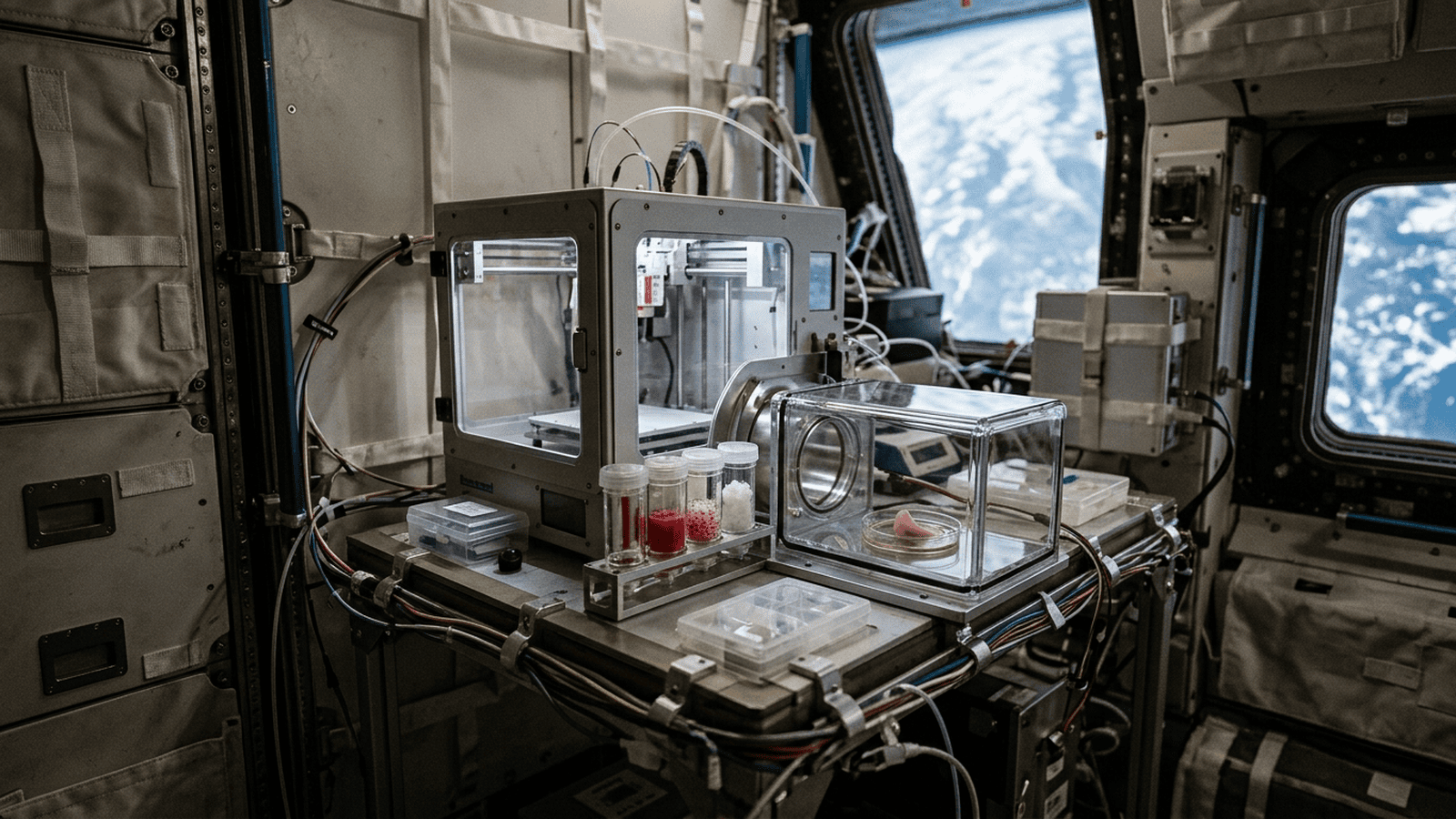
Redwire and University of California San Diego researchers used the BioFabrication Facility aboard the International Space Station to print a human meniscus tissue construct in microgravity. The demonstration can help researchers study tissue engineering, but it does not show that a transplant-ready implant has been made.
TLDR: Researchers printed a human meniscus tissue construct aboard the International Space Station using Redwire’s commercial BioFabrication Facility. The sample returned to Earth for study, offering a new way to investigate tissue engineering in microgravity. It is a research demonstration, not a ready-made implant or a proven treatment.
A research team used a commercial bioprinter aboard the International Space Station to produce a small piece of human meniscus tissue, marking a notable test of how living cells can be assembled in microgravity. Redwire, the company that built and operates the station’s BioFabrication Facility, announced the result in July 2024 with researchers from the University of California San Diego.
The experiment traveled to the station on a SpaceX cargo mission in November 2023. Astronauts used Redwire’s facility to print a construct from human meniscus cells and a bio-ink designed to hold them in place. The meniscus is the crescent-shaped cartilage in the knee that cushions the joint and helps distribute force. Meniscus tissue is largely avascular, so injuries often heal poorly, particularly in its inner region. The printed sample was returned to Earth for analysis.
The work addresses a practical obstacle in tissue engineering. On Earth, gravity can cause soft printed structures to sag or lose their shape before cells and supporting material settle into a stable form. A fluid-filled environment can provide support, but it may also wash away cells or make it harder to build a precise structure. Microgravity changes those conditions, offering researchers a way to test whether delicate biological materials can be arranged with fewer gravity-driven distortions. Researchers can test whether printing conditions affect cell distribution and material architecture.
The station’s BioFabrication Facility is a small research laboratory, not a factory for replacement organs. Redwire developed the system to print biological materials in orbit, where astronauts can run experiments and researchers can compare the resulting samples with Earth-based controls. The meniscus project was a demonstration of the facility’s capabilities and an investigation into tissue formation, rather than a clinical attempt to make a transplant-ready knee implant.
That distinction matters because printing a recognizable tissue construct is only an early step. A useful meniscus replacement would need the right shape and mechanical strength, contain living cells that remain healthy, and integrate safely with surrounding tissue. It would also need to perform under the repeated loading that knees experience. The reported space-made sample does not establish that it can meet those requirements or improve patient treatment.
Still, the experiment offers a way to investigate a longstanding engineering question: whether microgravity can help produce thicker or more complex tissues than are practical on Earth. Scientists have explored space-based cell growth and tissue engineering for years, but each material and cell type behaves differently. A result with meniscus cells cannot automatically be applied to other tissues, and comparisons with matched ground samples are essential to determine what the orbital environment actually changed.
The project also shows how commercial infrastructure is becoming part of basic research in low Earth orbit. Redwire supplies equipment and operations, while university researchers contribute biological questions and analyze samples. The model can make specialized hardware available to more research teams, although orbital experiments remain costly and are limited by launch schedules, crew time and the need to return samples for testing.
The next research steps are to examine the returned construct in detail, compare it with Earth-printed samples and test whether changes in printing conditions produce stronger, more consistent tissue. Further work would need to establish cell survival, material properties and how a construct behaves in biological systems. Such measurements can guide later experiments in orbit. For now, the result is a promising proof of process: a private-sector space laboratory helped researchers print human tissue in orbit, while the route from a small sample to a reliable medical implant remains long.

Mason Reed serves as a Staff Writer for Just Right News, where he spearheads the Future Frontiers & Special Projects desk. In an era defined by rapid technological shifts and evolving social landscapes, Mason provides a steady, principled voice, examining the innovations of tomorrow through the lens of traditional American values. His work is most prominently featured in his signature series, “The Next Horizon,” where he explores the intersection of emerging technology, national sovereignty, and the preservation of individual liberty.
A native of San Diego, California, Mason’s worldview was shaped by the unique culture of his hometown. Growing up in a region defined by its strong military presence and its history of maritime industry, he developed a deep-seated respect for the institutions that provide national stability and the entrepreneurial spirit that drives the American economy. This upbringing instilled in him a belief that true progress is not found in discarding the past, but in building upon a foundation of proven principles. His reporting often reflects this San Diego influence, emphasizing the importance of a robust national defense and the necessity of maintaining a competitive edge in the global marketplace.
Now based in San Francisco, Mason operates from the heart of the world’s technological engine. Living and working in the Bay Area provides him with a front-row seat to the advancements—and the ideological challenges—emanating from Silicon Valley. While many in the region embrace a “move fast and break things” mentality, Mason’s reporting serves as a vital counterweight. He offers Just Right News readers a “boots on the ground” perspective, documenting how radical local policies and the concentration of tech power impact the everyday lives of citizens. His proximity to the industry allows him to cut through the marketing jargon of big tech to uncover the real-world implications for privacy, free speech, and the nuclear family.
In his “Future Frontiers” beat, Mason tackles complex subjects ranging from the ethics of artificial intelligence to the burgeoning private space race. He approaches these topics with a healthy skepticism toward centralized bureaucracy, championing instead the decentralized innovations that empower individuals. Through “The Next Horizon,” he highlights the pioneers and thinkers who are working to ensure that the future remains a place where human dignity and constitutional rights are protected. He believes that the rapid pace of change requires more than just technical expertise; it requires a moral compass rooted in the Western tradition.
Throughout his tenure at Just Right News, Mason has remained committed to the idea that the future is something to be shaped, not merely accepted. His writing is characterized by a rigorous defense of American exceptionalism and a belief that the country’s best days lie ahead, provided it remains true to its founding ideals. Whether he is investigating the impact of automation on the American workforce or profiling the next generation of aerospace engineers, Mason Reed ensures that his readers are equipped with the insights they need to navigate a changing world with confidence and clarity.