

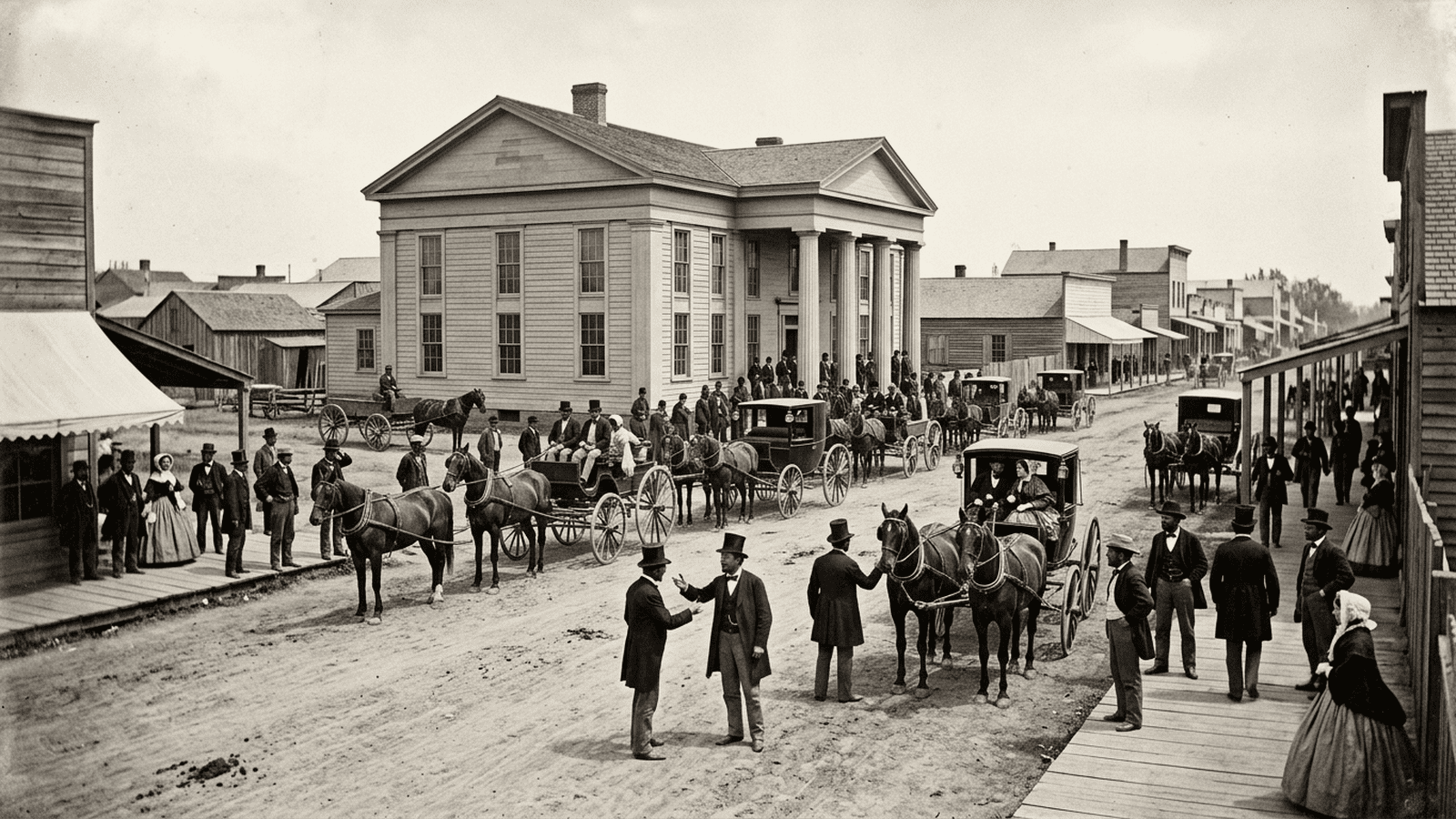
California lawmakers moved the state government from Benicia back to Sacramento in 1854 after several years of competing capital locations. The decision reflected town rivalries, transportation needs, and the Legislature’s authority to determine where the young United States state’s government would meet.
TLDR: California’s early lawmakers moved the state capital repeatedly as towns competed for influence and investment. In 1854, the Legislature returned from Benicia to Sacramento, where a new capitol building and the city’s position on major river routes supported a more lasting political center for the growing state.
California’s early state government had no settled home. In its first years, lawmakers met in San Jose, Vallejo, Sacramento, and Benicia as communities competed for the prestige and economic benefits of hosting the capitol. On February 4, 1854, the Legislature convened in Sacramento, ending Benicia’s brief tenure and beginning the river city’s more lasting association with the capital.
The moves reflected more than convenience. California entered the Union in 1850 amid a rush of migration, while its government built institutions and towns competed for population, investment, and political influence. A capitol brought legislators, officials, visitors, and spending. Choosing where to meet became a contest over regional advantage and the practical reach of state power. Because early law left the Legislature room to choose its meeting place, lawmakers could respond to local offers and changing conditions without a new statewide vote.
San Jose hosted the Legislature in 1850 and 1851. Vallejo became the next designated capital, but its facilities proved inadequate for state government. In January 1852, lawmakers shifted their meeting place to Sacramento. That arrangement did not last: in 1853, the Legislature selected Benicia, a growing town on the Carquinez Strait, and the state government moved there for its next session.
Benicia offered a more established setting than Vallejo’s unfinished facilities, but Sacramento supporters continued pressing their case. The river city was accessible to people and commerce moving through the interior, and its leaders stressed the need for a suitable permanent public building. River steamboats and routes into the mining districts made Sacramento a practical arrival point for officials and petitioners, not merely a beneficiary of local promotion. Transportation, accommodation, and the prospect that a capitol would make a town a durable government center shaped the debate.
In 1854, lawmakers chose Sacramento again. The session opened there on February 4, with the state government taking up residence in a new capitol building. The change was a legislative decision, not a constitutional amendment establishing Sacramento as the permanent capital. Its significance lay in the Legislature’s choice to consolidate government in a place better positioned to serve the expanding state—and in the fact that the choice finally held. The building provided a common location for legislative work and state offices as public administration grew.
The setting mattered. Sacramento stood at the confluence of the Sacramento and American rivers, an important location during the Gold Rush and for travel between the interior and the coast. The city had suffered devastating floods and fires, and its growth was far from assured. A state capitol offered a continuing source of activity and investment, although it did not alone determine the city’s future. As population growth increased demands for courts, records, and public administration, access to the city helped officials and residents reach state institutions.
The state’s early capital changes revealed how unsettled California’s political geography remained. Local rivalries could influence where lawmakers assembled, while the Legislature’s authority to choose a meeting place gave it a direct role in shaping the government’s physical center. Repeated relocations also exposed the cost of relying on temporary facilities in a fast-growing state.
Sacramento’s selection in 1854 did not instantly end every debate about the capitol. Construction, flooding, and the need for more adequate government space continued to challenge the state. In later years, California developed a permanent state capitol in Sacramento, reinforcing the decision made by lawmakers in the antebellum period. The move helped anchor state institutions in the interior and established a political center that has endured through subsequent population growth and legislative change.

Dylan Brooks serves as the Senior Correspondent for Statehouses and Local Governance at Just Right News, where he brings a principled, constitutionalist lens to the often-overlooked machinery of state-level politics. As the lead voice behind the acclaimed feature series “Fifty Laboratories of Power,” Dylan has dedicated his career to the idea that the most impactful governance happens closest to home. His reporting consistently champions the Tenth Amendment, exploring how individual states can serve as testing grounds for innovative, conservative policy solutions that prioritize personal liberty and fiscal responsibility.
A native of Des Moines, Iowa, Dylan’s journalistic philosophy was forged in the heart of the American Midwest. Growing up in a community where local school board meetings and town halls were the bedrock of civic life, he developed a deep appreciation for the “retail politics” of the heartland. This upbringing instilled in him a fundamental belief that the American experiment is best preserved when power is decentralized. He carries the values of his Iowa roots into every assignment, maintaining a healthy skepticism of federal overreach and a steadfast commitment to the concerns of everyday citizens over the interests of the administrative state.
Now based in Madison, Wisconsin, Dylan operates from one of the nation’s most pivotal political battlegrounds. His location in a state capital known for its rigorous policy debates allows him to provide Just Right News readers with a front-row seat to the legislative process. From Madison, he tracks the ripple effects of statehouse decisions on local municipalities, ensuring that the connection between high-level policy and community impact is never lost. His work often highlights the success of conservative governors and legislatures in fostering economic growth, protecting parental rights, and securing the integrity of local institutions.
As an African American man in the conservative media landscape, Dylan offers a vital perspective on how limited government and free-market principles empower individuals and families. He frequently reports on how deregulation and school choice initiatives provide new avenues for success in underserved communities, challenging the monolithic narratives often presented by legacy media outlets. Dylan’s work is characterized by a commitment to the facts and a refusal to shy away from the complex realities of modern governance.
Throughout his tenure at Just Right News, Dylan has become a trusted authority for readers who value a rigorous, principled approach to the news. Whether he is dissecting a complex state budget or profiling a local grassroots movement, his goal remains the same: to provide the American public with the information they need to hold their local leaders accountable. By focusing on the “Fifty Laboratories of Power,” Dylan Brooks ensures that the vital work being done in statehouses across the country receives the national attention it deserves, always through a lens that respects the traditions and sovereignty of the American people.