

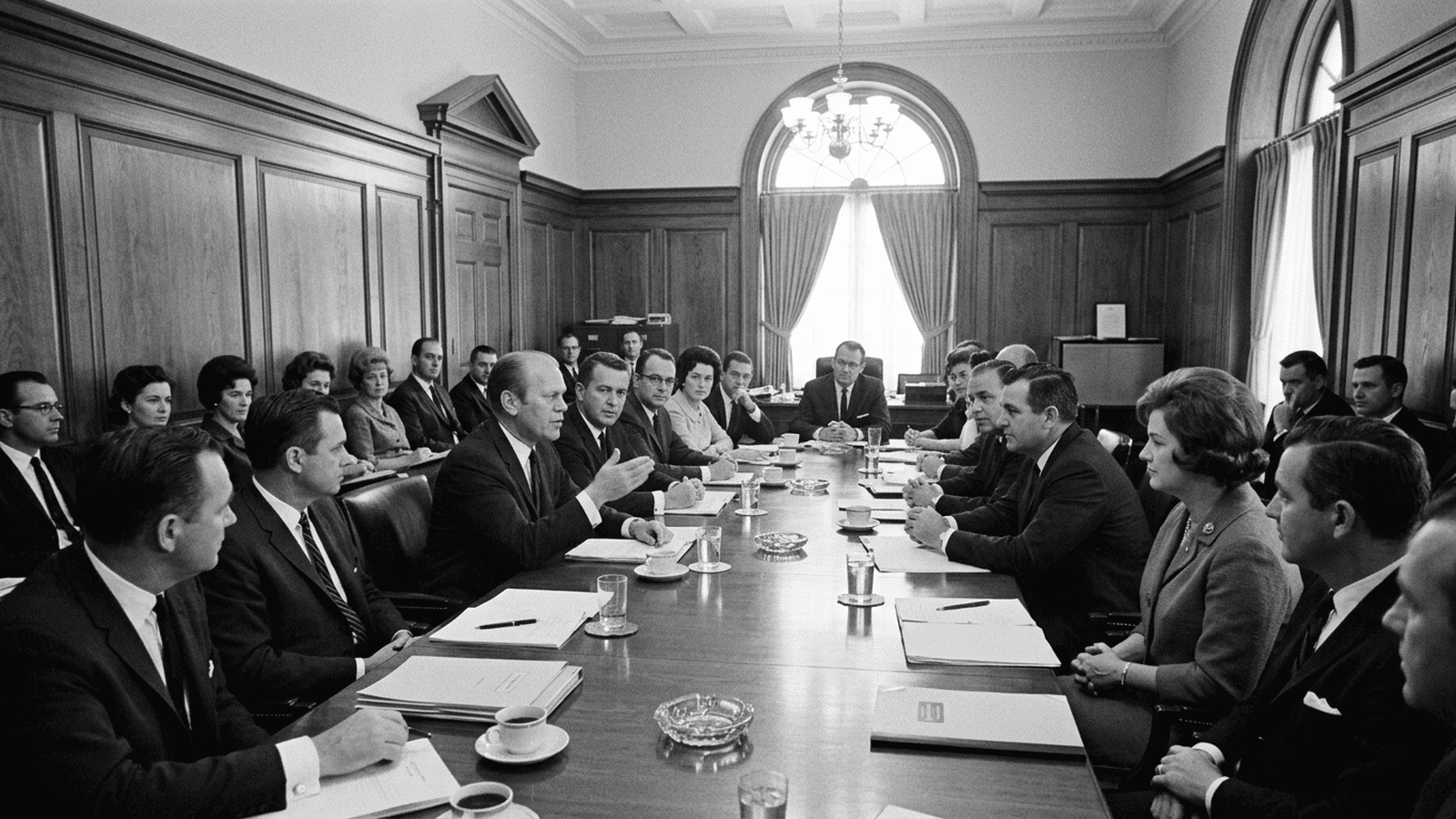
After Republicans suffered a major defeat in the 1964 election, House members chose Gerald Ford over Charles Halleck as minority leader on January 4, 1965. The United States House remained under overwhelming Democratic control, but the leadership change reflected a party effort to reassess its public style and organize a more effective opposition.
TLDR: House Republicans replaced Charles Halleck with Gerald Ford as minority leader on January 4, 1965, after the party’s severe 1964 election losses. Ford’s narrow victory reflected a push for a more collegial and effective opposition, though Democrats retained overwhelming control of the House and its agenda.
On January 4, 1965, House Republicans chose Gerald Ford of Michigan as their minority leader, replacing Charles Halleck of Indiana after a close internal contest. The decision followed a crushing election defeat and signaled an effort to change how the party presented itself in Congress. It was a leadership realignment, not a transfer of control: Democrats held a commanding House majority, and Ford’s new role was to lead an opposition party searching for a way forward.
Halleck had served as Republican leader since 1959 and was a familiar, forceful presence in House debate. His public style, including sharp partisan exchanges, had made him a recognizable figure. But the 1964 election intensified questions about whether that approach could help Republicans recover. Lyndon B. Johnson had won the presidency by a historic margin, and Democrats gained seats in the House, leaving Republicans with only 140 members against 295 Democrats.
The party’s defeat came amid national arguments over civil rights, federal power, and the role of government. The Civil Rights Act of 1964 had become law after a long congressional struggle. Halleck and Ford both voted for the measure, as did most House Republicans, while the bill also drew substantial support from Democrats. That vote crossed party lines, but it did not erase divisions over civil rights or determine the leadership contest by itself. Republicans also faced the political consequences of Barry Goldwater’s presidential campaign and the question of how to appeal beyond its conservative base.
Ford, then 51, had represented a Michigan district since 1949 and chaired the House Republican Conference. He was known as a team-oriented legislator and had built relationships across the party. In the leadership contest, he presented a contrast with Halleck’s more combative public persona and argued for a stronger, more effective opposition. On the House floor, the Republican caucus selected Ford by a vote of 73 to 67. The narrow margin showed that the change was a contested judgment within the party, not a unanimous verdict on Halleck’s record.
The vote mattered because House leaders shape strategy, coordinate debate, and give a party a public voice even when it lacks the numbers to pass legislation. Ford inherited a small minority in a chamber where Democrats controlled committee chairs and the legislative agenda. He could not reverse that arithmetic. His immediate task was to organize Republicans, criticize the administration, and make the party’s case to voters while Democrats advanced Johnson’s Great Society program.
The change also illustrated how congressional parties respond to electoral setbacks through internal parliamentary decisions. Republicans did not abandon their policy differences or settle the emerging conflict between moderates and conservatives. Instead, members elevated a leader they believed could strengthen party discipline and broaden its appeal. Ford’s reputation for collegiality helped him keep support from competing factions, though it did not make those factions disappear.
Ford remained minority leader until 1973, when he became House minority whip and then, after the resignation of Vice President Spiro Agnew, vice president. In 1974, following Richard Nixon’s resignation, Ford became president. Those later events gave the 1965 leadership vote an unexpected historical significance, but its immediate importance was more limited: it put a new Republican voice at the head of a weakened House delegation. The contest did not itself produce a lasting institutional reform. Rather, it demonstrated the caucus’s capacity to replace its leader after defeat, a form of party oversight that would continue to shape House leadership and Republican strategy during the civil rights era.

Sophie Carter serves as a Staff Writer for Just Right News, where she anchors the outlet’s critical coverage of Elections, Influence, and Democracy Infrastructure. In an era where the mechanics of voting and the flow of political capital are under constant scrutiny, Sophie provides a steady, principled voice dedicated to the preservation of American institutional integrity and the rule of law.
Raised in Charlotte, North Carolina, Sophie’s perspective was forged in a community that balances rapid modern growth with a deep respect for tradition and civic duty. Growing up in the Queen City, she witnessed firsthand how a robust local culture depends on the trust between the citizen and the state. This upbringing instilled in her a foundational belief that the right to vote is a sacred trust—one that must be protected from both administrative overreach and the encroaching influence of special interest groups. Her reporting reflects these North Carolina roots, emphasizing the importance of community-led governance and the preservation of the individual’s voice in the face of nationalized political movements.
Now based in Atlanta, Georgia, Sophie operates from the heart of one of the nation’s most pivotal and contested political landscapes. Her location allows her to report from the front lines of the debate over election security, legislative reform, and the modernization of voting systems. For Sophie, the “infrastructure” of democracy is not merely a matter of machines and ballots; it is the collection of laws, people, and transparent processes required to maintain public confidence. Her work often highlights the necessity of clear, enforceable standards that ensure every legal vote is counted fairly and that the machinery of our republic remains accountable to the taxpayers who fund it.
Central to her work at Just Right News is her acclaimed feature series, “The Price of a Vote.” Through this ongoing project, Sophie explores the complex web of influence that shapes modern campaigns and policy decisions. She delves into how high-level lobbying, non-governmental organizations, and shifting bureaucratic regulations impact the weight of an individual citizen’s ballot. By examining the financial and structural pressures placed on the electoral process, she provides readers with a comprehensive look at the forces vying for control over the American political system.
Sophie’s approach to journalism is rooted in a commitment to the constitutional framework. She views her role as a watchdog for the voter, ensuring that the systems meant to serve the public remain transparent and free from corruption. Whether she is analyzing the implementation of new voting technologies or investigating the influence of outside money on state-level policy, her work is characterized by a rigorous adherence to facts and a refusal to succumb to the sensationalism that often plagues modern political reporting.
At Just Right News, Sophie Carter continues to be a vital resource for readers who value clarity, conviction, and a defense of traditional American values. Her deep ties to the Southeast and her specialized focus on the mechanics of our republic make her an essential voice in the ongoing conversation about the future of American self-governance. Through her reporting, she remains dedicated to the idea that a secure and honest electoral system is the bedrock of a free and prosperous society.