

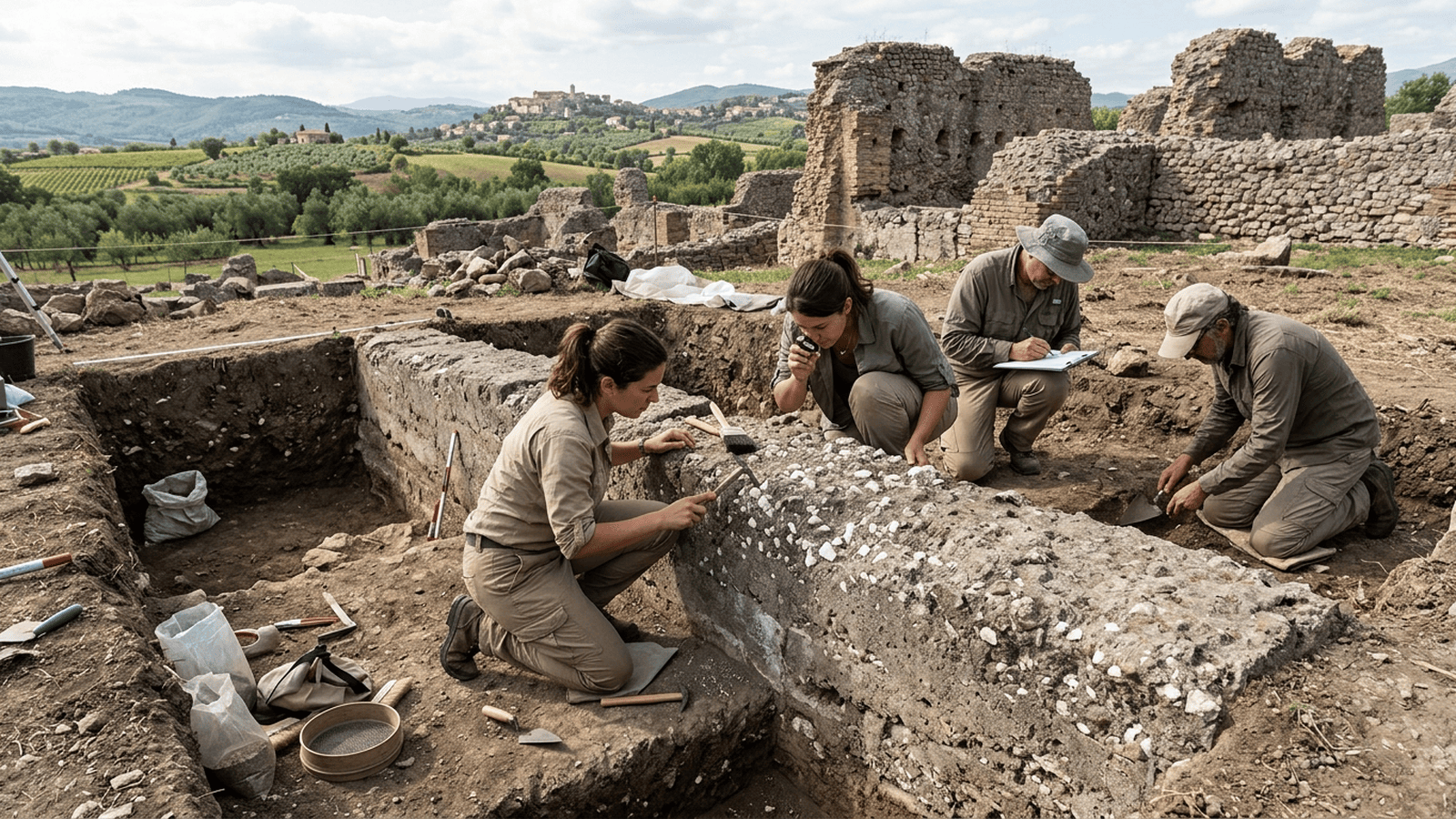
Researchers analyzing Roman concrete fragments from Privernum, Italy, found lime-rich inclusions that may help seal cracks when water enters the material. Laboratory tests support the idea that hot mixing with quicklime can create a crack-filling effect, though the recipe’s use across Roman construction and its suitability for modern buildings require further study.
TLDR: An analysis of Roman concrete from Privernum suggests that pale lime-rich clasts were not simply a sign of sloppy mixing. Tests indicate that water can mobilize calcium from the inclusions and deposit calcium carbonate in cracks. Researchers say the mechanism could inform durable concrete, but more testing is needed.
A Roman concrete wall can survive for centuries, but its longevity may owe something to a feature builders once thought to be a flaw. Researchers studying ancient structures near the Italian town of Privernum found that small, pale mineral chunks in the concrete could help seal cracks when water entered them. The finding offers a possible lesson for designing longer-lasting modern building materials.
The team, led by Massachusetts Institute of Technology civil engineer Admir Masic, examined concrete fragments collected at the archaeological site. In a 2023 paper in Science Advances, the researchers described the fragments’ lime clasts: calcium-rich inclusions visible as whitish chunks in the material. Such clasts had often been treated as evidence of poor mixing or low-quality construction.
Chemical and structural analyses suggested instead that the clasts formed through a deliberate process. The researchers argue that Roman builders combined quicklime, a reactive form of calcium oxide, with volcanic ash and other ingredients while the mixture was hot. This “hot mixing” would help explain both the clasts’ composition and the concrete’s distinctive internal structure.
The exact ancient recipe remains debated. Many accounts of Roman concrete emphasize slaked lime, produced by adding water to quicklime, before the ingredients were mixed. Masic’s team argues that at least some Roman builders used quicklime directly, or used a process that left reactive lime within the finished material. The Privernum samples support that interpretation, but cannot establish that every Roman structure was made the same way.
To test whether the clasts mattered, the researchers made concrete samples with and without quicklime and cracked them. They then exposed the cracks to water. In the quicklime-containing samples, water dissolved calcium from the lime-rich inclusions; that material later precipitated as calcium carbonate and helped fill the openings. The control samples did not show the same crack-filling behavior under the team’s test conditions.
The process resembles a limited form of self-healing. It does not mean Roman concrete can repair every kind of damage, or that a wall can restore its original strength after a major failure. Rather, the experiments indicate that small cracks may be sealed as water moves through the material and triggers mineral growth. That could reduce pathways for water and other substances that gradually weaken concrete.
The study also connects laboratory tests with evidence from surviving structures. Roman builders used volcanic ash, including material associated with the region around the Bay of Naples, and their marine concrete has endured in seawater for long periods. Researchers have investigated several reasons for that durability, including the chemistry of volcanic ingredients. The Privernum work adds lime clasts and hot mixing as another possible part of the story, not a replacement for all other explanations.
There are important limits to translating the recipe into modern construction. Ancient ingredients varied, and present-day concrete must meet strict requirements for strength, consistency, cost and environmental impact. A self-sealing mix would need controlled testing to determine how quickly cracks close, how much strength remains, and whether the approach works at building scale. It would also have to be compared with existing approaches, such as adding healing agents or designing concrete to limit cracking.
Still, the work points toward a practical research direction: engineer concrete with carefully controlled reactive inclusions that can respond when water enters a crack. If such mixes last longer, they could reduce repairs and the demand for replacement materials. The next steps include testing different lime proportions and exposure conditions, and examining more ancient structures to learn how widely the technique was used. The old walls are evidence of durability; identifying which parts of their recipe can be reliably recreated is the modern challenge.

Mason Reed serves as a Staff Writer for Just Right News, where he spearheads the Future Frontiers & Special Projects desk. In an era defined by rapid technological shifts and evolving social landscapes, Mason provides a steady, principled voice, examining the innovations of tomorrow through the lens of traditional American values. His work is most prominently featured in his signature series, “The Next Horizon,” where he explores the intersection of emerging technology, national sovereignty, and the preservation of individual liberty.
A native of San Diego, California, Mason’s worldview was shaped by the unique culture of his hometown. Growing up in a region defined by its strong military presence and its history of maritime industry, he developed a deep-seated respect for the institutions that provide national stability and the entrepreneurial spirit that drives the American economy. This upbringing instilled in him a belief that true progress is not found in discarding the past, but in building upon a foundation of proven principles. His reporting often reflects this San Diego influence, emphasizing the importance of a robust national defense and the necessity of maintaining a competitive edge in the global marketplace.
Now based in San Francisco, Mason operates from the heart of the world’s technological engine. Living and working in the Bay Area provides him with a front-row seat to the advancements—and the ideological challenges—emanating from Silicon Valley. While many in the region embrace a “move fast and break things” mentality, Mason’s reporting serves as a vital counterweight. He offers Just Right News readers a “boots on the ground” perspective, documenting how radical local policies and the concentration of tech power impact the everyday lives of citizens. His proximity to the industry allows him to cut through the marketing jargon of big tech to uncover the real-world implications for privacy, free speech, and the nuclear family.
In his “Future Frontiers” beat, Mason tackles complex subjects ranging from the ethics of artificial intelligence to the burgeoning private space race. He approaches these topics with a healthy skepticism toward centralized bureaucracy, championing instead the decentralized innovations that empower individuals. Through “The Next Horizon,” he highlights the pioneers and thinkers who are working to ensure that the future remains a place where human dignity and constitutional rights are protected. He believes that the rapid pace of change requires more than just technical expertise; it requires a moral compass rooted in the Western tradition.
Throughout his tenure at Just Right News, Mason has remained committed to the idea that the future is something to be shaped, not merely accepted. His writing is characterized by a rigorous defense of American exceptionalism and a belief that the country’s best days lie ahead, provided it remains true to its founding ideals. Whether he is investigating the impact of automation on the American workforce or profiling the next generation of aerospace engineers, Mason Reed ensures that his readers are equipped with the insights they need to navigate a changing world with confidence and clarity.