

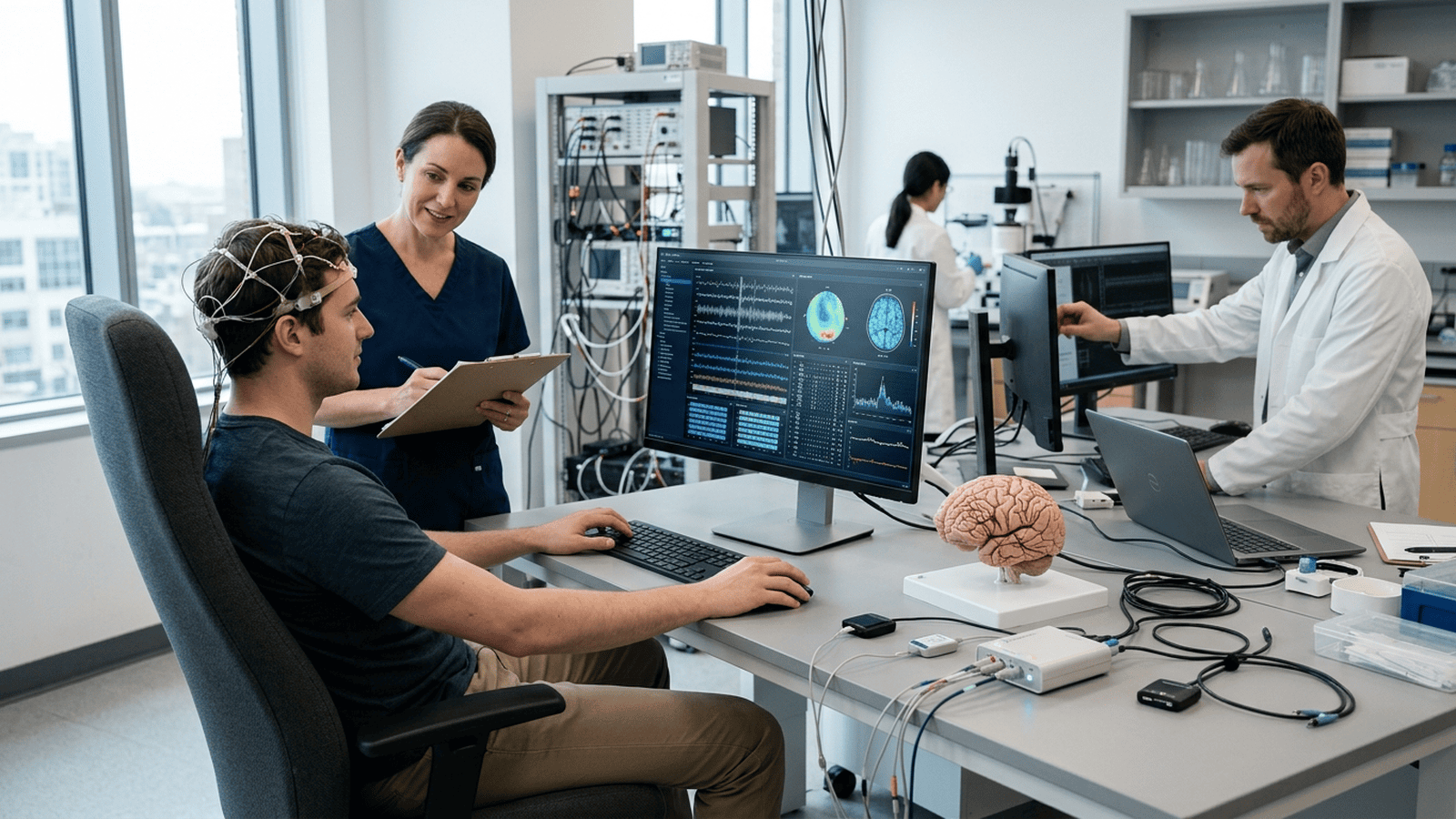
In the 2023 SWITCH study, four people with severe paralysis used Synchron’s vein-delivered brain implant to control digital devices at home. The early trial reported no serious device-related adverse events over 12 months, but larger studies are needed to establish broader safety and effectiveness.
TLDR: Synchron’s Stentrode is delivered through a blood vessel to record activity near the brain’s motor cortex. In a small first-in-human trial, four participants with severe paralysis used the system to control digital devices at home. The results support further study, but do not yet establish how well it will work for wider groups.
A brain-computer interface tested in people with severe paralysis has enabled participants to operate digital devices without an electrode array placed directly on the brain’s surface. The system, developed by the private company Synchron, uses an electrode-bearing implant called a Stentrode, delivered through a blood vessel to a vein beside the brain’s motor cortex.
Results from the first-in-human SWITCH study, published in the Journal of NeuroInterventional Surgery in 2023, followed four participants with severe paralysis. They had amyotrophic lateral sclerosis (ALS) or spinal cord injury. The implant was successfully placed in all four, who used the system at home to control computers or other digital devices.
The approach addresses a challenge in brain-computer interface research: how to record useful brain signals with less invasive surgery. Many experimental systems use electrodes implanted into brain tissue or positioned on its surface. Synchron’s device is instead introduced through a blood vessel, in a stent-like procedure. It records activity from the brain’s motor regions through the vessel wall.
Participants first learned to associate attempted movement with commands on a computer screen. For example, imagining a hand movement can select an icon. The implant detects patterns of electrical activity, and external equipment translates those signals into commands such as clicking, typing, or navigating a screen. It does not restore movement, but offers another way to communicate with digital devices.
The study’s main focus was safety and feasibility, not a comparison with other interfaces or a definitive measure of how well the system works. Over 12 months, the researchers reported no serious adverse events attributed to the device. The implant remained in place, and all four used it daily. The small number of participants, however, means the results cannot establish how reliably it will work across a broader population.
A brain signal that can be decoded in a controlled session must also be usable across changing conditions, over time, and by people with different disabilities. Practical questions include how much training is needed, how consistently a user can issue commands, and whether the system can support tasks beyond basic computer access. The published trial offers early evidence on safety and everyday use, but it does not settle those questions.
The endovascular route could make implantation less invasive than opening the skull to place electrodes directly on brain tissue. It still requires a medical procedure, specialist care, and equipment outside the body to interpret and act on the recorded signals. Researchers will also need to monitor long-term safety, including whether the device continues to record effectively and whether blood vessels remain healthy around the implant.
Synchron’s work is part of efforts to develop assistive technology for people who have lost reliable control of their limbs. Brain-computer interfaces are being studied for communication, computer access, and, in other research settings, control of assistive devices. Each system involves trade-offs among signal quality, surgical risk, speed, reliability, and ease of use; results from one design cannot automatically be applied to another.
The SWITCH findings provide an early demonstration that a brain interface delivered through a vein can support device control outside a laboratory. Larger and longer studies will be needed to establish safety and performance, compare results among users, and determine what tasks the system can handle consistently. If subsequent trials confirm the initial results, the technology could expand access to digital communication for people with severe paralysis, while leaving important questions about durability, practical support, and everyday independence to answer.

Mason Reed serves as a Staff Writer for Just Right News, where he spearheads the Future Frontiers & Special Projects desk. In an era defined by rapid technological shifts and evolving social landscapes, Mason provides a steady, principled voice, examining the innovations of tomorrow through the lens of traditional American values. His work is most prominently featured in his signature series, “The Next Horizon,” where he explores the intersection of emerging technology, national sovereignty, and the preservation of individual liberty.
A native of San Diego, California, Mason’s worldview was shaped by the unique culture of his hometown. Growing up in a region defined by its strong military presence and its history of maritime industry, he developed a deep-seated respect for the institutions that provide national stability and the entrepreneurial spirit that drives the American economy. This upbringing instilled in him a belief that true progress is not found in discarding the past, but in building upon a foundation of proven principles. His reporting often reflects this San Diego influence, emphasizing the importance of a robust national defense and the necessity of maintaining a competitive edge in the global marketplace.
Now based in San Francisco, Mason operates from the heart of the world’s technological engine. Living and working in the Bay Area provides him with a front-row seat to the advancements—and the ideological challenges—emanating from Silicon Valley. While many in the region embrace a “move fast and break things” mentality, Mason’s reporting serves as a vital counterweight. He offers Just Right News readers a “boots on the ground” perspective, documenting how radical local policies and the concentration of tech power impact the everyday lives of citizens. His proximity to the industry allows him to cut through the marketing jargon of big tech to uncover the real-world implications for privacy, free speech, and the nuclear family.
In his “Future Frontiers” beat, Mason tackles complex subjects ranging from the ethics of artificial intelligence to the burgeoning private space race. He approaches these topics with a healthy skepticism toward centralized bureaucracy, championing instead the decentralized innovations that empower individuals. Through “The Next Horizon,” he highlights the pioneers and thinkers who are working to ensure that the future remains a place where human dignity and constitutional rights are protected. He believes that the rapid pace of change requires more than just technical expertise; it requires a moral compass rooted in the Western tradition.
Throughout his tenure at Just Right News, Mason has remained committed to the idea that the future is something to be shaped, not merely accepted. His writing is characterized by a rigorous defense of American exceptionalism and a belief that the country’s best days lie ahead, provided it remains true to its founding ideals. Whether he is investigating the impact of automation on the American workforce or profiling the next generation of aerospace engineers, Mason Reed ensures that his readers are equipped with the insights they need to navigate a changing world with confidence and clarity.