

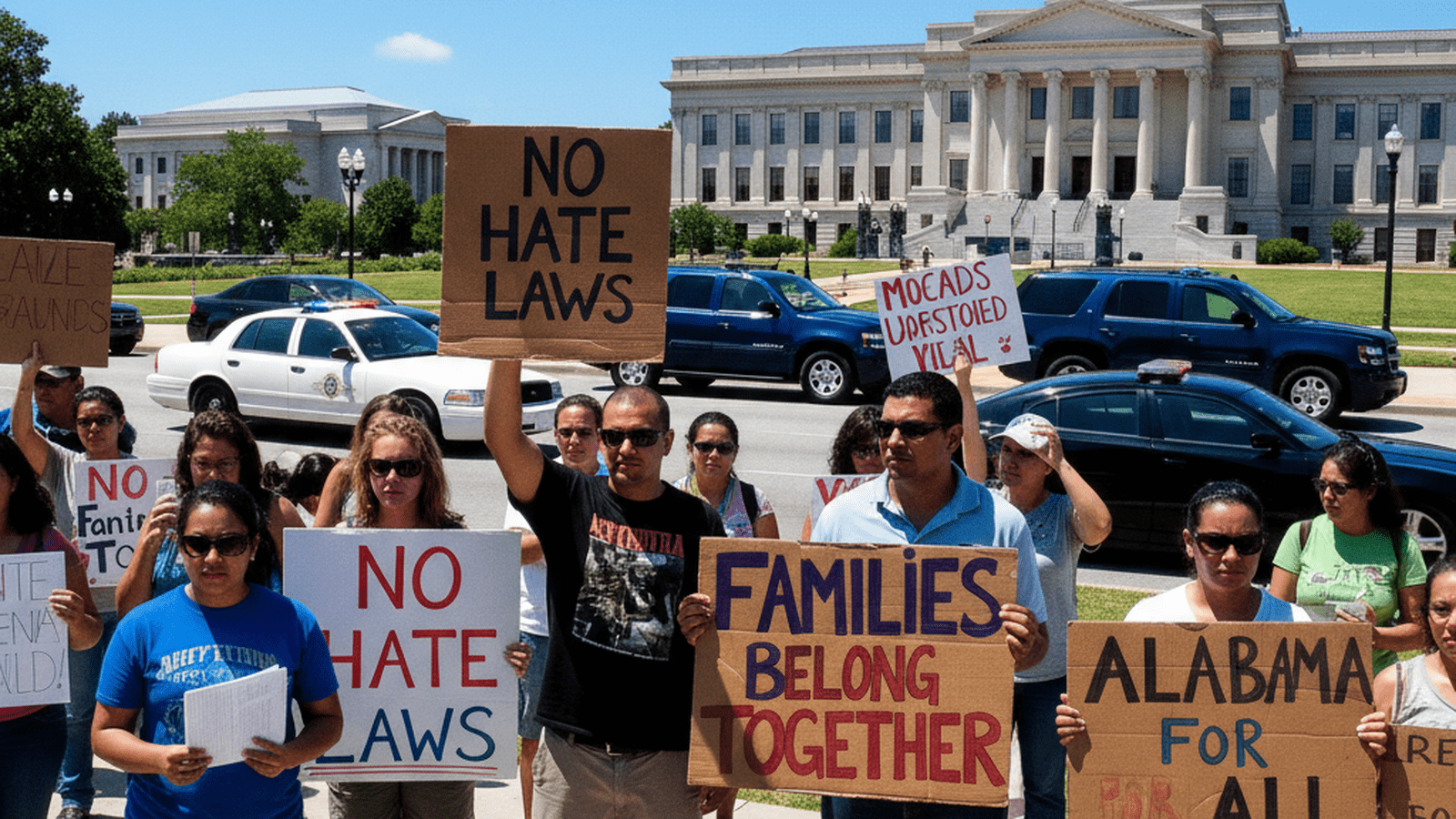
In 2011, Alabama enacted HB 56, the nation’s strictest anti-illegal immigration law, which sparked a major civil rights crisis and federal legal challenges. The United States Department of Justice and civil rights organizations successfully argued that many provisions of the law unconstitutionally infringed upon federal authority and individual liberties.
TLDR: Alabama’s 2011 HB 56 law attempted to regulate nearly every aspect of life for undocumented immigrants, leading to mass departures and economic disruption. Federal courts eventually struck down the most aggressive provisions, reinforcing that immigration enforcement remains a primary federal responsibility under the United States Constitution.
In June 2011, Alabama Governor Robert Bentley signed House Bill 56, officially known as the Beason-Hammon Alabama Taxpayer and Citizen Protection Act. Proponents framed the legislation as a necessary measure to protect jobs and state resources during a period of economic recovery. However, the law quickly became the most controversial piece of state-level immigration legislation in the United States. It went significantly further than Arizona’s previous enforcement efforts by targeting daily interactions between citizens and undocumented residents.
The provisions of HB 56 were sweeping and designed to encourage undocumented immigrants to self-deport through a policy of attrition. The law required public elementary and secondary schools to determine the immigration status of enrolling students, a move that critics argued violated the 1982 Supreme Court ruling in Plyler v. Doe. It also prohibited undocumented immigrants from receiving any state or local public benefits and made it a felony for them to apply for or solicit work. Furthermore, the act criminalized the act of harboring or transporting an undocumented person, which critics argued would penalize even family members, landlords, and church groups.
The immediate aftermath of the law’s enactment was marked by social and economic upheaval across Alabama. Within days, thousands of Hispanic residents, including those with legal status, fled the state in fear of detention or harassment. This mass exodus created a sudden labor shortage in the state’s vital agricultural and construction sectors. Farmers reported that millions of dollars in crops were left to rot in the fields because there were no workers to harvest them. The poultry industry, a cornerstone of the Alabama economy, also faced significant disruptions as processing plants struggled to maintain staffing levels. School districts reported a sharp spike in absences among Hispanic students as parents kept children home to avoid status checks.
Legal challenges to HB 56 were swift and multifaceted. The United States Department of Justice filed a lawsuit arguing that the law overstepped state authority and interfered with federal immigration enforcement. Civil rights organizations, including the American Civil Liberties Union and the Southern Poverty Law Center, joined the fray, alleging that the law encouraged racial profiling and violated the Due Process Clause of the Fourteenth Amendment. They argued that the state was creating a hostile environment that infringed upon the fundamental rights of all residents, regardless of their legal status.
In late 2011 and throughout 2012, federal courts began to dismantle the most aggressive portions of the act. U.S. District Judge Sharon Blackburn initially upheld parts of the law but blocked the provisions regarding school status checks and the criminalization of soliciting work. The landscape shifted further when the United States Supreme Court ruled in Arizona v. United States in 2012, clarifying that states could not create their own immigration crimes that conflicted with federal law. This precedent forced the 11th U.S. Circuit Court of Appeals to strike down additional sections of the Alabama law, including the provision that invalidated contracts involving undocumented individuals.
By 2013, the state of Alabama reached a settlement with civil rights groups, effectively ending the most contentious aspects of HB 56. The state agreed to permanently block the provisions that required schools to check student status and those that made it a crime for undocumented people to seek work or give rides to one another. The episode led to significant legislative soul-searching regarding the economic costs of restrictive immigration policies. Subsequent years saw a shift in focus toward federal comprehensive reform, though the legal battles over HB 56 established critical boundaries for state-level involvement in immigration matters and reinforced federal supremacy in the United States.

Lila Hayes serves as a Staff Writer for Just Right News, where she anchors the “Courts, Law, and Constitutional Order” beat. Her work is defined by a steadfast commitment to the foundational principles of the American republic and a rigorous defense of the legal frameworks that ensure national stability. As a primary voice for the outlet, she provides readers with a clear-eyed analysis of the judiciary, focusing on the importance of originalism and the preservation of the separation of powers.
Lila’s perspective was forged in the American heartland. Raised in St. Louis, Missouri, she grew up in a Hispanic household where the values of hard work, faith, and respect for the law were paramount. Her upbringing instilled in her a deep appreciation for the American Dream and the legal protections that make it possible. This Missouri background remains a cornerstone of her reporting, providing a grounded, common-sense counter-narrative to the often-insular legal circles of the coastal elite. She understands that the decisions made in high-court chambers have real-world consequences for families and small business owners across the country.
At Just Right News, Lila has become widely recognized for her signature feature series, “The Rulebook of Power.” In this ongoing project, she delves into the mechanics of the federal government, examining how administrative overreach and judicial activism can threaten the delicate balance of the Constitution. She approaches her beat with the tenacity of a veteran journalist and the precision of a legal scholar, consistently advocating for a judiciary that interprets the law as written rather than legislating from the bench. For Lila, the Constitution is not a “living” document subject to the whims of modern social trends; it is a fixed standard that ensures the government remains the servant of the people, not their master.
Now based in Philadelphia, Pennsylvania, Lila finds herself at the very epicenter of American constitutional history. Living and working in the city where the Founders drafted the documents she defends daily provides a constant source of inspiration. The historic halls and landmarks of Philadelphia serve as a daily reminder of the high stakes involved in her reporting. Her presence in the city allows her to bridge the gap between the historical intent of the law and its contemporary application, ensuring that the legacy of the Founding Fathers remains central to the national conversation.
Throughout her career, Lila has remained dedicated to the idea that a free society requires an informed citizenry and a transparent legal system. Her reporting is more than just a collection of headlines; it is a defense of the constitutional order that has sustained the nation for over two centuries. By focusing on the “Rulebook of Power,” she ensures that her readers understand not just what is happening in the courtrooms, but why those decisions matter for the future of American liberty. Lila Hayes continues to be a vital voice for those who believe that the law should be a shield for the citizen and a constraint on the state.