

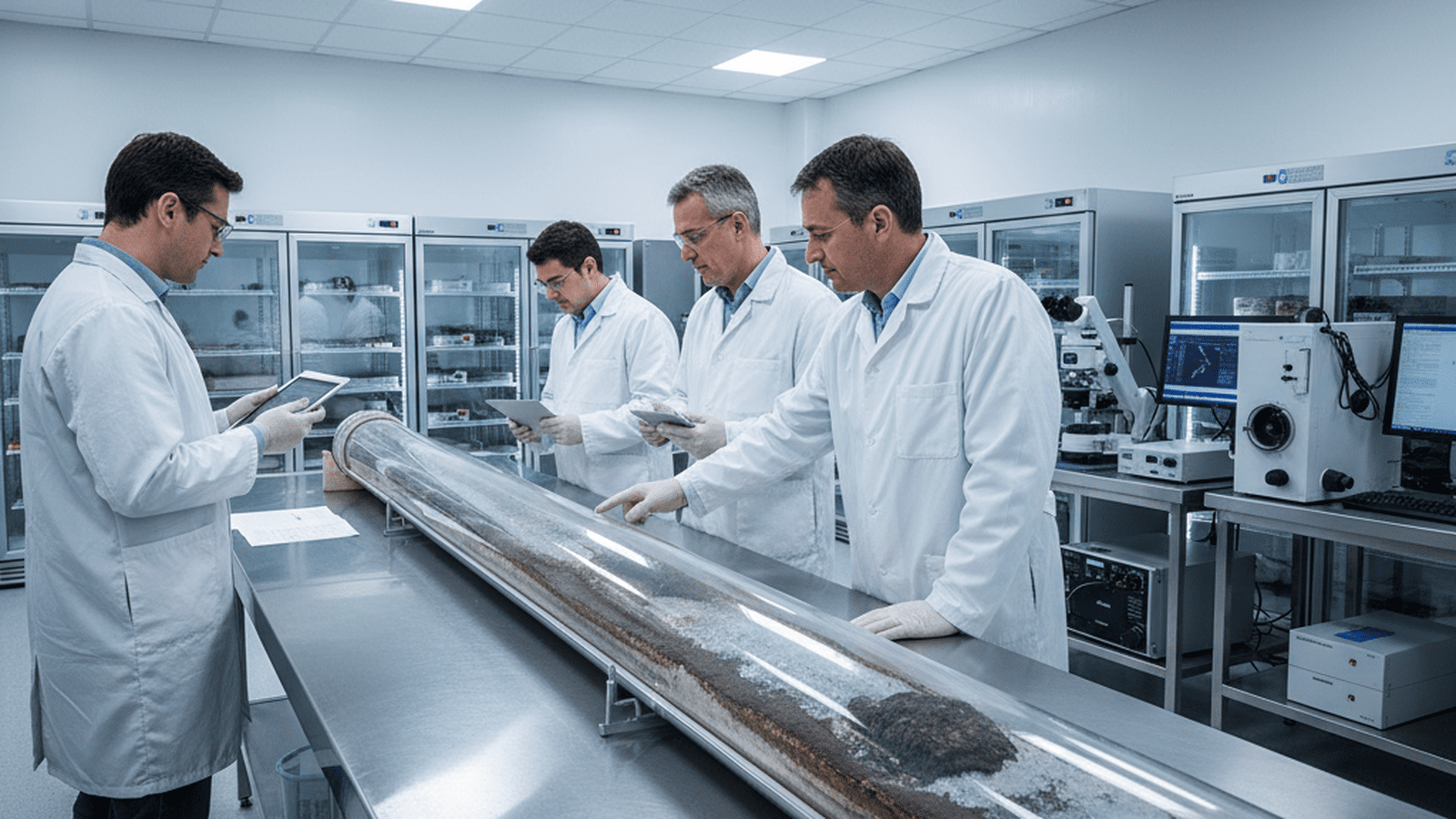
Scientists analyzing forgotten sediment samples from a Cold War-era military base discovered fossilized plants beneath 1.4 kilometers of ice. The findings prove that the Greenland ice sheet melted significantly during a previous warm period, suggesting the region is more susceptible to climate change than previously understood.
TLDR: An international study of subglacial sediment from Greenland’s Camp Century revealed fossilized moss and twigs, indicating the area was ice-free 400,000 years ago. This discovery suggests the ice sheet is highly sensitive to moderate warming, posing a greater risk for significant sea-level rise under current climate trends.
An international team of researchers has uncovered evidence that the Greenland ice sheet is significantly more vulnerable to moderate warming than previously estimated. By analyzing sediment samples collected decades ago at a remote military outpost, scientists discovered fossilized plant remains buried under 1.4 kilometers of ice. The findings, published in the journal Science, indicate that large portions of Greenland were a green tundra as recently as 400,000 years ago.
The sediment was originally retrieved in 1966 from Camp Century, a U.S. Army base located in northwestern Greenland. During the Cold War, the site served as a cover for Project Iceworm, a clandestine plan to store nuclear missiles in subglacial tunnels. The 12-foot-long sediment core extracted from the bottom of the ice hole was transported to various institutions before being stored in a freezer in Denmark. It remained largely ignored until 2017, when researchers rediscovered the jars of frozen dirt and began a comprehensive analysis.
Upon washing the sediment, the research team was surprised to find perfectly preserved organic matter. Using high-powered microscopes, they identified mosses, twigs, and even the remains of insects. The presence of these macrofossils suggests that the site was not only ice-free but supported a thriving ecosystem. This contradicts the long-standing hypothesis that the Greenland ice sheet has remained a solid, unchanging block of ice for the last 2.5 million years.
To determine when the plants lived, the team employed advanced geochronological techniques. They used luminescence dating, which measures the last time mineral grains were exposed to sunlight, and cosmogenic isotope analysis. The latter examines the ratios of rare isotopes like aluminum-26 and beryllium-10, which form when bare ground is bombarded by cosmic rays. The data converged on a period known as Marine Isotope Stage 11, a window of natural warming between 424,000 and 374,000 years ago.
During this interval, global temperatures were only slightly higher than they are today, and atmospheric carbon dioxide levels were significantly lower than current concentrations. Despite these relatively mild conditions, the ice sheet at Camp Century vanished entirely. This suggests that the threshold for a total or near-total collapse of the Greenland ice sheet may be lower than current climate models predict. The melting of the ice sheet during Marine Isotope Stage 11 likely contributed to a global sea-level rise of at least 1.5 meters.
The study was a collaborative effort involving the University of Vermont, Columbia University, the University of Copenhagen, and several other international institutions. By reconciling the biological evidence with physical dating methods, the researchers have provided a clearer picture of the Arctic’s sensitivity. The discovery serves as a stark warning for the modern era, as human-induced greenhouse gas emissions continue to drive temperatures upward at an unprecedented rate.
If the Greenland ice sheet were to melt completely in the coming centuries, global sea levels would rise by approximately seven meters, or 23 feet. Such a shift would permanently alter global coastlines and displace hundreds of millions of people. The Camp Century data provides a historical precedent for such a collapse, demonstrating that the ice sheet is not an immovable feature of the planet but a dynamic and fragile system.
Future research will focus on obtaining new samples from other deep-drilling sites across the Greenland interior. Scientists aim to map the extent of past melting to determine if the entire ice sheet disappeared or if some high-elevation regions remained glaciated. These investigations are essential for refining sea-level projections and informing international climate policy. The forgotten dirt from Camp Century has transformed from a Cold War relic into a critical piece of evidence for understanding the Earth’s future.

Mark Davis serves as the Senior Correspondent for Energy, Climate, and Resource Economics at Just Right News. In an era where the conversation around the environment is often dominated by alarmism and top-down mandates, Mark provides a vital, market-oriented perspective on the complex forces shaping our world. As the lead voice behind the acclaimed feature series “Power and the Planet,” he explores the intersection of environmental policy, global energy markets, and the fundamental economic principles that sustain modern civilization.
Mark’s pragmatic approach to resource management was forged in the high desert of his hometown, Albuquerque, New Mexico. Growing up in a region defined by both its breathtaking natural beauty and its rugged, resource-dependent landscape, he developed an early appreciation for the delicate balance between conservation and utilization. New Mexico’s unique position as a hub for both traditional energy production and cutting-edge scientific research provided Mark with a front-row seat to the evolution of the American energy sector. This upbringing instilled in him a deep-seated belief that true environmental stewardship is inseparable from economic prosperity and technological innovation.
Now based in Boulder, Colorado, Mark operates from the heart of the nation’s climate research community. While Boulder is often seen as a bastion of environmental idealism, Mark utilizes his post to provide a necessary counterweight, grounded in the realities of resource economics. He understands that energy policy does not exist in a vacuum; it has tangible consequences for the American taxpayer, the stability of the national power grid, and the strength of the domestic manufacturing sector. By reporting from the front lines of the climate debate, he is able to challenge prevailing narratives with hard data and a commitment to the principles of the free market.
Throughout his tenure at Just Right News, Mark has distinguished himself by focusing on the “Resource Economics” aspect of his beat. He frequently highlights the hidden costs of rapid energy transitions and advocates for an “all-of-the-above” energy strategy that prioritizes American energy independence. His work often shines a light on the geopolitical implications of resource scarcity, arguing that a secure nation must first be an energy-secure nation. Whether he is analyzing the impact of federal land-use regulations or investigating the supply chains required for new technologies, Mark remains focused on how policy decisions affect the lives and livelihoods of everyday citizens.
In “Power and the Planet,” Mark continues to bridge the gap between complex scientific concepts and the economic realities facing the country. He rejects the false choice between a healthy environment and a thriving economy, instead seeking out solutions that leverage American ingenuity and private-sector competition. For Mark, reporting on the climate is not about following the latest trends, but about ensuring that the conversation remains tethered to the foundational values of liberty, property rights, and fiscal responsibility. His contributions ensure that Just Right News readers receive a comprehensive, clear-eyed view of the challenges and opportunities defining the future of our planet.