

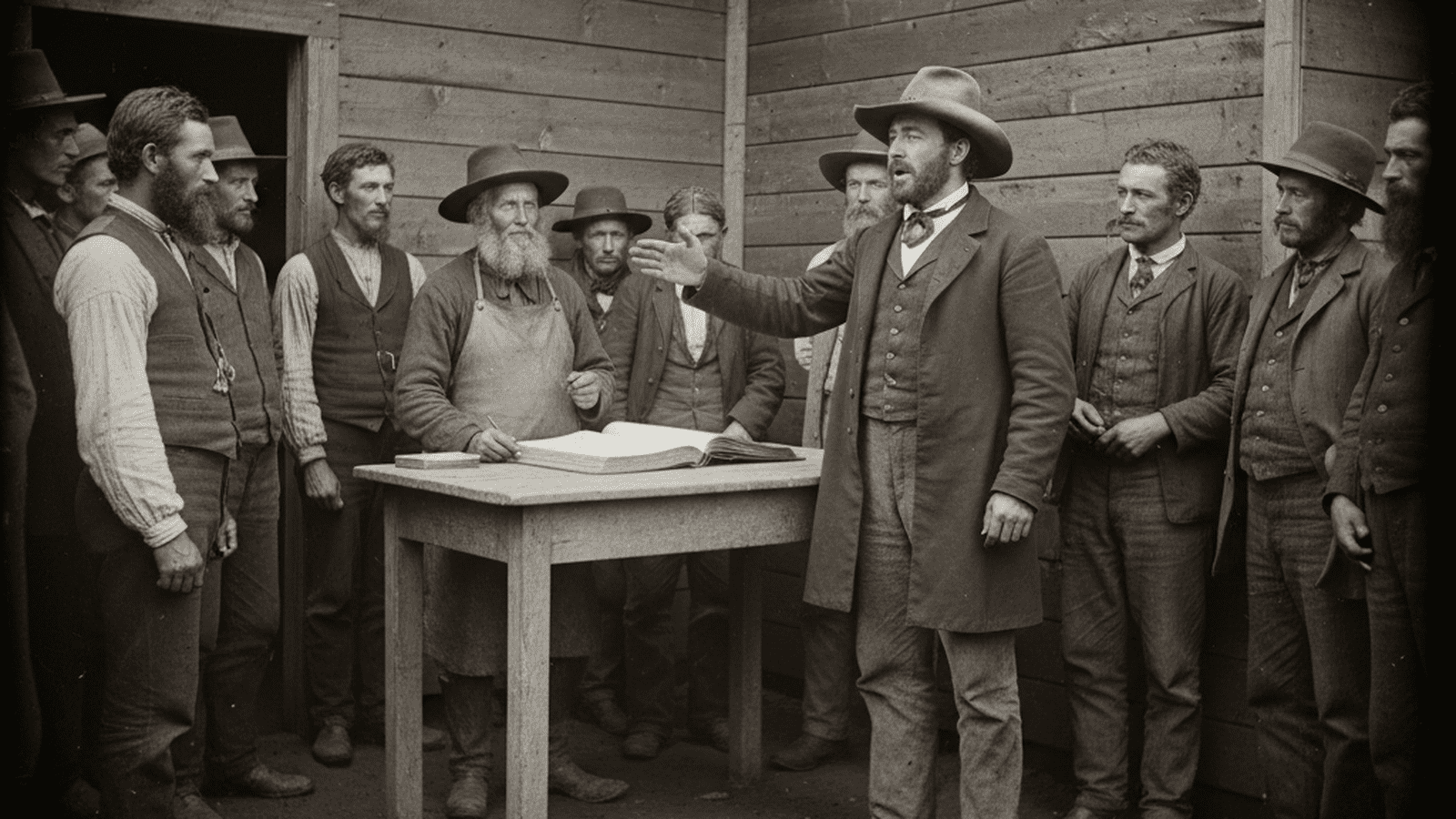
In 1854, the Oregon Territorial Legislature enacted a law requiring all elections to be conducted via viva voce, or oral voting. This United States political shift was designed to enforce party discipline and eliminate the use of private paper ballots in the Pacific Northwest.
TLDR: The 1854 Oregon Viva Voce Act replaced paper ballots with public oral declarations at the polls. Driven by the dominant Democratic Salem Clique, the measure aimed to ensure party loyalty. The controversial practice highlighted the intense antebellum struggle over voter privacy and political influence on the American frontier.
In the early 1850s, the political landscape of the Oregon Territory was defined by the iron grip of the Democratic Party, led by a group of influential figures known as the Salem Clique. This faction sought to consolidate power as the territory moved toward statehood. In January 1854, the Territorial Legislature took a decisive step to ensure party discipline by passing the Viva Voce Act. This law mandated that all votes be cast orally rather than through the traditional, though often inconsistent, use of paper ballots.
Under the new system, a voter would approach the election judges and clearly state the names of the candidates he supported. An election clerk would then record these choices in a public poll book. Proponents of the measure, largely aligned with the Democratic machine, argued that this method was more transparent than the secretive nature of written ballots. They contended that an honest citizen should have nothing to hide and that public declarations would prevent the fraudulent stuffing of ballot boxes.
However, the shift to viva voce voting was deeply controversial. The Whig Party, which was the primary opposition at the time, viewed the act as a blatant tool for voter intimidation. In the close-knit communities of the frontier, a man’s livelihood often depended on his reputation and his relationships with local creditors, landlords, or employers. By forcing voters to announce their preferences publicly, the legislature effectively allowed powerful interests to monitor the political loyalty of their subordinates.
The social environment of the mid-19th-century polling place further complicated the process. Elections in the Oregon Territory were often boisterous affairs, frequently held in saloons or general stores where whiskey flowed freely. The requirement to shout one’s political allegiance into a crowded room often led to immediate confrontations. Critics argued that the law discouraged independent-minded citizens from participating in the democratic process if they feared social or economic retaliation for their choices.
The Salem Clique defended the practice as a necessary reform to maintain the integrity of the party system. They believed that the written ballot allowed for ticket-splitting, where a voter might support candidates from different parties. To the Democratic leadership, such behavior was a sign of political instability. By requiring oral votes, the party could ensure that its members remained straight and did not deviate from the official party line.
The era of viva voce voting in Oregon was relatively brief but highly impactful. As the territory prepared for the 1857 Constitutional Convention, the debate over voting methods resurfaced with renewed intensity. The rise of the Republican Party and the growing national movement toward the secret ballot eventually eroded support for oral voting. When Oregon finally achieved statehood in 1859, the new state constitution initially preserved the viva voce system for the legislature but allowed for the eventual transition back to written ballots for the general public.
This period of Oregon’s history serves as a stark reminder of how procedural changes in election law can be used to manipulate political outcomes. The struggle between public declaration and private conscience helped shape the early American understanding of voter privacy. Subsequent reforms in the late 19th century, including the adoption of the Australian secret ballot, were direct responses to the types of intimidation and party control exemplified by the 1854 act. Today, the legacy of these antebellum debates continues to inform discussions regarding election security and the protection of the individual voter’s right to a confidential ballot.

Sophie Carter serves as a Staff Writer for Just Right News, where she anchors the outlet’s critical coverage of Elections, Influence, and Democracy Infrastructure. In an era where the mechanics of voting and the flow of political capital are under constant scrutiny, Sophie provides a steady, principled voice dedicated to the preservation of American institutional integrity and the rule of law.
Raised in Charlotte, North Carolina, Sophie’s perspective was forged in a community that balances rapid modern growth with a deep respect for tradition and civic duty. Growing up in the Queen City, she witnessed firsthand how a robust local culture depends on the trust between the citizen and the state. This upbringing instilled in her a foundational belief that the right to vote is a sacred trust—one that must be protected from both administrative overreach and the encroaching influence of special interest groups. Her reporting reflects these North Carolina roots, emphasizing the importance of community-led governance and the preservation of the individual’s voice in the face of nationalized political movements.
Now based in Atlanta, Georgia, Sophie operates from the heart of one of the nation’s most pivotal and contested political landscapes. Her location allows her to report from the front lines of the debate over election security, legislative reform, and the modernization of voting systems. For Sophie, the “infrastructure” of democracy is not merely a matter of machines and ballots; it is the collection of laws, people, and transparent processes required to maintain public confidence. Her work often highlights the necessity of clear, enforceable standards that ensure every legal vote is counted fairly and that the machinery of our republic remains accountable to the taxpayers who fund it.
Central to her work at Just Right News is her acclaimed feature series, “The Price of a Vote.” Through this ongoing project, Sophie explores the complex web of influence that shapes modern campaigns and policy decisions. She delves into how high-level lobbying, non-governmental organizations, and shifting bureaucratic regulations impact the weight of an individual citizen’s ballot. By examining the financial and structural pressures placed on the electoral process, she provides readers with a comprehensive look at the forces vying for control over the American political system.
Sophie’s approach to journalism is rooted in a commitment to the constitutional framework. She views her role as a watchdog for the voter, ensuring that the systems meant to serve the public remain transparent and free from corruption. Whether she is analyzing the implementation of new voting technologies or investigating the influence of outside money on state-level policy, her work is characterized by a rigorous adherence to facts and a refusal to succumb to the sensationalism that often plagues modern political reporting.
At Just Right News, Sophie Carter continues to be a vital resource for readers who value clarity, conviction, and a defense of traditional American values. Her deep ties to the Southeast and her specialized focus on the mechanics of our republic make her an essential voice in the ongoing conversation about the future of American self-governance. Through her reporting, she remains dedicated to the idea that a secure and honest electoral system is the bedrock of a free and prosperous society.