

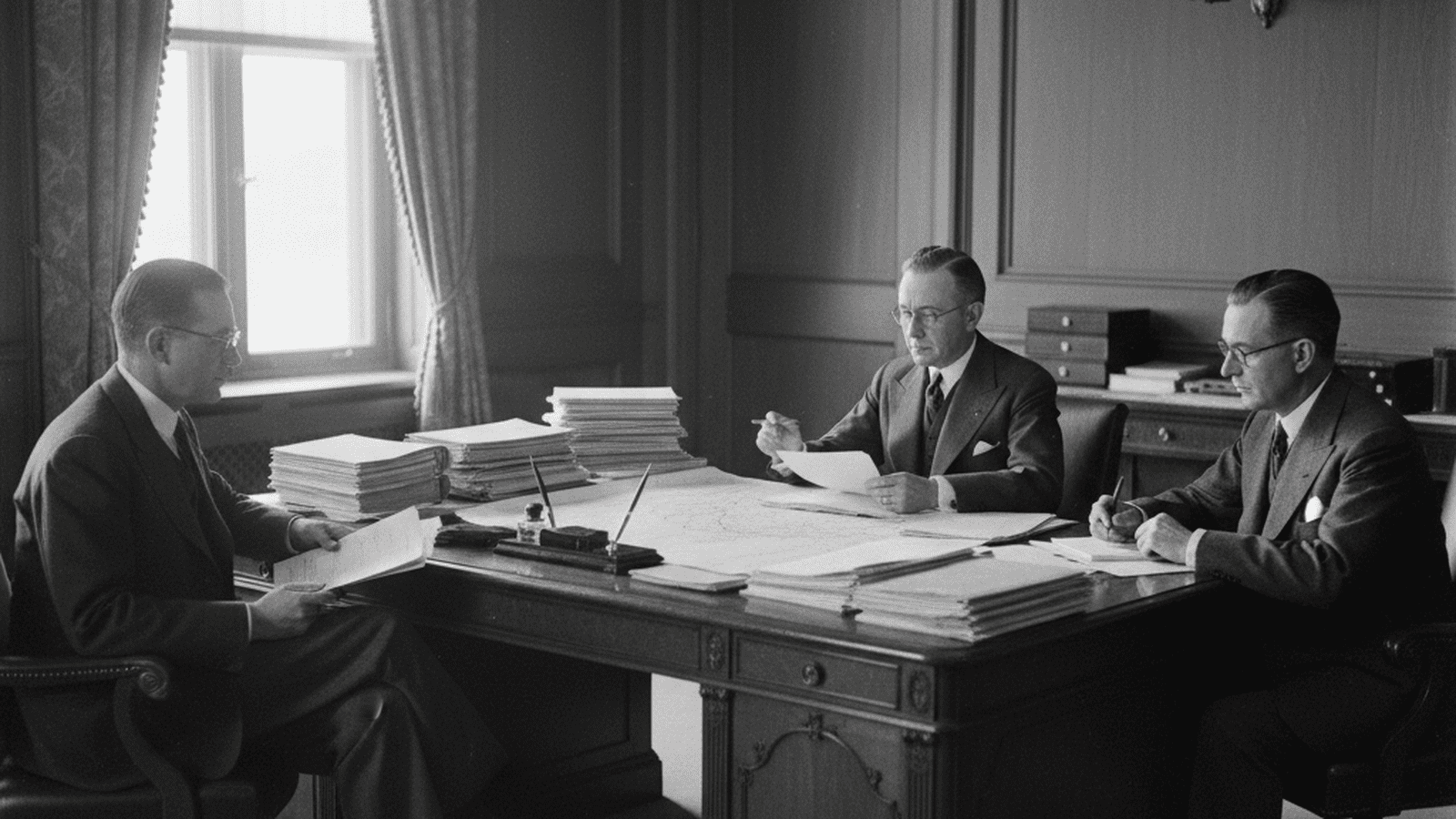
In 1939, the United States underwent a fundamental shift in governance through the Reorganization Act, which established the Executive Office of the President. Following the recommendations of the Brownlow Committee, this reform granted the President direct administrative control over federal agencies for the first time.
TLDR: The 1939 Reorganization Act transformed the United States presidency by creating the Executive Office of the President. Based on the Brownlow Committee’s findings, the law allowed Franklin D. Roosevelt to centralize administrative power, moving the Bureau of the Budget to the White House and establishing the modern presidential staff system.
By the mid-1930s, the United States federal government had expanded at a rate unprecedented in peacetime. Franklin D. Roosevelt’s New Deal initiatives created a dizzying array of new agencies, often referred to as “alphabet soup” organizations, to combat the Great Depression. However, this rapid growth created a management crisis. Many of these new entities operated with significant autonomy, reporting neither to the Cabinet nor directly to the President, leading to overlapping jurisdictions and administrative chaos.
In 1936, Roosevelt appointed the Committee on Administrative Management to address this fragmentation. Chaired by Louis Brownlow and including political scientists Charles Merriam and Luther Gulick, the group was tasked with applying modern management principles to the federal government. Their final report, submitted in January 1937, began with the blunt assertion that “The President needs help.” The committee argued that the presidency had become so burdened by administrative detail that the Chief Executive could no longer effectively manage the executive branch.
The Brownlow Committee recommended a sweeping consolidation of agencies and the creation of a dedicated staff to assist the President. Specifically, they proposed the creation of the Executive Office of the President (EOP) and the transfer of the Bureau of the Budget from the Treasury Department to the White House. These recommendations were met with immediate and fierce resistance in Congress. Opponents, still reeling from Roosevelt’s attempt to “pack” the Supreme Court, viewed the reorganization plan as a “dictator bill” that would dangerously centralize power in the hands of one man.
The initial reorganization bill was defeated in the House of Representatives in 1938. However, Roosevelt persisted, framing the issue not as a grab for power, but as a necessary step for government efficiency and the preservation of democracy. After the 1938 midterm elections, a modified version of the proposal, the Reorganization Act of 1939, finally passed. This legislation granted the President the authority to reorganize the executive branch, subject to a legislative veto.
Roosevelt immediately utilized this new power to issue Reorganization Plan No. 1. This order established the EOP, which included the White House Office and the Bureau of the Budget. For the first time, the President had a professional staff of assistants who were not tied to specific departments but were instead loyal to the presidency as an institution. This change allowed the White House to coordinate policy across the entire federal government, ensuring that the various agencies were working toward the administration’s unified goals.
The creation of the EOP fundamentally altered the balance of power within the United States government. It marked the end of the “traditional” presidency, where the Chief Executive had little staff and relied heavily on Cabinet secretaries who often had their own political agendas. The new structure provided the President with the tools to manage a massive, modern bureaucracy, effectively shifting the center of gravity in Washington from the Capitol to the West Wing.
This administrative revolution set the stage for the further expansion of executive power during World War II and the Cold War. Subsequent presidents would continue to expand the EOP, adding new offices such as the National Security Council and the Council of Economic Advisers. While the 1939 reforms improved efficiency, they also sparked ongoing debates about the “imperial presidency” and the lack of transparency in the growing White House staff. Today, the EOP remains the nerve center of the federal government, a testament to the structural shift initiated during the New Deal era.

Miles Harrington serves as the Senior Correspondent for Federal Systems & Executive Power at Just Right News, where he brings a disciplined, constitutionalist lens to the inner workings of the American government. With a focus on the mechanics of the federal bureaucracy and the limits of executive authority, Harrington has established himself as a vital voice for readers who value transparency, accountability, and the preservation of the separation of powers.
A native of Richmond, Virginia, Harrington’s perspective is deeply rooted in the traditions of the Old Dominion. Growing up in a city defined by its historical significance and its role as a center of American jurisprudence, he developed an early appreciation for the foundational principles of the Republic. His upbringing in Richmond—a place where the legacy of the Founding Fathers is woven into the landscape—instilled in him a belief that the federal government should remain within its constitutional bounds. This background informs his skepticism of centralized overreach and his commitment to reporting on the ways in which the administrative state impacts the lives of everyday citizens.
In his current role, Harrington specializes in the complexities of federal systems. He doesn’t just report on the headlines of the day; he digs into the structural shifts within the executive branch that often go unnoticed by the mainstream press. Whether he is analyzing the implications of a new federal regulation or investigating the expansion of agency jurisdiction, his work is characterized by a rigorous adherence to the facts and a dedication to the rule of law.
Harrington is perhaps best known for his signature feature series, “How Washington Works.” Through this ongoing project, he demystifies the often-opaque processes of the nation’s capital, pulling back the curtain on the “Deep State” and the unelected officials who wield significant influence over national policy. By breaking down complex legislative maneuvers and executive orders, he empowers Just Right News readers to understand the true levers of power in Washington. His reporting serves as a necessary check on the federal government, ensuring that the actions of those in power are held up to the light of public scrutiny.
Now based in Washington, D.C., Harrington operates at the epicenter of the political world, yet he remains intentionally distanced from the “Beltway bubble.” His proximity to the halls of power allows him to maintain a robust network of sources across the federal landscape, but his heart remains in the principled conservatism of his Virginia roots. He views his role not merely as a reporter, but as a steward of the public trust, dedicated to providing the clarity and context that conservative voters need to navigate an increasingly complex political environment.
Through his sharp analysis and unwavering commitment to the truth, Miles Harrington continues to be a cornerstone of the Just Right News team. His work ensures that the principles of limited government and executive restraint remain at the forefront of the national conversation, providing a crucial service to those who believe in a government that is truly of, by, and for the people.