

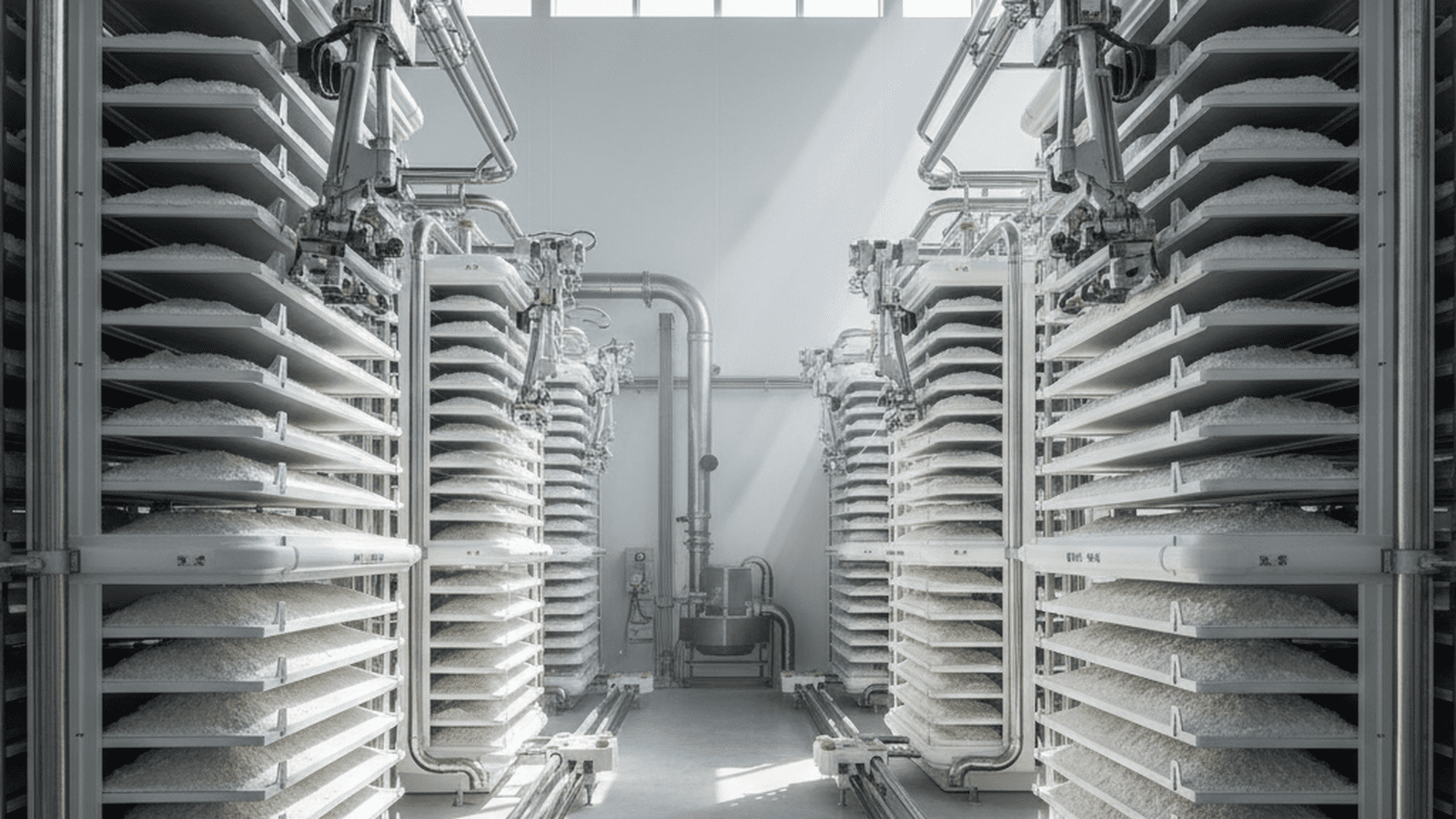
Heirloom Carbon Technologies has launched the first commercial direct air capture facility in the United States using a limestone-based process. This technology accelerates the natural carbonation cycle to remove CO2 from the atmosphere at a lower energy cost than traditional methods.
TLDR: California-based Heirloom Carbon Technologies has successfully scaled a carbon removal process that uses limestone to sponge CO2 from the air. By heating and hydrating the mineral in a modular system, the company has created a cost-effective path toward large-scale atmospheric decarbonization through a natural chemical cycle.
The challenge of atmospheric carbon removal has long been hindered by the high energy costs and complex chemical requirements of direct air capture (DAC) systems. However, a private-sector breakthrough in California is now demonstrating a more efficient path forward. Heirloom Carbon Technologies has successfully deployed a commercial-scale facility that utilizes limestone, one of the most abundant minerals on the planet, to pull carbon dioxide directly from the sky.
The science behind the facility relies on a process known as the limestone cycle. In nature, limestone (calcium carbonate) takes years to absorb CO2 from the environment. Heirloom’s engineers have developed a method to compress this timeline into less than three days. The process begins by heating crushed limestone in a kiln powered by renewable energy. This thermal treatment releases the stored CO2, which is captured and pumped deep underground into geological formations for permanent storage.
What remains after the heating process is calcium oxide, a highly reactive mineral. This material is then hydrated and spread onto large, modular trays. These trays are stacked in tall towers, exposing the mineral to the open air. Because calcium oxide has a natural affinity for carbon dioxide, it acts as a chemical sponge, binding with atmospheric CO2 to reform into limestone. Once the mineral is saturated, the cycle repeats, allowing the same material to be used hundreds of times.
One of the primary advantages of this limestone-based approach is its passive nature. Traditional DAC systems often rely on massive, energy-intensive fans to force air through liquid solvents or solid filters. Heirloom’s design allows the wind to do the work, significantly reducing the electricity required for operation. This efficiency is critical for meeting the economic targets necessary for widespread adoption. The company aims to bring the cost of carbon removal down to approximately $100 per ton, a threshold many experts believe is the tipping point for a viable global carbon market.
The facility in Tracy, California, serves as a proof of concept for modular scaling. By using standardized trays and racks, the system can be expanded rapidly without the need for bespoke engineering for every new site. This modularity allows for decentralized deployment, where capture units can be placed near renewable energy sources or sequestration sites, minimizing the need for extensive CO2 transport infrastructure.
The environmental implications of this technology extend beyond simple carbon sequestration. Because the process uses a closed-loop mineral cycle and renewable energy, it maintains a highly favorable net-negative carbon balance. Furthermore, the use of limestone avoids the need for the synthetic, often toxic, sorbents used in other DAC technologies. This makes the process safer for local environments and easier to permit in various jurisdictions.
As the global community looks toward net-zero targets, the role of permanent carbon removal has become increasingly prominent in climate policy. While reducing emissions remains the priority, the Intergovernmental Panel on Climate Change has noted that carbon removal will be essential to offset hard-to-abate sectors like aviation and heavy industry. The success of the Heirloom facility suggests that the private sector is closing the gap between laboratory theory and industrial reality.
Future research is now focusing on optimizing the kiln temperatures and mineral surface areas to further increase capture rates. Engineers are also exploring the use of different mineral feedstocks that might offer even higher absorption capacities. As these facilities scale up, the integration of automated monitoring and verification systems will be essential to ensure that every ton of carbon claimed is securely stored for the long term.

Mark Davis serves as the Senior Correspondent for Energy, Climate, and Resource Economics at Just Right News. In an era where the conversation around the environment is often dominated by alarmism and top-down mandates, Mark provides a vital, market-oriented perspective on the complex forces shaping our world. As the lead voice behind the acclaimed feature series “Power and the Planet,” he explores the intersection of environmental policy, global energy markets, and the fundamental economic principles that sustain modern civilization.
Mark’s pragmatic approach to resource management was forged in the high desert of his hometown, Albuquerque, New Mexico. Growing up in a region defined by both its breathtaking natural beauty and its rugged, resource-dependent landscape, he developed an early appreciation for the delicate balance between conservation and utilization. New Mexico’s unique position as a hub for both traditional energy production and cutting-edge scientific research provided Mark with a front-row seat to the evolution of the American energy sector. This upbringing instilled in him a deep-seated belief that true environmental stewardship is inseparable from economic prosperity and technological innovation.
Now based in Boulder, Colorado, Mark operates from the heart of the nation’s climate research community. While Boulder is often seen as a bastion of environmental idealism, Mark utilizes his post to provide a necessary counterweight, grounded in the realities of resource economics. He understands that energy policy does not exist in a vacuum; it has tangible consequences for the American taxpayer, the stability of the national power grid, and the strength of the domestic manufacturing sector. By reporting from the front lines of the climate debate, he is able to challenge prevailing narratives with hard data and a commitment to the principles of the free market.
Throughout his tenure at Just Right News, Mark has distinguished himself by focusing on the “Resource Economics” aspect of his beat. He frequently highlights the hidden costs of rapid energy transitions and advocates for an “all-of-the-above” energy strategy that prioritizes American energy independence. His work often shines a light on the geopolitical implications of resource scarcity, arguing that a secure nation must first be an energy-secure nation. Whether he is analyzing the impact of federal land-use regulations or investigating the supply chains required for new technologies, Mark remains focused on how policy decisions affect the lives and livelihoods of everyday citizens.
In “Power and the Planet,” Mark continues to bridge the gap between complex scientific concepts and the economic realities facing the country. He rejects the false choice between a healthy environment and a thriving economy, instead seeking out solutions that leverage American ingenuity and private-sector competition. For Mark, reporting on the climate is not about following the latest trends, but about ensuring that the conversation remains tethered to the foundational values of liberty, property rights, and fiscal responsibility. His contributions ensure that Just Right News readers receive a comprehensive, clear-eyed view of the challenges and opportunities defining the future of our planet.