

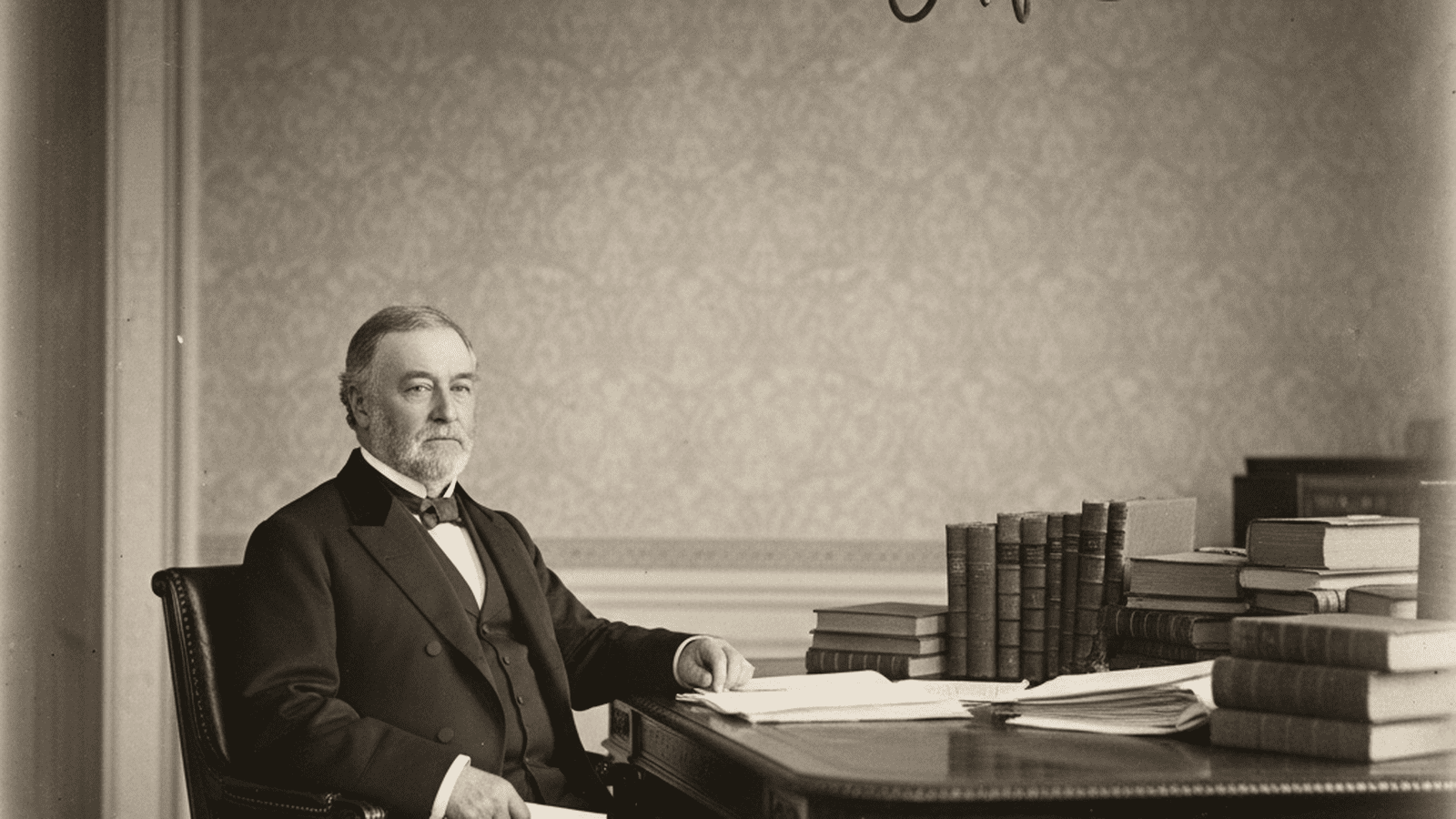
In 1887, the United States Congress repealed the Tenure of Office Act, ending a long-standing restriction on the President’s power to remove executive officials. This event followed a high-stakes standoff between President Grover Cleveland and a Republican-controlled Senate over executive privilege and patronage.
TLDR: President Grover Cleveland successfully challenged the Tenure of Office Act in 1887, asserting that the executive branch must have sole authority over personnel removals. The subsequent repeal of the law ended decades of legislative overreach, restoring the President’s constitutional prerogative and setting the stage for the modern, more powerful American presidency.
The Gilded Age is often characterized by legislative dominance and relatively weak presidents, but the administration of Grover Cleveland marked a significant turning point for executive power in the United States. In 1885, Cleveland became the first Democrat to occupy the White House since the Civil War. He immediately faced a hostile, Republican-controlled Senate determined to maintain its influence over federal patronage and the distribution of government jobs. The central point of contention was the Tenure of Office Act, a controversial law passed in 1867 during the bitter impeachment crisis of Andrew Johnson.
The Tenure of Office Act required the President to obtain Senate approval before removing any executive official whose appointment had originally required Senate confirmation. For nearly two decades, this law had effectively stripped the executive branch of its ability to manage its own personnel, forcing presidents to keep subordinates they did not trust or who were politically opposed to their agendas. When Cleveland began suspending hundreds of Republican holdovers to make room for his own appointees, the Senate Judiciary Committee, led by the formidable Senator George Frisbie Hoar of Massachusetts, demanded that the administration hand over all documents and private correspondence related to the removals.
Cleveland viewed this demand as an unconstitutional encroachment on the executive branch and a violation of the separation of powers. In March 1886, he sent a defiant and historic message to the Senate, asserting that the power of removal was an inherent executive function. He argued that the documents requested by the Senate were private and that the President was not accountable to the legislature for his reasons for dismissing subordinates. This assertion of executive privilege was a bold move in an era when the presidency had been significantly diminished by years of congressional overreach and the scars of the Reconstruction era.
The standoff created a national sensation, pitting the “Veto Mayor” of Buffalo against the “Old Guard” of the Senate. Cleveland’s “Message on the Tenure of Office Act” argued that the President was responsible directly to the people for the conduct of the executive departments. He maintained that if the Senate could block removals, the President could not be held responsible for the faithful execution of the laws, as he would be forced to work through agents he could not control. Public opinion began to shift in Cleveland’s favor, as many citizens viewed the Senate’s actions as a partisan attempt to protect political spoils rather than a principled defense of constitutional checks and balances.
Recognizing that the law had become a political liability and a hindrance to efficient governance, the Senate’s resistance began to crumble. In 1887, Senator George F. Hoar himself, despite his earlier opposition, introduced the bill to repeal the Tenure of Office Act. The repeal passed with little fanfare compared to the initial fireworks, but its implications were profound for the structure of the federal government. It effectively restored the “Decision of 1789,” the early constitutional interpretation that the President possessed the sole authority to remove executive officers without legislative interference.
The repeal of the Tenure of Office Act in 1887 represented a major victory for the independence of the presidency. It allowed future executives to exert greater control over the federal bureaucracy and solidified the principle that the President must have the authority to manage the personnel tasked with implementing policy. This restoration of power paved the way for the more assertive presidencies of the 20th century, moving the country away from the “Congressional Government” described by Woodrow Wilson. Later Supreme Court decisions, such as Myers v. United States in 1926, eventually affirmed the constitutionality of the President’s removal power, citing the precedent set during the Cleveland era as a vital restoration of executive autonomy.

Miles Harrington serves as the Senior Correspondent for Federal Systems & Executive Power at Just Right News, where he brings a disciplined, constitutionalist lens to the inner workings of the American government. With a focus on the mechanics of the federal bureaucracy and the limits of executive authority, Harrington has established himself as a vital voice for readers who value transparency, accountability, and the preservation of the separation of powers.
A native of Richmond, Virginia, Harrington’s perspective is deeply rooted in the traditions of the Old Dominion. Growing up in a city defined by its historical significance and its role as a center of American jurisprudence, he developed an early appreciation for the foundational principles of the Republic. His upbringing in Richmond—a place where the legacy of the Founding Fathers is woven into the landscape—instilled in him a belief that the federal government should remain within its constitutional bounds. This background informs his skepticism of centralized overreach and his commitment to reporting on the ways in which the administrative state impacts the lives of everyday citizens.
In his current role, Harrington specializes in the complexities of federal systems. He doesn’t just report on the headlines of the day; he digs into the structural shifts within the executive branch that often go unnoticed by the mainstream press. Whether he is analyzing the implications of a new federal regulation or investigating the expansion of agency jurisdiction, his work is characterized by a rigorous adherence to the facts and a dedication to the rule of law.
Harrington is perhaps best known for his signature feature series, “How Washington Works.” Through this ongoing project, he demystifies the often-opaque processes of the nation’s capital, pulling back the curtain on the “Deep State” and the unelected officials who wield significant influence over national policy. By breaking down complex legislative maneuvers and executive orders, he empowers Just Right News readers to understand the true levers of power in Washington. His reporting serves as a necessary check on the federal government, ensuring that the actions of those in power are held up to the light of public scrutiny.
Now based in Washington, D.C., Harrington operates at the epicenter of the political world, yet he remains intentionally distanced from the “Beltway bubble.” His proximity to the halls of power allows him to maintain a robust network of sources across the federal landscape, but his heart remains in the principled conservatism of his Virginia roots. He views his role not merely as a reporter, but as a steward of the public trust, dedicated to providing the clarity and context that conservative voters need to navigate an increasingly complex political environment.
Through his sharp analysis and unwavering commitment to the truth, Miles Harrington continues to be a cornerstone of the Just Right News team. His work ensures that the principles of limited government and executive restraint remain at the forefront of the national conversation, providing a crucial service to those who believe in a government that is truly of, by, and for the people.