

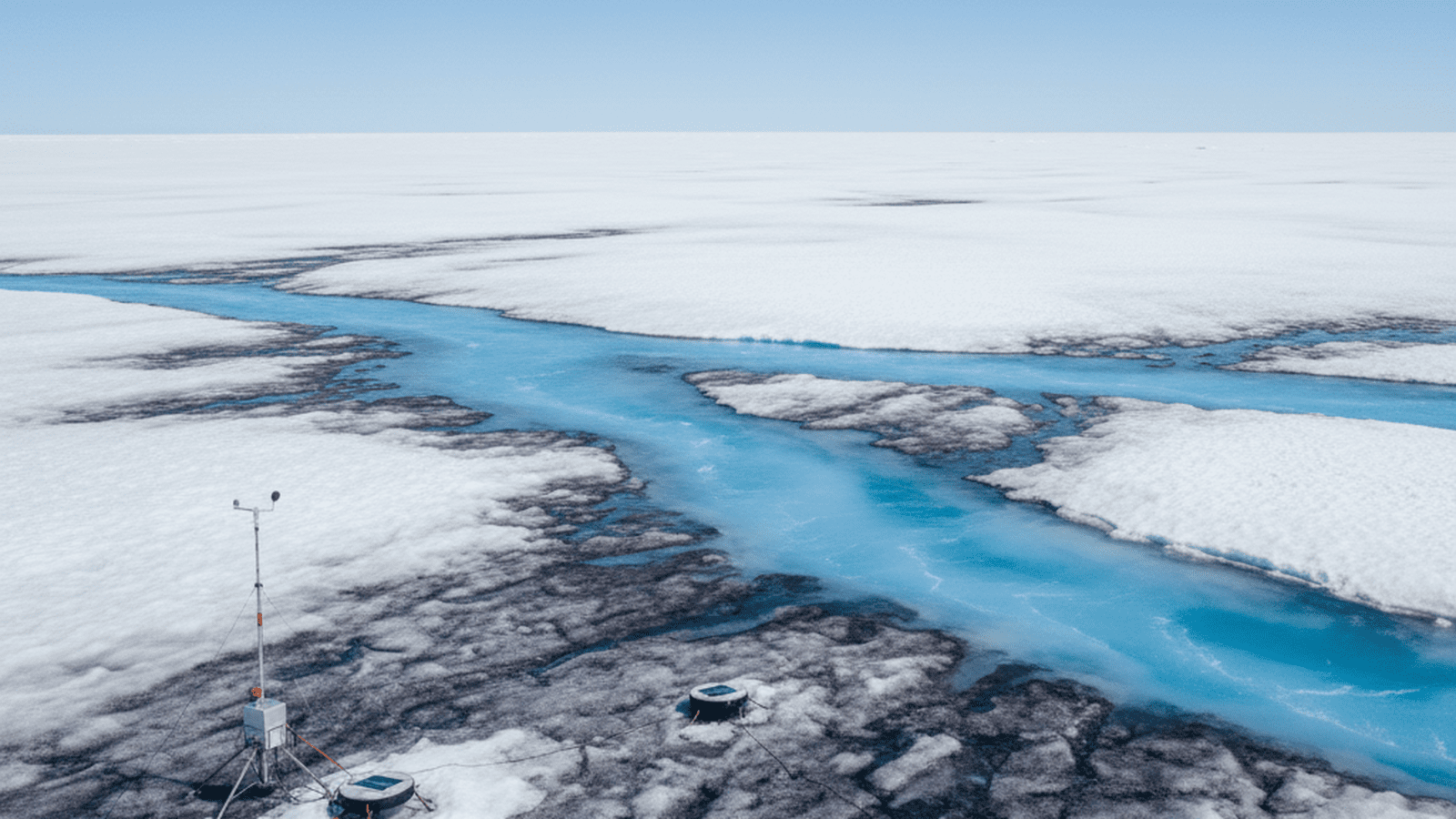
A multi-year field expedition to the Greenland Ice Sheet has confirmed that blooms of pigmented ice algae are significantly accelerating surface melt by darkening the ice. These biological organisms reduce the surface albedo, causing the ice to absorb more solar radiation than clean or snow-covered surfaces.
TLDR: Researchers conducting field studies on the Greenland Ice Sheet have identified pigmented algae as a major driver of melting. By darkening the ice surface, these blooms decrease reflectivity and increase heat absorption. This biological feedback loop is now being integrated into climate models to improve sea-level rise predictions.
The Greenland Ice Sheet, a massive expanse of frozen water covering nearly 1.7 million square kilometers, is currently the largest single contributor to global sea-level rise. While rising atmospheric temperatures are the primary driver of this loss, recent multi-year field expeditions have identified a powerful biological catalyst that is significantly accelerating the process: pigmented ice algae. These microscopic organisms, once considered a minor curiosity, are now recognized as a dominant force in the seasonal darkening of the ice surface, particularly within a region known as the “Dark Zone” on the ice sheet’s western flank.
During the peak of the Arctic summer, the surface of the ice sheet undergoes a dramatic transformation. As the winter snowpack melts away, it reveals the underlying glacier ice. This is where species such as Ancylonema nordenskioeldii and Mesotaenium berggrenii thrive. Unlike snow algae, which typically appear red or green and live in the seasonal snow layer, these specialized ice algae reside directly within the top few centimeters of the ice matrix. To survive the intense, 24-hour polar sunlight and high levels of ultraviolet radiation, these algae produce a dark, brownish-purple pigment. This pigment acts as a biological sunscreen, protecting the algae’s delicate internal machinery while simultaneously absorbing solar energy.
The physical consequence of this biological activity is a sharp reduction in albedo—the measure of a surface’s reflectivity. Fresh, clean snow is highly reflective, bouncing back up to 90% of incoming solar radiation into space. In contrast, bare glacier ice has a lower albedo, typically around 50% to 60%. However, when the ice is heavily colonized by algal blooms, the albedo can plummet to as low as 35%. This shift turns the ice sheet from a reflective mirror into a massive solar collector. The absorbed heat causes the surrounding ice to melt at an accelerated rate, providing the liquid water that the algae need to grow and reproduce.
This creates a self-reinforcing biological feedback loop. As the climate warms, the melt season begins earlier and lasts longer, providing a more stable environment for the algae to proliferate. The more the algae grow, the darker the ice becomes, and the faster it melts. Field researchers, including those involved in the “Deep Purple” project funded by the European Research Council, have spent years on the ice to quantify this effect. Using a combination of ground-based spectroscopy, automated weather stations, and high-resolution drone imagery, they have been able to distinguish the darkening caused by algae from that caused by inorganic impurities like soot or mineral dust. Their data confirms that during the height of summer, biological growth is the primary factor driving the darkening of the ice.
The implications for climate forecasting are profound. Historically, glaciological models have relied almost exclusively on physical and thermodynamic variables, such as air temperature and precipitation, to predict ice loss. By omitting the “bio-albedo” effect, these models may be significantly underestimating the speed at which the Greenland Ice Sheet will disappear. Scientists are now working to integrate biological growth rates and nutrient cycles—such as the delivery of phosphorus from windblown dust—into the next generation of Earth System Models. Understanding these complex interactions is essential for providing more accurate predictions of future sea-level rise, which threatens coastal communities worldwide. As the Arctic continues to warm at twice the global average, the expansion of these dark, living carpets represents a critical frontier in climate science.

Mark Davis serves as the Senior Correspondent for Energy, Climate, and Resource Economics at Just Right News. In an era where the conversation around the environment is often dominated by alarmism and top-down mandates, Mark provides a vital, market-oriented perspective on the complex forces shaping our world. As the lead voice behind the acclaimed feature series “Power and the Planet,” he explores the intersection of environmental policy, global energy markets, and the fundamental economic principles that sustain modern civilization.
Mark’s pragmatic approach to resource management was forged in the high desert of his hometown, Albuquerque, New Mexico. Growing up in a region defined by both its breathtaking natural beauty and its rugged, resource-dependent landscape, he developed an early appreciation for the delicate balance between conservation and utilization. New Mexico’s unique position as a hub for both traditional energy production and cutting-edge scientific research provided Mark with a front-row seat to the evolution of the American energy sector. This upbringing instilled in him a deep-seated belief that true environmental stewardship is inseparable from economic prosperity and technological innovation.
Now based in Boulder, Colorado, Mark operates from the heart of the nation’s climate research community. While Boulder is often seen as a bastion of environmental idealism, Mark utilizes his post to provide a necessary counterweight, grounded in the realities of resource economics. He understands that energy policy does not exist in a vacuum; it has tangible consequences for the American taxpayer, the stability of the national power grid, and the strength of the domestic manufacturing sector. By reporting from the front lines of the climate debate, he is able to challenge prevailing narratives with hard data and a commitment to the principles of the free market.
Throughout his tenure at Just Right News, Mark has distinguished himself by focusing on the “Resource Economics” aspect of his beat. He frequently highlights the hidden costs of rapid energy transitions and advocates for an “all-of-the-above” energy strategy that prioritizes American energy independence. His work often shines a light on the geopolitical implications of resource scarcity, arguing that a secure nation must first be an energy-secure nation. Whether he is analyzing the impact of federal land-use regulations or investigating the supply chains required for new technologies, Mark remains focused on how policy decisions affect the lives and livelihoods of everyday citizens.
In “Power and the Planet,” Mark continues to bridge the gap between complex scientific concepts and the economic realities facing the country. He rejects the false choice between a healthy environment and a thriving economy, instead seeking out solutions that leverage American ingenuity and private-sector competition. For Mark, reporting on the climate is not about following the latest trends, but about ensuring that the conversation remains tethered to the foundational values of liberty, property rights, and fiscal responsibility. His contributions ensure that Just Right News readers receive a comprehensive, clear-eyed view of the challenges and opportunities defining the future of our planet.