

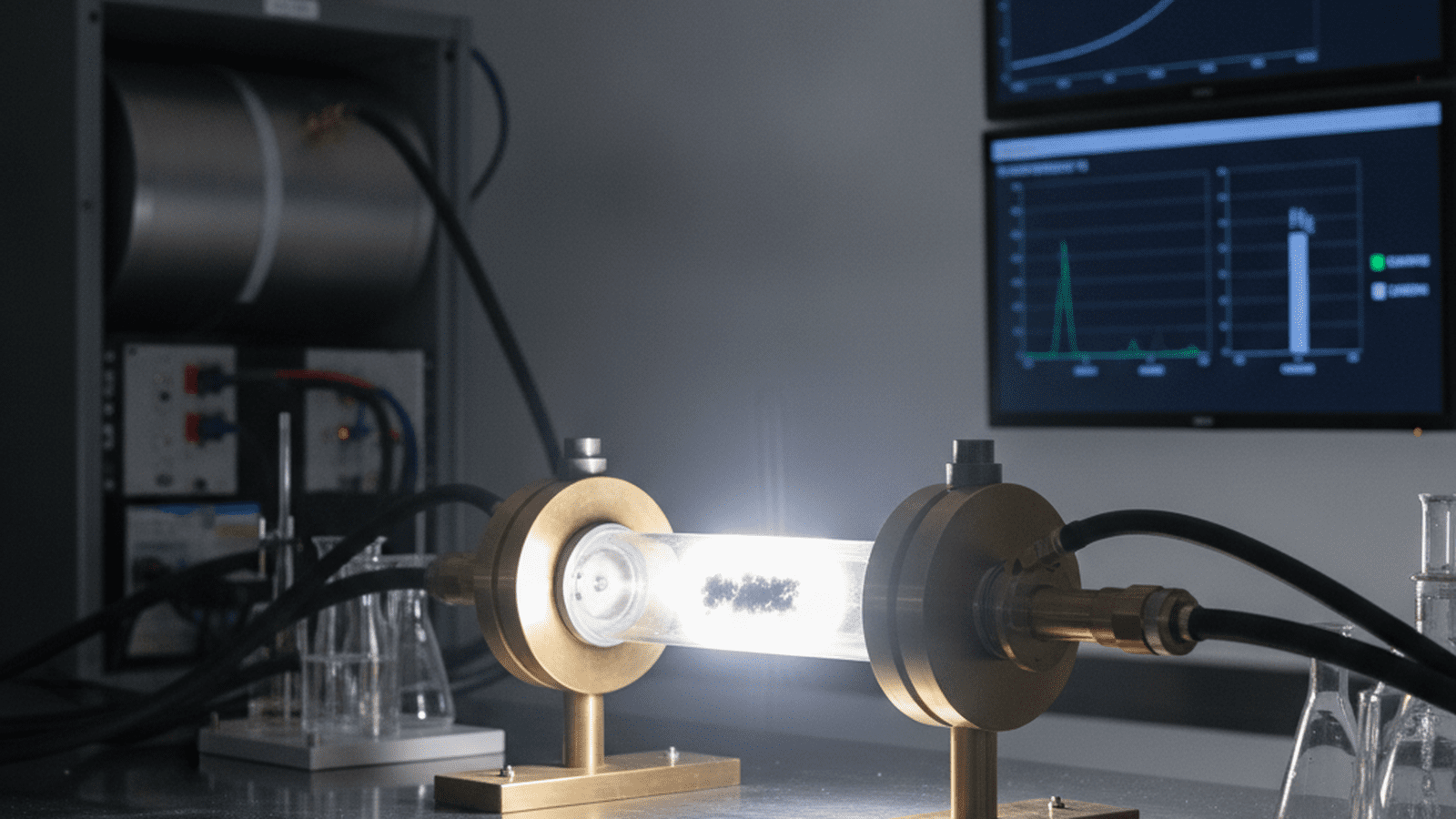
Researchers at Rice University have pioneered a flash Joule heating technique that converts waste plastic into clean hydrogen gas and high-quality graphene in milliseconds. The process uses rapid electrical pulses to break chemical bonds, offering a carbon-neutral method for hydrogen production when powered by renewable energy.
TLDR: Rice University scientists have developed a ‘flash Joule heating’ method to instantly turn waste plastic into hydrogen fuel and graphene. By applying high-voltage electricity for milliseconds, the team breaks down mixed plastics without pre-sorting, creating a zero-emission energy source and a valuable material for strengthening industrial composites.
Researchers at Rice University have developed a technique to transform waste plastic into high-yield hydrogen gas and valuable graphene in a process that takes less than a second. Led by chemist James Tour, the team utilized a method known as flash Joule heating to address two global challenges simultaneously: the accumulation of plastic waste and the need for low-carbon energy sources. This breakthrough offers a potential pathway to decarbonize hydrogen production while incentivizing plastic recycling through the creation of high-value byproducts.
The process involves exposing ground plastic waste to a high-voltage electric current for approximately four milliseconds. This rapid burst of energy raises the temperature of the material to roughly 3,100 degrees Kelvin, a state of extreme heat that bypasses traditional melting phases. Under these intense conditions, the carbon-hydrogen bonds in the plastic break apart almost instantaneously. The hydrogen atoms combine to form volatile hydrogen gas, which can be captured and used as a clean fuel for fuel cells or industrial processes. Meanwhile, the remaining carbon atoms rearrange themselves into turbostratic graphene, a high-quality material characterized by its loosely packed layers.
Traditional methods of hydrogen production, such as steam methane reforming, rely heavily on fossil fuels and release significant amounts of carbon dioxide as a byproduct. In contrast, the flash Joule heating method produces no carbon dioxide if the electricity used is sourced from renewable grids or on-site solar arrays. The researchers noted that the energy required to power the process is relatively low, making it economically competitive with existing industrial techniques that require sustained high temperatures. Furthermore, the production of graphene provides a secondary revenue stream that could offset the costs of waste management and hydrogen generation. This dual-product output addresses the economic barriers that often stall new green technologies by providing immediate industrial value.
One of the most significant advantages of this technique is its versatility regarding feedstock. The Rice University team demonstrated that the process works effectively on mixed plastic waste, including types that are notoriously difficult to recycle through conventional mechanical means. Polyethylene, polypropylene, and polystyrene were all successfully converted without the need for intensive sorting or cleaning. This flexibility could drastically reduce the logistical hurdles currently facing the global recycling industry, which struggles with contamination in waste streams. By eliminating the need for high-purity inputs, the flash Joule method simplifies the supply chain for recycled materials.
The quality of the graphene produced is also a key factor in the study’s significance. Turbostratic graphene features misaligned layers that are easier to separate and integrate into other materials compared to the more common AB-stacked graphene. When added to concrete, even small amounts of this graphene can significantly increase the material’s strength and durability. This application offers a way to sequester the carbon from the original plastic into the built environment, preventing it from entering the atmosphere or oceans as microplastics. The resulting composite materials are not only stronger but also have a lower overall carbon footprint.
As the world transitions toward a hydrogen economy, scalable and sustainable production methods are essential. The Rice University lab is now focusing on scaling the flash Joule heating apparatus to handle larger volumes of waste. Future research will investigate the application of this method to other carbon-rich waste streams, such as food waste and coal fly ash. If successfully commercialized, this technology could transform plastic waste from an environmental liability into a critical resource for the green energy transition, effectively closing the loop on carbon-based materials. Engineers are currently working on continuous-flow reactors to move the process from batch-style lab experiments to industrial-scale operations.

Mark Davis serves as the Senior Correspondent for Energy, Climate, and Resource Economics at Just Right News. In an era where the conversation around the environment is often dominated by alarmism and top-down mandates, Mark provides a vital, market-oriented perspective on the complex forces shaping our world. As the lead voice behind the acclaimed feature series “Power and the Planet,” he explores the intersection of environmental policy, global energy markets, and the fundamental economic principles that sustain modern civilization.
Mark’s pragmatic approach to resource management was forged in the high desert of his hometown, Albuquerque, New Mexico. Growing up in a region defined by both its breathtaking natural beauty and its rugged, resource-dependent landscape, he developed an early appreciation for the delicate balance between conservation and utilization. New Mexico’s unique position as a hub for both traditional energy production and cutting-edge scientific research provided Mark with a front-row seat to the evolution of the American energy sector. This upbringing instilled in him a deep-seated belief that true environmental stewardship is inseparable from economic prosperity and technological innovation.
Now based in Boulder, Colorado, Mark operates from the heart of the nation’s climate research community. While Boulder is often seen as a bastion of environmental idealism, Mark utilizes his post to provide a necessary counterweight, grounded in the realities of resource economics. He understands that energy policy does not exist in a vacuum; it has tangible consequences for the American taxpayer, the stability of the national power grid, and the strength of the domestic manufacturing sector. By reporting from the front lines of the climate debate, he is able to challenge prevailing narratives with hard data and a commitment to the principles of the free market.
Throughout his tenure at Just Right News, Mark has distinguished himself by focusing on the “Resource Economics” aspect of his beat. He frequently highlights the hidden costs of rapid energy transitions and advocates for an “all-of-the-above” energy strategy that prioritizes American energy independence. His work often shines a light on the geopolitical implications of resource scarcity, arguing that a secure nation must first be an energy-secure nation. Whether he is analyzing the impact of federal land-use regulations or investigating the supply chains required for new technologies, Mark remains focused on how policy decisions affect the lives and livelihoods of everyday citizens.
In “Power and the Planet,” Mark continues to bridge the gap between complex scientific concepts and the economic realities facing the country. He rejects the false choice between a healthy environment and a thriving economy, instead seeking out solutions that leverage American ingenuity and private-sector competition. For Mark, reporting on the climate is not about following the latest trends, but about ensuring that the conversation remains tethered to the foundational values of liberty, property rights, and fiscal responsibility. His contributions ensure that Just Right News readers receive a comprehensive, clear-eyed view of the challenges and opportunities defining the future of our planet.