

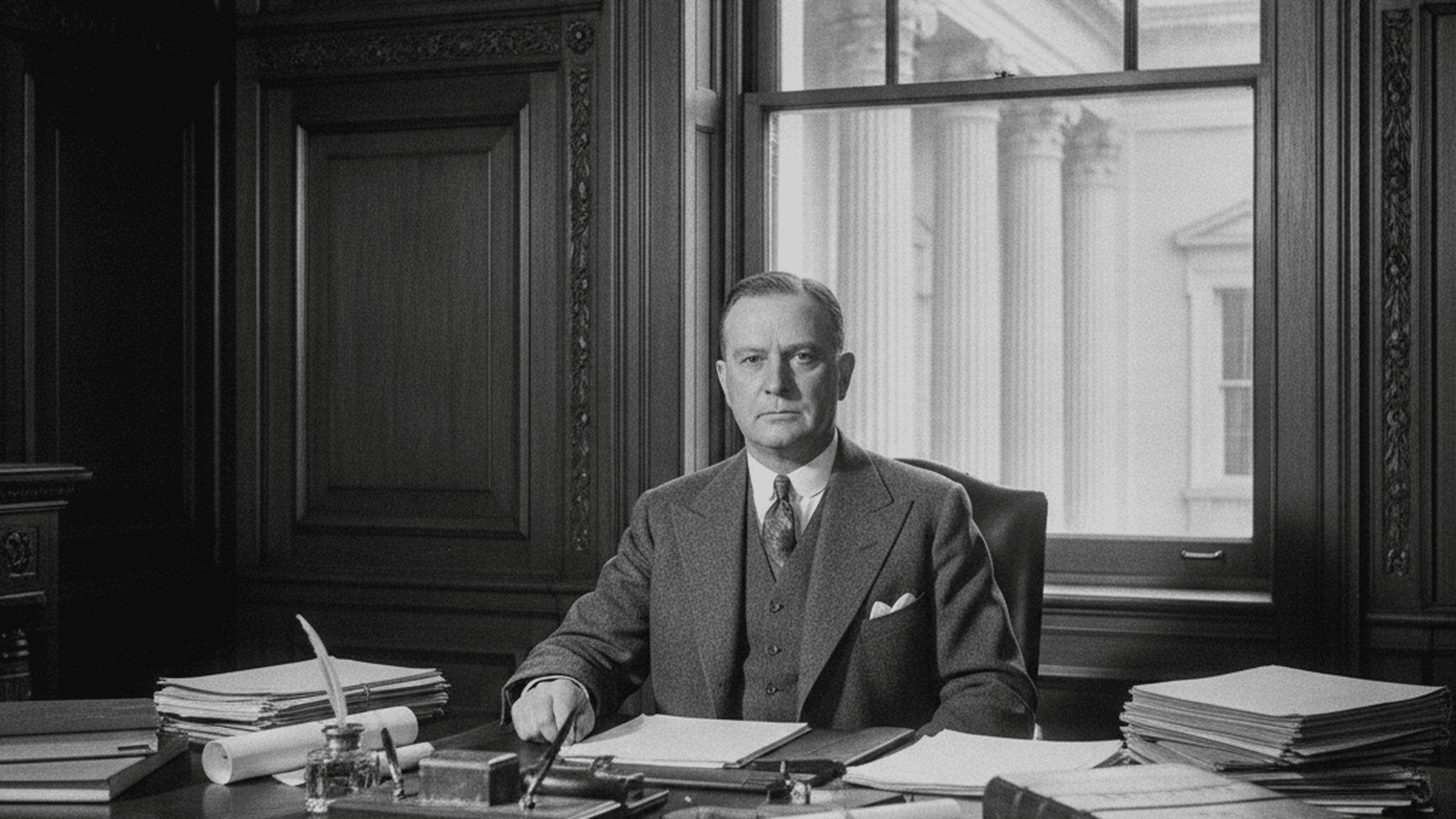
The 1935 Supreme Court case Humphrey’s Executor v. United States established significant limits on the U.S. president’s power to remove officials from independent regulatory agencies. The ruling prevented President Franklin D. Roosevelt from firing a Federal Trade Commission member for purely political reasons, asserting that Congress could protect certain “quasi-legislative” roles from executive interference.
TLDR: In 1935, the Supreme Court unanimously ruled against President Franklin D. Roosevelt in Humphrey’s Executor v. United States. The decision limited the president’s authority to fire members of independent regulatory agencies without cause. This landmark ruling protected the autonomy of the “fourth branch” of government from direct executive control during the New Deal era.
In the depths of the Great Depression, President Franklin D. Roosevelt sought to reshape the American economy through his sweeping New Deal programs. Central to this effort was the belief that the executive branch required unified control over the various boards and commissions that regulated national commerce. This philosophy inevitably clashed with the established independence of the Federal Trade Commission (FTC), leading to the landmark case of Humphrey’s Executor v. United States.
William E. Humphrey was a conservative Republican appointed to the FTC by President Herbert Hoover in 1931. His term was set for seven years, but his regulatory philosophy was diametrically opposed to Roosevelt’s interventionist approach. In the summer of 1933, Roosevelt wrote to Humphrey, asking for his resignation on the grounds that the administration’s goals could be better achieved with personnel of his own choosing. Humphrey, asserting the statutory independence of the commission, refused to step down. Roosevelt persisted, eventually dismissing him in October 1933, not for “inefficiency, neglect of duty, or malfeasance in office”—the only grounds for removal cited in the FTC Act—but for purely political and policy-based reasons.
The legal battle that followed centered on the extent of Article II executive power. The Roosevelt administration relied heavily on the 1926 precedent set in Myers v. United States. In that case, Chief Justice William Howard Taft had ruled that the President possessed an inherent, illimitable power to remove executive officers, specifically a postmaster. Roosevelt’s lawyers argued that this power extended to all officials appointed by the President, regardless of their function. They contended that any restriction on this power by Congress was an unconstitutional infringement on the executive’s duty to manage the government.
However, when the case reached the Supreme Court, the justices were increasingly wary of Roosevelt’s expansion of executive authority. On May 27, 1935—a day known as “Black Monday” because the Court struck down several New Deal initiatives—the Court issued a unanimous decision against the President. Justice George Sutherland, writing for the Court, made a crucial distinction that would define administrative law for the next century. He argued that while the President could fire “purely executive” officials like a postmaster, he did not have the same authority over officials in agencies that performed “quasi-legislative” or “quasi-judicial” duties.
The Court characterized the FTC as a body of experts intended to act as a non-partisan, deliberative entity. Sutherland noted that such agencies were created by Congress to carry out specific legislative policies and adjudicate disputes, functions that required a degree of insulation from the political whims of the White House. To allow the President to fire such officials at will would, in the Court’s view, threaten the constitutional separation of powers and turn independent regulators into mere tools of the executive. The decision effectively established that the President’s removal power is not absolute and can be limited by statute when the office involves non-executive functions.
The Humphrey’s Executor ruling established the legal foundation for the “independent” regulatory agency, often referred to as the “fourth branch” of government. It confirmed that Congress has the power to create “for cause” removal protections, ensuring that the leadership of bodies like the Federal Reserve, the SEC, and the NLRB remains stable across different administrations. While recent Supreme Court decisions, such as Seila Law LLC v. CFPB (2020), have narrowed this protection for agencies led by a single director, the 1935 ruling remains a cornerstone of the American regulatory state. It serves as a permanent reminder that the President’s power to “take care that the laws be faithfully executed” does not grant absolute control over every corner of the federal bureaucracy.

Miles Harrington serves as the Senior Correspondent for Federal Systems & Executive Power at Just Right News, where he brings a disciplined, constitutionalist lens to the inner workings of the American government. With a focus on the mechanics of the federal bureaucracy and the limits of executive authority, Harrington has established himself as a vital voice for readers who value transparency, accountability, and the preservation of the separation of powers.
A native of Richmond, Virginia, Harrington’s perspective is deeply rooted in the traditions of the Old Dominion. Growing up in a city defined by its historical significance and its role as a center of American jurisprudence, he developed an early appreciation for the foundational principles of the Republic. His upbringing in Richmond—a place where the legacy of the Founding Fathers is woven into the landscape—instilled in him a belief that the federal government should remain within its constitutional bounds. This background informs his skepticism of centralized overreach and his commitment to reporting on the ways in which the administrative state impacts the lives of everyday citizens.
In his current role, Harrington specializes in the complexities of federal systems. He doesn’t just report on the headlines of the day; he digs into the structural shifts within the executive branch that often go unnoticed by the mainstream press. Whether he is analyzing the implications of a new federal regulation or investigating the expansion of agency jurisdiction, his work is characterized by a rigorous adherence to the facts and a dedication to the rule of law.
Harrington is perhaps best known for his signature feature series, “How Washington Works.” Through this ongoing project, he demystifies the often-opaque processes of the nation’s capital, pulling back the curtain on the “Deep State” and the unelected officials who wield significant influence over national policy. By breaking down complex legislative maneuvers and executive orders, he empowers Just Right News readers to understand the true levers of power in Washington. His reporting serves as a necessary check on the federal government, ensuring that the actions of those in power are held up to the light of public scrutiny.
Now based in Washington, D.C., Harrington operates at the epicenter of the political world, yet he remains intentionally distanced from the “Beltway bubble.” His proximity to the halls of power allows him to maintain a robust network of sources across the federal landscape, but his heart remains in the principled conservatism of his Virginia roots. He views his role not merely as a reporter, but as a steward of the public trust, dedicated to providing the clarity and context that conservative voters need to navigate an increasingly complex political environment.
Through his sharp analysis and unwavering commitment to the truth, Miles Harrington continues to be a cornerstone of the Just Right News team. His work ensures that the principles of limited government and executive restraint remain at the forefront of the national conversation, providing a crucial service to those who believe in a government that is truly of, by, and for the people.