

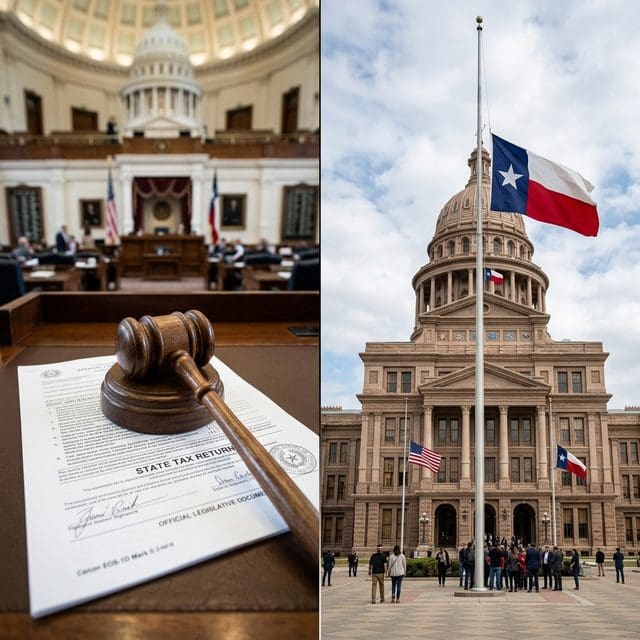
Governor Gavin Newsom signed a targeted 25% tax on private detention facilities, signaling a new chapter in the ongoing jurisdictional friction between Sacramento and federal immigration policy.
The laboratory of federalism is currently producing a volatile reaction in California, where Governor Gavin Newsom has signed a targeted 25% tax on private detention centers. The measure, effective July 1, 2028, represents a sophisticated shift in state-level resistance to federal immigration enforcement. By leveraging the power to tax rather than attempting a direct ban on federal contractors, Sacramento is testing the limits of state authority to influence national policy through fiscal pressure. This new levy is expected to generate approximately $177 million annually, with proceeds earmarked for the Due Process for All Fund, which provides legal services to immigrants.
The policy is notably narrower than previous proposals that sought a 50% tax rate, suggesting a strategic calibration intended to withstand legal challenges regarding federal preemption. By focusing on gross income rather than operational prohibitions, California seeks to make the business of private detention economically untenable within its borders while maintaining a veneer of tax neutrality. Governor Newsom recently vetoed AB 2465, which would have denied state grants and tax credits to these businesses, signaling that the administration is betting specifically on this targeted tax to achieve its goals.
While California experiments with fiscal levers, Tennessee is grappling with the fundamental responsibilities of state-administered justice. Governor Bill Lee announced on October 3 that Department of Correction Commissioner Frank Strada will resign following the failed execution of Christa Pike. The inmate survived two attempts at lethal injection on October 1 and remains in critical condition. The fallout has prompted an independent review of state protocols, as the resignation serves as the first major administrative consequence of the incident. Pike’s legal team has filed an emergency motion to preserve all execution-related evidence, including training records and chemical residues, alleging violations of constitutional protections against cruel and unusual punishment.
These developments in Tennessee underscore the immense weight of the Tenth Amendment, which reserves the administration of criminal justice to the states but requires those states to maintain rigorous standards of competence. The resignation of a top official serves as a stark reminder that local governance carries high-stakes accountability. The state must now navigate the legal and ethical minefield of a failed capital sentence while maintaining the integrity of its penal system. This internal reckoning contrasts with the external-facing policies of California, yet both demonstrate the central role of the governor in managing the friction between state law and constitutional mandates.
Further south, other states are preparing their own policy shifts through direct democracy. Florida voters will decide on November 3 whether to increase the state’s budget-stabilization-fund ceiling from 10% to 25% of general revenue, a move toward fiscal resilience. Additional Florida amendments seek to exempt qualifying agricultural property from taxation and expand homestead exemptions. Texas is likewise preparing for a massive electoral cycle, with voter registration closing October 5 for races that will determine the state’s executive direction. From California’s aggressive taxation of federal functions to Tennessee’s internal reckoning with executive failure, the states continue to serve as the primary arenas for constitutional tension, proving that the most consequential policy battles are fought in the statehouses where local leaders exercise their sovereign prerogative.

Dylan Brooks serves as the Senior Correspondent for Statehouses and Local Governance at Just Right News, where he brings a principled, constitutionalist lens to the often-overlooked machinery of state-level politics. As the lead voice behind the acclaimed feature series “Fifty Laboratories of Power,” Dylan has dedicated his career to the idea that the most impactful governance happens closest to home. His reporting consistently champions the Tenth Amendment, exploring how individual states can serve as testing grounds for innovative, conservative policy solutions that prioritize personal liberty and fiscal responsibility.
A native of Des Moines, Iowa, Dylan’s journalistic philosophy was forged in the heart of the American Midwest. Growing up in a community where local school board meetings and town halls were the bedrock of civic life, he developed a deep appreciation for the “retail politics” of the heartland. This upbringing instilled in him a fundamental belief that the American experiment is best preserved when power is decentralized. He carries the values of his Iowa roots into every assignment, maintaining a healthy skepticism of federal overreach and a steadfast commitment to the concerns of everyday citizens over the interests of the administrative state.
Now based in Madison, Wisconsin, Dylan operates from one of the nation’s most pivotal political battlegrounds. His location in a state capital known for its rigorous policy debates allows him to provide Just Right News readers with a front-row seat to the legislative process. From Madison, he tracks the ripple effects of statehouse decisions on local municipalities, ensuring that the connection between high-level policy and community impact is never lost. His work often highlights the success of conservative governors and legislatures in fostering economic growth, protecting parental rights, and securing the integrity of local institutions.
As an African American man in the conservative media landscape, Dylan offers a vital perspective on how limited government and free-market principles empower individuals and families. He frequently reports on how deregulation and school choice initiatives provide new avenues for success in underserved communities, challenging the monolithic narratives often presented by legacy media outlets. Dylan’s work is characterized by a commitment to the facts and a refusal to shy away from the complex realities of modern governance.
Throughout his tenure at Just Right News, Dylan has become a trusted authority for readers who value a rigorous, principled approach to the news. Whether he is dissecting a complex state budget or profiling a local grassroots movement, his goal remains the same: to provide the American public with the information they need to hold their local leaders accountable. By focusing on the “Fifty Laboratories of Power,” Dylan Brooks ensures that the vital work being done in statehouses across the country receives the national attention it deserves, always through a lens that respects the traditions and sovereignty of the American people.