

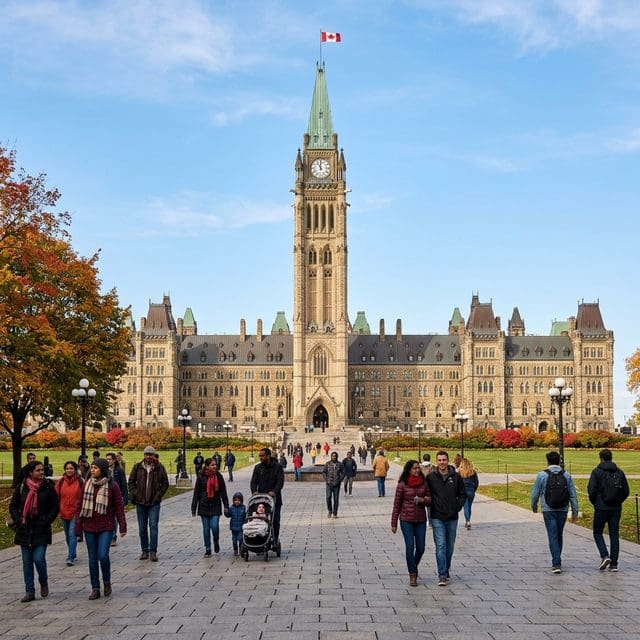
The Canadian government is preparing to table a new three-year immigration strategy that introduces strict caps on temporary residents while aiming to maintain permanent admissions below one percent of the total population.
The Canadian government is entering the final stages of drafting its Immigration Levels Plan for 2027–2029, a statutory document that serves as the blueprint for the nation’s demographic and economic trajectory. According to reports from Immigration, Refugees and Citizenship Canada (IRCC), the new plan must be tabled in Parliament by November 1, 2026. This upcoming cycle is particularly significant as it will establish the first official permanent-resident target for the year 2029, while confirming or revising the indicative targets previously set for 2027 and 2028. The policy comes at a time when the federal government is under increasing pressure to balance labor needs with the integrity of the social contract and community infrastructure.
Current planning baselines for 2027 and 2028 remain set at 380,000 permanent-resident admissions annually. However, the government has introduced a new, aggressive focus on managing the temporary-resident population. The current framework aims for approximately 370,000 new temporary arrivals each year, comprising 150,000 international students and 220,000 temporary workers. This shift follows a period of rapid growth where the non-permanent-resident share of the population peaked at 7.6%. IRCC reports that this share has since declined to 6.5%, but the stated policy objective is to bring that figure below 5% by the end of 2027. To ensure long-term stability, the government also intends to keep permanent-resident admissions below 1% of the total population beyond 2027.
While Prime Minister Mark Carney has signaled that a “controlled increase” in population growth could eventually resume, the Immigration Minister’s office has not yet confirmed whether the 2027–2029 plan will reflect an upward adjustment or a continued cooling. External advisory bodies, such as the C.D. Howe Institute’s Immigration Targets Council, are advocating for a more conservative approach. The council has recommended lowering permanent-resident admissions to 380,000 in 2027, then further reducing the intake to 350,000 in 2028 and 340,000 in 2029. The council also suggests that the 5% temporary-resident objective should be treated as a hard ceiling, with an ultimate goal of reducing that share to 3% to preserve local community character and housing availability.
A significant complication in these planning efforts is the existence of two one-time transition measures that could add approximately 148,000 permanent residents over the 2026–2027 period outside the regular annual plan. This includes roughly 115,000 protected persons and their dependents, alongside up to 33,000 in-Canada workers. These “out-of-plan” admissions represent a significant demographic variable that federal planners must account for when calculating the impact on public services and the rule of law within the immigration system.
Beyond raw numbers, the IRCC is also prioritizing linguistic demographics. The current framework points toward a 12% Francophone-admissions target for migrants settling outside of Quebec by 2029. To reach this goal, the government has set interim targets of 9.5% in 2027 and 10.5% in 2028. This focus on Francophone immigration is part of a broader effort to maintain the cultural and linguistic heritage of the country amidst rapid global migration shifts.
As the November deadline approaches, the 2027–2029 plan will serve as a definitive statement on how Canada intends to manage the intersection of economic demand and social cohesion. By setting the first-ever 2029 targets, the government is attempting to provide a predictable roadmap for provinces, municipalities, and employers who must adapt to these shifting population dynamics. The final document will be closely watched by stakeholders across the political spectrum to see if the government adheres to its 5% temporary resident cap or if economic pressures lead to a revision of these restrictive measures.

Julie Harris serves as a Staff Writer for Just Right News, where she tackles some of the most pressing and complex issues facing the nation today. As the lead reporter for the Migration, Demographics & Cultural Shifts beat, Julie provides a grounded, principled perspective on how the movement of people and the changing makeup of communities are reshaping the American landscape. Her work is defined by a commitment to exploring the long-term consequences of social change, prioritizing the stability of local institutions and the preservation of national identity.
Her deep understanding of these issues is rooted in her upbringing in Tucson, Arizona. Growing up in a prominent border state, Julie witnessed firsthand the intricate realities of migration and the profound impact it has on local infrastructure, law enforcement, and the social fabric. This early exposure instilled in her a respect for the rule of law and a keen awareness of the challenges that arise when federal policies fail to align with the needs of border communities. Her reporting often reflects this lived experience, bringing a necessary level of nuance to topics that are often treated with abstraction in coastal newsrooms.
Now based in Santa Fe, New Mexico, Julie continues to report from the heart of the American Southwest. Her location provides a unique vantage point to observe the intersection of traditional regional cultures and the modern shifts brought about by both internal and external migration. In Santa Fe, a city defined by its rich history and distinct cultural heritage, she finds a perfect environment to explore how communities strive to maintain their character while navigating the pressures of a rapidly changing world. This perspective allows her to bridge the gap between policy debates in Washington and the reality of life in the high desert.
At Just Right News, Julie’s work is characterized by a dedication to examining the data and the human stories that define the “New Mosaic” of America. Her signature feature series, “The New Mosaic,” has become a cornerstone of her reporting. Through this series, Julie explores the evolving social architecture of the United States, documenting how shifts in population affect everything from local economies to the political landscape. She brings a critical eye to the narrative of demographic inevitability, instead asking how these shifts impact the average citizen’s sense of belonging and the integrity of the American social contract.
Julie’s background and her dedication to conservative principles make her a vital voice in contemporary journalism. She understands that demographics are more than just numbers on a spreadsheet; they represent the future of the American family and the nation’s enduring legacy. Through her diligent reporting and insightful analysis, Julie Harris ensures that her readers are informed about the forces shaping their world, providing a perspective that is as thoughtful as it is necessary for the modern era.