

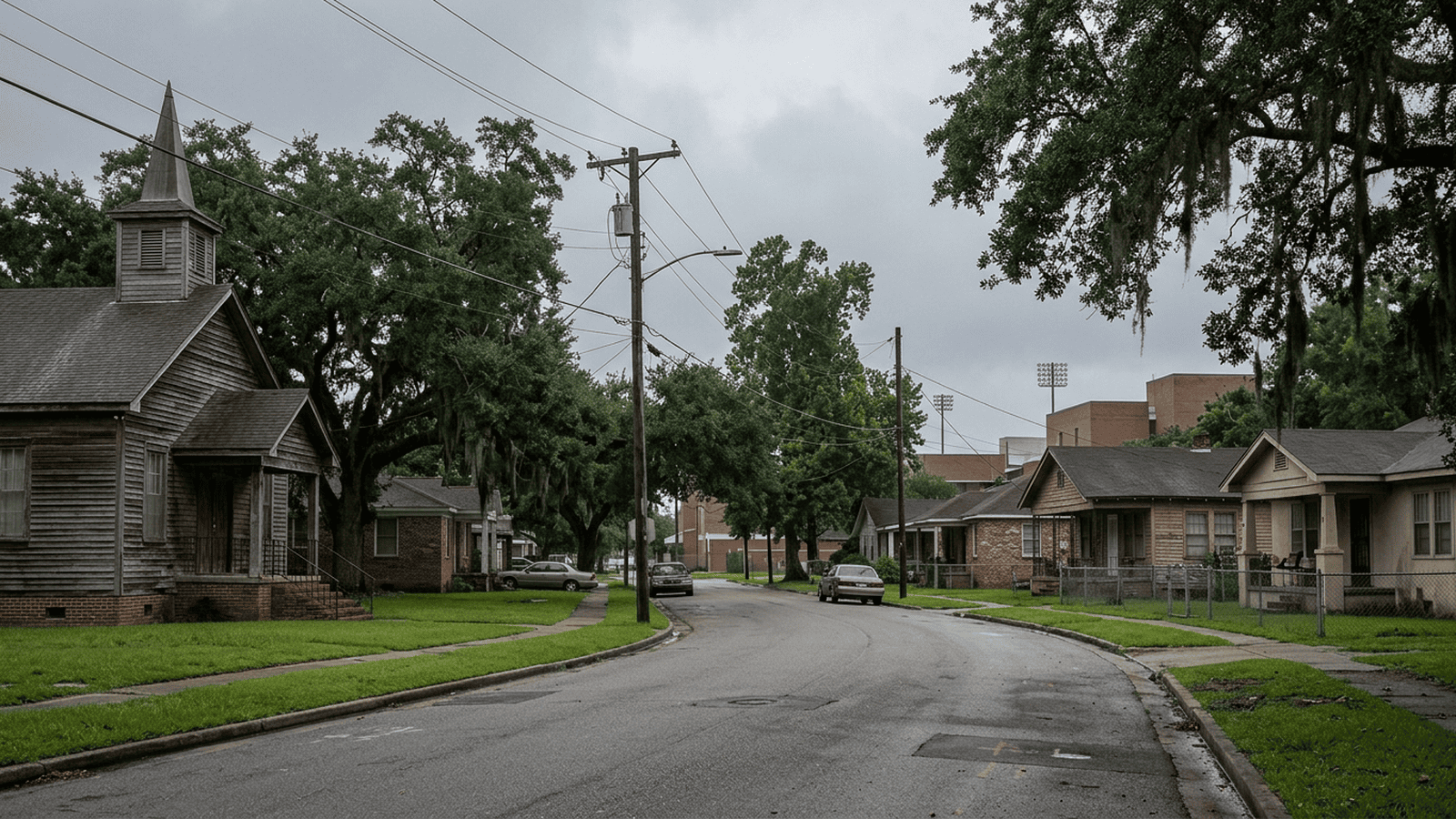
Louisiana’s revised congressional map places Scotlandville in a majority-white district after the Supreme Court ruled Rep. Cleo Fields’ former district unconstitutional. The district’s Black population share fell from 53% to 25%, and Fields says he will not seek reelection in November. The change follows decades of legal battles over district lines, including earlier shifts that moved Scotlandville between districts and a 2023 court decision that led to a majority-Black district. Residents worry that Fields’ departure will weaken their direct connection to Congress, while local institutions such as the Louisiana Leadership Institute remain part of the community. The election under the revised boundaries is the next step; the account does not specify further deadlines or oversight arrangements.
TLDR: A Supreme Court ruling prompted Louisiana to redraw a district that includes Scotlandville, reducing its Black population share from 53% to 25%. Rep. Cleo Fields will not seek reelection, and the community faces the November election without its longtime homegrown representative.
Scotlandville, a predominantly Black community of about 10,000 people in Baton Rouge, is facing a changed place on Louisiana’s congressional map. The new lines put the community in a majority-white district for the second time. Rep. Cleo Fields, who grew up there, says he will leave Congress and return to the Legislature rather than seek reelection in a district he believes he has little chance of winning.
The stated legal rationale is that the U.S. Supreme Court found Fields’ district unconstitutional after a lawsuit brought by non-Black voters. Louisiana then redrew its congressional districts, as Alabama and Tennessee also moved to change their maps in time for November elections. The ruling followed years of legal disputes over how districts should reflect voting rights and racial equality.
The process has produced a straightforward map change, but not a simple local transition. Fields’ district shifted from 53% Black to 25% Black under the new lines. For Scotlandville, that means the end of representation by a congressman who was raised in the community and whose political career has repeatedly followed changes to the district boundaries.
Fields first entered Congress in 1993, when Scotlandville was part of the 4th District, redrawn to create a majority-Black seat. A federal court ruled the boundaries unconstitutional in 1996, and the community moved into the predominantly white 6th District. Fields then became a state senator. After a 2023 court decision involving Alabama required Louisiana to draw new lines to achieve fairer representation for minorities, the district became majority Black again. Fields won the seat in 2024.
That latest arrangement did not last. A new lawsuit reached the Supreme Court, whose conservative majority ruled the district unconstitutional. The decision brought another round of congressional map changes in the South. A separate effort by President Donald Trump had urged Republican-led states to redraw maps to help his party retain control of Congress in the midterms. Louisiana, Alabama and Tennessee moved quickly to put new districts in place for November.
The legal framework behind these fights has changed over time. The Voting Rights Act, signed in 1965, required certain states and jurisdictions with histories of racial discrimination to obtain Justice Department approval before congressional maps could take effect. It also allowed people to sue over laws and procedures that could deny voters the chance to elect candidates of their choice. The act did not end disputes over district lines, and litigation has continued for decades.
In Scotlandville, residents describe what a change in representation means at street level. Press Robinson Sr., 89, who has worked on congressional map issues for years, said the community is back where it was after Reconstruction. He argued that redistricting has again disenfranchised people of color. His view reflects the stakes for residents who see a district map not only as a legal arrangement, but as a route to influence in Washington.
Near Southern University A & M, people gathered outside a convenience store but were wary of discussing politics. One younger man said he did not know who represented the area on the city council, much less in Congress. Frank Levy, the cashier, said political apathy helped create the conditions for gerrymandering. The moment points to a local challenge beyond district boundaries: residents may have fewer direct connections to federal politics even as the maps change around them.
About five minutes away, Dakasha Caulfield Leonard sat in the chapel of Scott’s Bluff Morticians, a long-standing local business she took over after her father became ill. She worries about Fields’ departure. Leonard described Scotlandville as a small community where people know one another, and said Fields carried its voices because he was part of it. Without him, she fears there may be no one else to do that work.
Fields’ connection to the community also took shape through the Louisiana Leadership Institute, which he founded in 1993 as the Congressional Classroom. The complex includes a gymnasium, classrooms, a fine arts center, a football field and a stadium with artificial turf. Fields said he created it to bring government and other experiences to young people who had grown up as he had. Its continued presence shows that local institutions can outlast a congressional term, though the excerpt does not establish what future funding or leadership will look like.
The practical impact is clear in the political numbers and immediate timeline. The district’s Black population fell from 53% to 25%, and Fields announced in July that he would not run for reelection. Louisiana changed its map ahead of the November elections, while the excerpt gives no specific filing requirements, fees, compliance forms or enforcement schedule. Scotlandville’s residents will vote under the new boundaries, and the community will lose a representative who grew up there; the next congressional representative is not identified in the material.
The next necessary steps are the November elections and the continued legal process around congressional maps. No additional deadlines or oversight arrangements are specified in the account. The lines are set for the election, and the courts and election process will determine what follows.

Ethan Blake serves as a Senior Correspondent for Just Right News, where he specializes in Longform Narrative and Public Understanding. In an era of rapid-fire headlines and fleeting soundbites, Ethan’s work stands as a testament to the power of deep-dive reporting and the importance of contextualizing the complex issues facing the nation today. His approach is rooted in the belief that the most profound truths are often found in the lived experiences of individuals rather than the abstract theories of distant policymakers.
Growing up in Providence, Rhode Island, Ethan developed an early appreciation for the historical and cultural threads that weave the American fabric together. Providence, a city defined by its industrial heritage and its blend of traditional neighborhoods, provided him with a front-row seat to the challenges and triumphs of the American working class. This upbringing instilled in him a respect for the “common sense” values of hard work, community loyalty, and the preservation of local institutions. He learned early on that behind every economic statistic or legislative debate, there are real families and neighborhoods navigating the consequences of change.
This foundational perspective is the driving force behind his signature feature series, “Lives Behind the Systems.” Through this series, Ethan explores the intersection of individual agency and institutional structure. Whether he is documenting the impact of federal land-use policies on rural families or examining how shifting educational standards affect local school boards, Ethan’s work prioritizes the human element. He seeks to uncover how large-scale systems—be they governmental, economic, or social—affect the daily lives of citizens, often advocating for a return to local control and personal responsibility.
Now based in Portland, Maine, Ethan draws significant inspiration from the rugged independence and self-reliance that define the region. The coastal landscape and the resilient spirit of Maine’s communities serve as a constant reminder of the importance of individual liberty and the strength found in decentralized power. Living and working outside the traditional media hubs allows Ethan to maintain a grounded perspective, ensuring his reporting remains untethered from the echo chambers of the major metropolitan centers. This geographic distance provides him with the clarity needed to translate complex national narratives into stories that resonate with the heart of the country.
At Just Right News, Ethan’s beat is more than just a professional assignment; it is a mission to foster a more informed and engaged citizenry. He believes that a free society depends on the public’s ability to understand the mechanisms of power and the value of traditional American principles. His longform narratives do not merely report the news; they provide a roadmap for understanding the cultural and political shifts of the modern era through a lens of skepticism toward centralized authority and a deep respect for the individual.
Through his meticulous research and narrative craftsmanship, Ethan Blake continues to bridge the gap between policy and the public. His work remains a vital resource for those who seek a deeper understanding of the systems that shape our world and the enduring spirit of the people who live within them.