

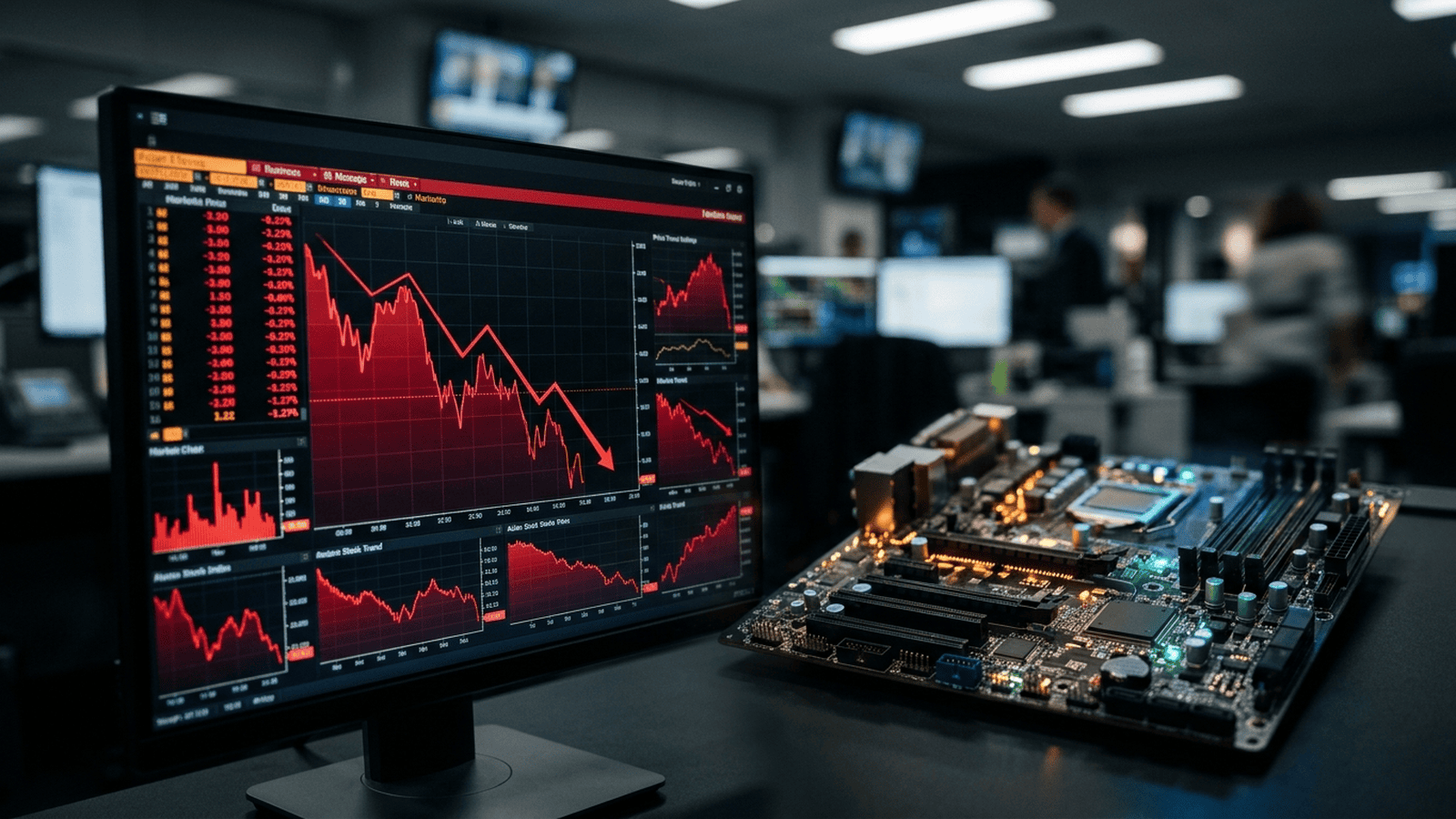
Asian shares fell as investors sold AI and chip stocks, extending a broad decline on Wall Street. Japan’s Nikkei and South Korea’s Kospi each lost 4.5%, while the S&P 500 dropped 2% for a sixth straight loss. Investors have worried that AI-related shares became overpriced and that the boom may not last. Anthropic’s debut offered a counterpoint: its shares finished 17.1% above their $83 offering price, but the rally did not stop the wider slide. Nvidia reversed an early gain and ended lower, with the report also citing CEO Jensen Huang’s sudden resignation as a factor. The account reports market price effects, but no new rules, fees, paperwork, or deadlines.
TLDR: Markets across Asia and the United States retreated as investors weighed AI growth against concerns that related stock prices had climbed too high. Anthropic’s strong debut was not enough to halt losses, and the report identifies no new policy requirements or deadlines.
Asian markets fell Friday as investors sold shares tied to artificial intelligence and computer chips, extending a retreat that had already pushed major U.S. indexes lower. The declines showed that confidence in the technology’s promise has not removed concerns about stock prices or the pace of the AI boom.
The immediate rationale was market concern that AI-related shares had become too expensive, alongside doubts about whether the boom could continue. Those are the reasons described in the market report, not a government policy rationale. The price declines offered a direct response to that uncertainty: investors marked down the value of shares they viewed as exposed to it.
Japan’s Nikkei 225 fell 4.5% in morning trading to 56,775.04. South Korea’s Kospi also dropped 4.5%, to 4,905.20. Australia’s S&P/ASX 200 declined 1.6% to 8,594.10, while Hong Kong’s Hang Seng lost nearly 2% to 22,393.93. The Shanghai Composite fell 1.7% to 3,515.87.
The regional selling reached prominent technology names. Advantest and SoftBank Group fell in Tokyo, Samsung Electronics declined in South Korea, and Tencent was among the Chinese companies affected. These moves made the change in investor sentiment plain across markets and companies linked to AI or chips. The report did not give individual share-price changes for those firms.
Wall Street had already experienced a broad decline. The S&P 500 fell 2% for a sixth straight loss, dropping 147.80 points to 7,175.83. The Dow Jones Industrial Average lost 1,101.11 points, or 2.2%, to 49,097.06. The Nasdaq composite sank 550.69 points, or 2.3%, to 23,879.20.
Those losses followed a sharp but short-lived lift after Anthropic began trading on the Nasdaq. The company behind the Claude AI chatbot sold shares at $83 apiece in its initial public offering. The S&P 500 rose as much as 1.3% after the offering, and Anthropic shares quickly climbed above $115 after trading began shortly before noon. The shares later gave back part of that gain, ending at $97.17, still 17.1% above the offering price.
Anthropic’s strong debut appeared to show that investors still had faith in the AI industry. But the broader decline showed that one successful offering did not settle questions about valuations across the sector. The industry had recently faced steep drops after investors worried that prices had risen too far in the rush to buy into the technology. The report described the offering as a needed boost after those losses, but the boost did not prevent another market decline.
Nvidia’s trading captured the turn in sentiment. Its shares gained as much as 4.7% early in the session, then reversed and finished down 3.3%. The report said the sudden resignation of CEO Jensen Huang added to the damage. Huang had been one of the industry’s leading advocates and had used some of Nvidia’s large profits to fund further growth. The report did not provide details about the circumstances of his resignation.
The pattern is a reminder that investor confidence can move quickly in both directions. A high-profile public offering can attract buyers, while concern about prices, the outlook for AI, or company leadership can weigh on the same market. The declines do not by themselves establish that the AI boom is over. They do show that investors are reassessing the value of companies whose fortunes are tied to the technology.
Other market measures moved as well, though not all in the same direction. The yield on the 10-year Treasury fell to 5.04% from 5.07% Wednesday. U.S. crude rose 0.38% to $83.53 a barrel, and Brent crude edged up 0.40% to $92.35. The U.S. dollar slipped to 159.22 Japanese yen from 159.60 yen, while the euro edged down to $1.0970 from $1.0973.
The practical impact reported was on market prices: technology and chip shares fell, and major indexes in Asia and the United States recorded losses. The excerpt gives no new fees, paperwork, compliance rules, enforcement actions, or deadlines, and identifies no government policy change. Investors in the affected markets are directly exposed to these price moves, but the report does not quantify individual or household losses. The market’s next steps are further trading and reassessment; no formal oversight process or deadline is described. The figures provide a clear record of the session, while the market’s direction remains uncertain.

Miles Harrington serves as the Senior Correspondent for Federal Systems & Executive Power at Just Right News, where he brings a disciplined, constitutionalist lens to the inner workings of the American government. With a focus on the mechanics of the federal bureaucracy and the limits of executive authority, Harrington has established himself as a vital voice for readers who value transparency, accountability, and the preservation of the separation of powers.
A native of Richmond, Virginia, Harrington’s perspective is deeply rooted in the traditions of the Old Dominion. Growing up in a city defined by its historical significance and its role as a center of American jurisprudence, he developed an early appreciation for the foundational principles of the Republic. His upbringing in Richmond—a place where the legacy of the Founding Fathers is woven into the landscape—instilled in him a belief that the federal government should remain within its constitutional bounds. This background informs his skepticism of centralized overreach and his commitment to reporting on the ways in which the administrative state impacts the lives of everyday citizens.
In his current role, Harrington specializes in the complexities of federal systems. He doesn’t just report on the headlines of the day; he digs into the structural shifts within the executive branch that often go unnoticed by the mainstream press. Whether he is analyzing the implications of a new federal regulation or investigating the expansion of agency jurisdiction, his work is characterized by a rigorous adherence to the facts and a dedication to the rule of law.
Harrington is perhaps best known for his signature feature series, “How Washington Works.” Through this ongoing project, he demystifies the often-opaque processes of the nation’s capital, pulling back the curtain on the “Deep State” and the unelected officials who wield significant influence over national policy. By breaking down complex legislative maneuvers and executive orders, he empowers Just Right News readers to understand the true levers of power in Washington. His reporting serves as a necessary check on the federal government, ensuring that the actions of those in power are held up to the light of public scrutiny.
Now based in Washington, D.C., Harrington operates at the epicenter of the political world, yet he remains intentionally distanced from the “Beltway bubble.” His proximity to the halls of power allows him to maintain a robust network of sources across the federal landscape, but his heart remains in the principled conservatism of his Virginia roots. He views his role not merely as a reporter, but as a steward of the public trust, dedicated to providing the clarity and context that conservative voters need to navigate an increasingly complex political environment.
Through his sharp analysis and unwavering commitment to the truth, Miles Harrington continues to be a cornerstone of the Just Right News team. His work ensures that the principles of limited government and executive restraint remain at the forefront of the national conversation, providing a crucial service to those who believe in a government that is truly of, by, and for the people.