

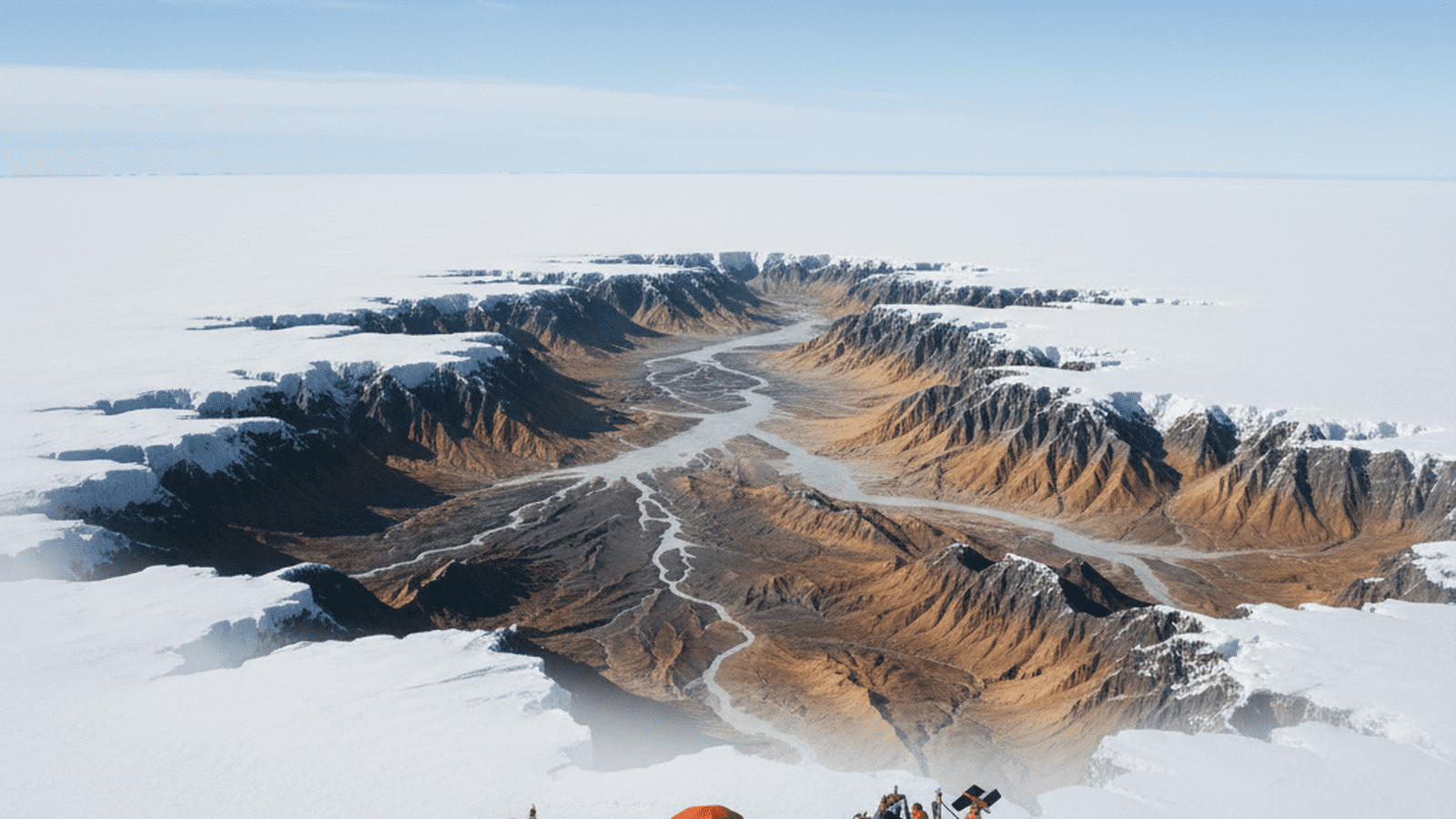
Researchers have identified a massive, ancient landscape of hills and valleys preserved beneath the East Antarctic Ice Sheet for millions of years. The discovery, made using satellite data and radio-echo sounding, provides a rare glimpse into the continent’s topographical history before it was covered in ice.
TLDR: Scientists have discovered a 32,000-square-kilometer landscape hidden under the East Antarctic Ice Sheet. Carved by ancient rivers, this “time capsule” has remained unchanged for at least 14 million years. The find helps researchers model how the ice sheet might react to future global warming and sea-level rise.
A team of international scientists, led by researchers from Durham and Newcastle Universities, has uncovered a vast, hidden landscape of valleys and ridges preserved for millions of years beneath the East Antarctic Ice Sheet. This remarkable discovery reveals a topography shaped by ancient rivers during a period when the continent’s climate was significantly warmer, long before it was encased in its current frozen shroud. The landmass, situated within the Aurora-Schmidt basins inland from the Wilkes and Denman glaciers, covers an area of approximately 32,000 square kilometers—a region roughly the size of Belgium.
To map this subterranean world, the research team utilized an innovative combination of satellite imagery and radio-echo sounding data. Radio-echo sounding involves sending radio waves through the thick ice and measuring the reflections that bounce off the bedrock below. While this technique provides a direct look at the terrain, the sheer scale of Antarctica makes comprehensive aerial surveys difficult. To fill the gaps, the scientists analyzed subtle textures and “ripples” on the surface of the ice sheet, which act as a topographical mirror of the underlying terrain. By synthesizing these data sets, the team visualized a landscape that has been shielded from the atmosphere and the erosive forces of the elements for at least 14 million years, and potentially much longer.
The identified landscape consists of three distinct highland blocks separated by deep, U-shaped valleys. The morphology of these features strongly suggests they were originally carved by river systems during the mid-Cenozoic era. At that time, the Antarctic climate likely resembled the temperate highlands of modern-day Patagonia or the South Island of New Zealand, featuring lush vegetation and flowing water. The researchers believe that as the climate cooled, the East Antarctic Ice Sheet formed over this landscape and remained largely “cold-based.” In this state, the ice is frozen to the bedrock, preventing the sliding and grinding action that typically erodes sub-glacial rock into smooth plains.
This discovery is a significant breakthrough for glaciology because it provides a “time capsule” of the continent’s transition from a greenhouse world to an icehouse world. The preservation of such delicate fluvial features suggests that the ice in this specific region has remained remarkably stable despite numerous cycles of global warming and cooling over the past several million years. Understanding the history of this stability is critical for predicting how the East Antarctic Ice Sheet—the largest ice mass on Earth—will respond to modern anthropogenic climate change.
The topography of the bedrock plays a fundamental role in determining the speed and direction of ice flow toward the ocean. Deep valleys can act as conduits for ice, while highland blocks can serve as anchors that stabilize the sheet. If the ice above this newly discovered landscape were to thin significantly due to rising temperatures, the underlying terrain would influence how quickly the ice retreats. This region was previously one of the least understood parts of the continent, often referred to as a “ghost” area in glaciological maps due to the lack of direct measurements.
Future research will focus on gathering more detailed seismic data to refine the maps of these ancient valleys and ridges. There is also growing interest in the scientific community regarding the possibility of drilling through the two kilometers of ice to collect sediment samples directly from the buried riverbeds. Such physical evidence would provide a definitive record of the biological and atmospheric conditions that existed when the landscape was last exposed to the sun, offering a vital benchmark for how the region might change as the planet continues to warm.

Mark Davis serves as the Senior Correspondent for Energy, Climate, and Resource Economics at Just Right News. In an era where the conversation around the environment is often dominated by alarmism and top-down mandates, Mark provides a vital, market-oriented perspective on the complex forces shaping our world. As the lead voice behind the acclaimed feature series “Power and the Planet,” he explores the intersection of environmental policy, global energy markets, and the fundamental economic principles that sustain modern civilization.
Mark’s pragmatic approach to resource management was forged in the high desert of his hometown, Albuquerque, New Mexico. Growing up in a region defined by both its breathtaking natural beauty and its rugged, resource-dependent landscape, he developed an early appreciation for the delicate balance between conservation and utilization. New Mexico’s unique position as a hub for both traditional energy production and cutting-edge scientific research provided Mark with a front-row seat to the evolution of the American energy sector. This upbringing instilled in him a deep-seated belief that true environmental stewardship is inseparable from economic prosperity and technological innovation.
Now based in Boulder, Colorado, Mark operates from the heart of the nation’s climate research community. While Boulder is often seen as a bastion of environmental idealism, Mark utilizes his post to provide a necessary counterweight, grounded in the realities of resource economics. He understands that energy policy does not exist in a vacuum; it has tangible consequences for the American taxpayer, the stability of the national power grid, and the strength of the domestic manufacturing sector. By reporting from the front lines of the climate debate, he is able to challenge prevailing narratives with hard data and a commitment to the principles of the free market.
Throughout his tenure at Just Right News, Mark has distinguished himself by focusing on the “Resource Economics” aspect of his beat. He frequently highlights the hidden costs of rapid energy transitions and advocates for an “all-of-the-above” energy strategy that prioritizes American energy independence. His work often shines a light on the geopolitical implications of resource scarcity, arguing that a secure nation must first be an energy-secure nation. Whether he is analyzing the impact of federal land-use regulations or investigating the supply chains required for new technologies, Mark remains focused on how policy decisions affect the lives and livelihoods of everyday citizens.
In “Power and the Planet,” Mark continues to bridge the gap between complex scientific concepts and the economic realities facing the country. He rejects the false choice between a healthy environment and a thriving economy, instead seeking out solutions that leverage American ingenuity and private-sector competition. For Mark, reporting on the climate is not about following the latest trends, but about ensuring that the conversation remains tethered to the foundational values of liberty, property rights, and fiscal responsibility. His contributions ensure that Just Right News readers receive a comprehensive, clear-eyed view of the challenges and opportunities defining the future of our planet.