

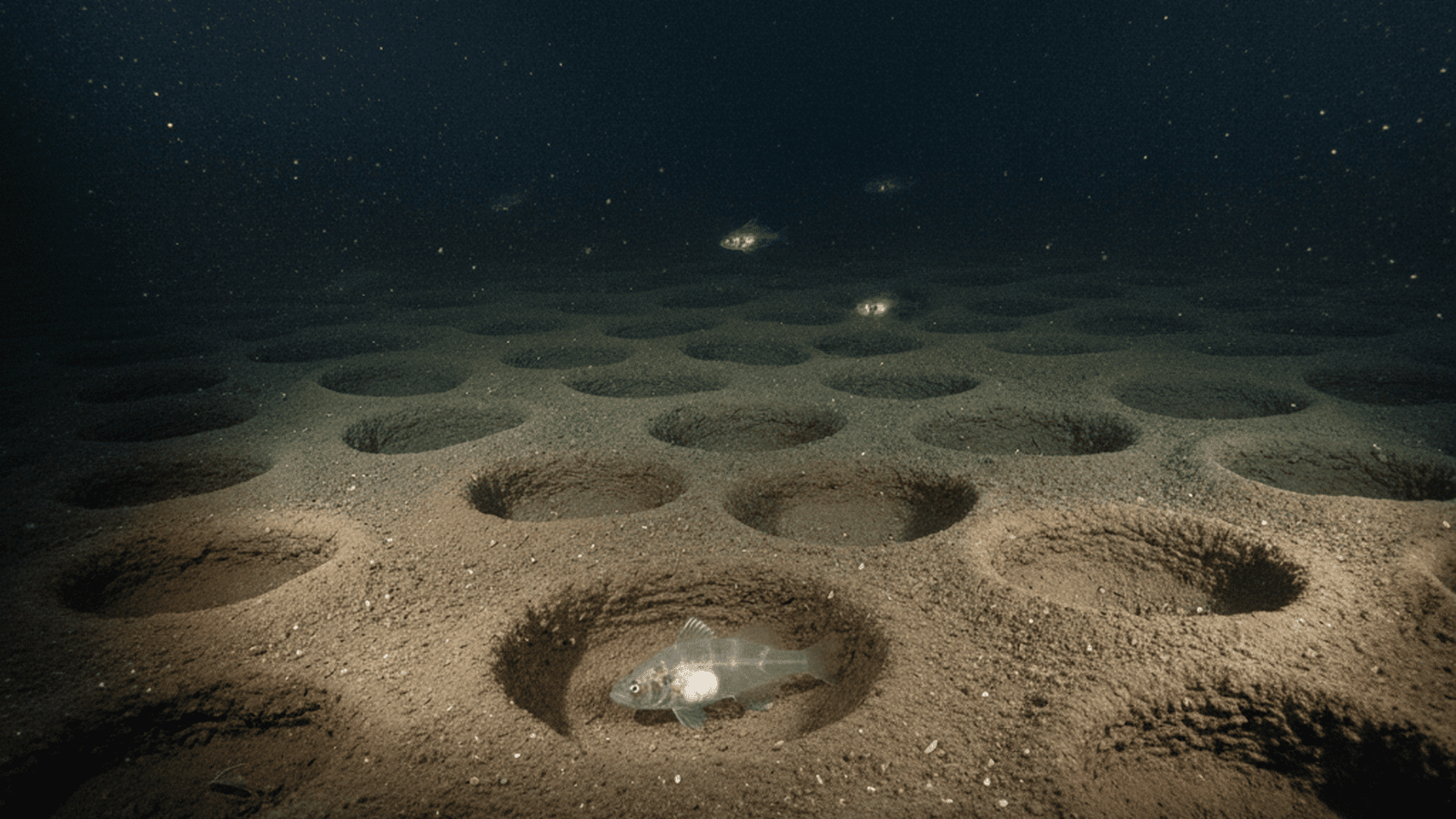
Scientists have discovered a massive breeding colony of icefish in the Weddell Sea, Antarctica, covering 240 square kilometers. The colony contains an estimated 60 million active nests, making it the largest known contiguous fish breeding site in the world.
TLDR: Researchers using the Polarstern icebreaker found a 240-square-kilometer icefish nesting colony in the Weddell Sea. With 60 million nests, this discovery highlights the unexpected scale of deep-sea ecosystems and the importance of the Weddell Sea as a critical biological hotspot for predators like seals.
In early 2021, a team of researchers from the Alfred Wegener Institute (AWI), Helmholtz Centre for Polar and Marine Research, embarked on an expedition to the Weddell Sea aboard the research icebreaker Polarstern. Their primary objective was to study the seafloor’s biodiversity, but what they encountered was far beyond their expectations. Using the Ocean Floor Observation and Bathymetry System (OFOBS)—a sophisticated camera platform towed behind the ship—the team discovered a massive, contiguous breeding colony of icefish (Neopagetopsis ionah) covering an estimated 240 square kilometers. This site, located at depths between 420 and 535 meters, is now recognized as the largest known fish breeding colony in the world, containing approximately 60 million active nests.
The discovery was made during a routine survey of the Filchner Trough. As the OFOBS transmitted real-time high-resolution imagery to the ship, the researchers were stunned to see a landscape dominated by circular depressions in the silty sediment. Each nest measured about 75 centimeters in diameter and 15 centimeters deep. Most of these nests were occupied by a single adult icefish, which stood guard over tens of thousands of eggs. The density of the nests was staggering, averaging one nest for every four square meters, creating a vast, repetitive pattern across the seafloor that seemed to stretch indefinitely.
The Jonah’s icefish is a member of the Channichthyidae family, a group of fish uniquely adapted to the extreme conditions of the Southern Ocean. These “white-blooded” fish are the only known vertebrates to lack hemoglobin in their blood. This adaptation, while seemingly a disadvantage, allows their blood to remain less viscous at sub-freezing temperatures, reducing the energy required for circulation. Instead of hemoglobin, they rely on the high oxygen solubility of the cold Antarctic waters, which is absorbed directly through their skin and gills. Their translucent appearance and visible internal organs make them a biological marvel of evolution in extreme environments.
The location of this colony is not accidental. Data collected by the Polarstern’s sensors revealed that the bottom water in this specific area of the Weddell Sea is slightly warmer—by about 2 degrees Celsius—than the surrounding waters. This temperature anomaly is attributed to the presence of Modified Upper Circumpolar Deep Water, which flows onto the continental shelf. This warmer water likely provides an ideal environment for the incubation of eggs and the growth of larvae, making the site a critical reproductive hub for the species.
The ecological significance of this colony extends far beyond the icefish themselves. The sheer volume of biomass—estimated at over 60,000 tons—supports a complex and thriving ecosystem. Satellite tracking of Weddell seals in the region has shown that these predators frequently dive to the exact depths and locations of the icefish nests. This suggests that the colony serves as a vital foraging ground, providing a concentrated food source in an otherwise nutrient-limited deep-sea environment. The presence of numerous fish carcasses near the colony also indicates that it supports a variety of scavengers, including starfish, brittle stars, and sea cucumbers.
This discovery provides a powerful argument for the protection of the Weddell Sea. The area is currently under consideration for the establishment of a Marine Protected Area (MPA) by the Commission for the Conservation of Antarctic Marine Living Resources (CCAMLR). Such protections are essential to safeguard this unique and vulnerable ecosystem from potential threats like climate change and commercial fishing. The existence of such a massive, previously unknown biological feature highlights how much of the deep ocean remains unexplored and the importance of continued scientific investment in polar research. Future studies will utilize long-term seafloor observatories to monitor the colony’s health and its response to shifting oceanographic conditions.

Rachel Vaughn serves as a Senior Correspondent for Just Right News, where she leads the network’s coverage of Global Health, Climate, and Development. With a career defined by intellectual rigor and a commitment to principled reporting, Rachel provides a vital conservative perspective on some of the most complex and high-stakes issues facing the world today. Her work is characterized by a refusal to accept bureaucratic narratives at face value, focusing instead on how international policies impact national sovereignty, individual liberty, and the American taxpayer.
Raised in New Haven, Connecticut, Rachel grew up in an environment dominated by elite academic discourse. This upbringing provided her with a front-row seat to the inner workings of the American establishment, but it also instilled in her a healthy skepticism of the “ivory tower” consensus. She learned early on that while academic theories may sound promising in a lecture hall, they often fail to account for the practical realities of the working class. This background drives her to bridge the gap between high-level policy discussions and the common-sense concerns of everyday citizens, ensuring that her reporting remains grounded and accessible.
Now based in Burlington, Vermont, Rachel operates from a unique vantage point within one of the nation’s most progressive political landscapes. Living and working in a region that often serves as a testing ground for radical social and environmental experiments allows her to witness the real-world consequences of these policies firsthand. From her base in the Green Mountain State, she provides Just Right News readers with essential “boots on the ground” reporting, documenting the friction between local mandates and the constitutional freedoms of the individual. Her presence in Burlington ensures that her critiques of globalist agendas are informed by a direct understanding of how those ideologies manifest at the local level.
In her acclaimed feature series, “Planetary Stakes,” Rachel explores the intersection of international development and environmental stewardship. She rejects the alarmism often found in mainstream media, opting instead for a sober analysis of the economic and geopolitical costs of global climate agreements. Her reporting frequently highlights the importance of market-driven innovation and the role of American leadership in fostering global health without ceding authority to unelected international bodies. Through “Planetary Stakes,” she has become a leading voice for those who believe that true conservation and public health are best achieved through transparency, accountability, and the protection of private property rights.
Throughout her tenure at Just Right News, Rachel has distinguished herself as a journalist who is unafraid to ask difficult questions of global institutions. Whether she is investigating the influence of non-governmental organizations on domestic policy or analyzing the fiscal transparency of international health initiatives, her goal remains the same: to provide her audience with the facts necessary to navigate an increasingly interconnected world. Her blend of East Coast intellectual heritage and her current immersion in the political heart of the Northeast makes her an indispensable asset to the newsroom and a trusted source for readers seeking a principled, conservative take on the issues that define our era.