

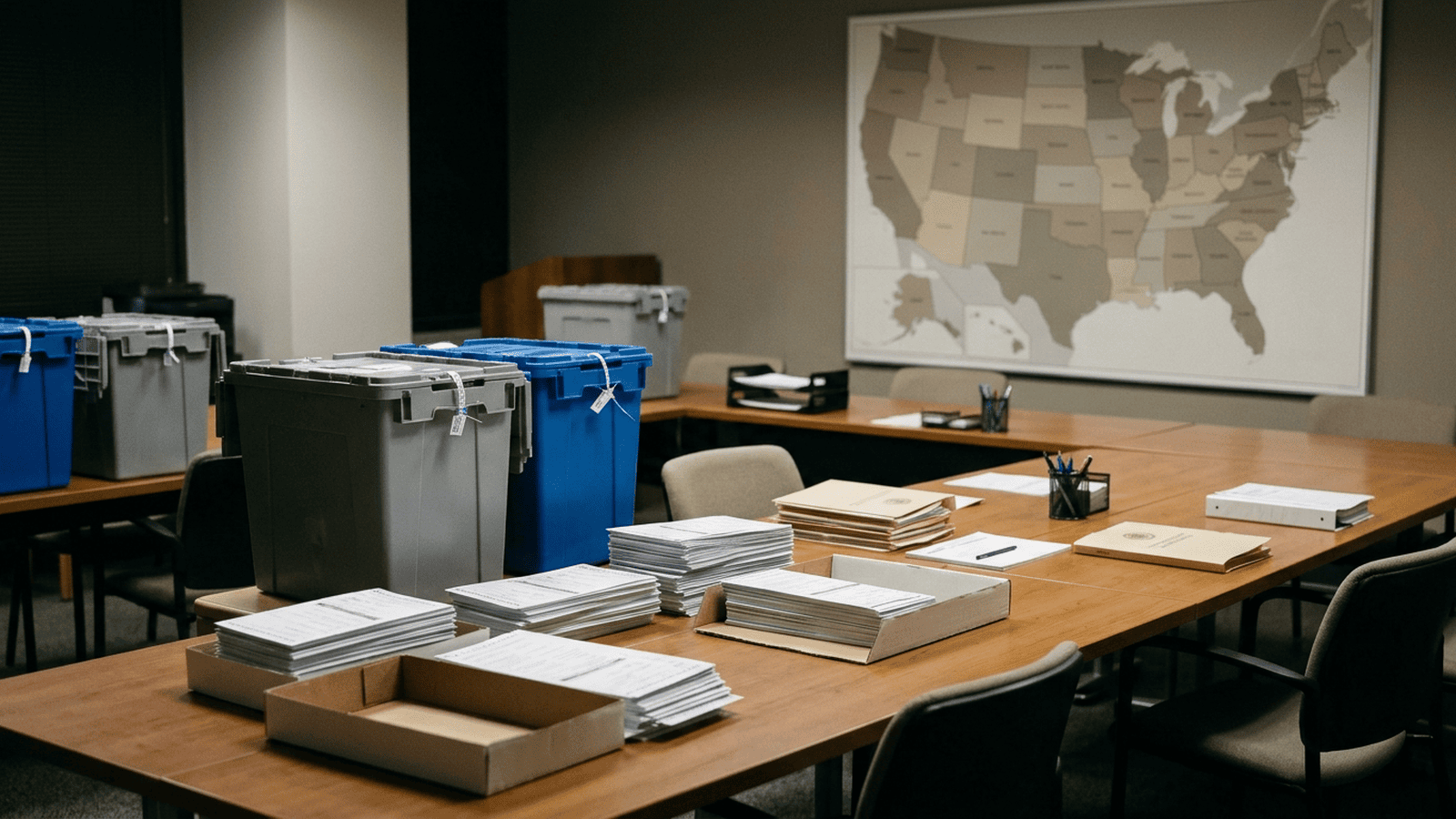
Democrats are projected to control the Senate with at least 55 seats and have picked up dozens of House seats, but one Senate race and more than a dozen House contests remain unresolved. Alaska’s ranked-choice counting may require another round, with the Senate result not expected until 15 days after Election Day. Minnesota law permits a recount request when a candidate trails by less than 0.25 percentage points. Louisiana’s 6th District and 5th District races are headed to runoffs, with the latter scheduled for December. Outstanding counts, possible recount procedures, and runoff votes will determine the remaining winners and the final margins in Congress.
TLDR: Democrats are projected to hold at least 55 Senate seats and gain dozens in the House, while one Senate contest and more than a dozen House races remain uncalled. Ranked-choice tabulation, a possible Minnesota recount, outstanding ballots, and Louisiana runoffs are among the remaining steps before the final congressional margins are known.
The 2026 midterm elections have shifted control of the Senate to Democrats, who are also projected to pick up dozens of House seats. But the final balance of Congress is not settled. As of Thursday, November 12, one Senate race and more than a dozen House races had no projected winner, leaving close contests and outstanding ballots to resolve.
No broad policy change is at issue. Some outcomes remain open because ballots still need to be counted, Alaska uses ranked-choice voting, and two Louisiana House races are headed to runoffs.
Democrats are set to begin next year with at least 55 Senate seats, compared with 44 for Republicans, while the remaining Senate contest is in Alaska. Republican Sen. Dan Sullivan is running against Democrat Mary Peltola in a razor-thin race. Both campaigns say they have the advantage, but the result is not yet projected.
Alaska’s ranked-choice system can require another round of tabulation if no candidate receives a majority as the first choice. In that case, the last-place candidate is eliminated and ballots are counted again according to voters’ next preferences. The final result is not expected until 15 days after Election Day. The delay is part of how the state’s system determines a winner, rather than a result that can be declared from the first count alone.
Democrats flipped several House seats, including districts that had favored Republicans. Some outstanding contests remain close enough to change the size of the parties’ delegations. Others are affected by redistricting or local political conditions. The unfinished map includes both competitive races and contests whose districts still lean toward one party.
In Louisiana’s 6th District, Democrat Chauna Banks and Republican Blake Miguez are headed to a runoff after neither won a majority in the state’s “jungle” primary. The district, which is majority-Black, was redrawn after the Supreme Court voided the state’s maps, finding that mapmakers relied too heavily on race and narrowing the Voting Rights Act. The new district is significantly redder than before. The runoff will decide who represents it, but no date is given for that vote.
Several Republican-held seats remain unprojected. In Colorado’s 4th District, Republican Rep. Lauren Boebert faces Democrat Eileen Laubacher. Boebert moved to the district two years ago after narrowly winning reelection in a more competitive district in 2022. In Minnesota’s 1st District, Republican Rep. Brad Finstad faces Democrat Jake Johnson. Finstad won by 17.2 points in 2024, but this year’s contest is tight.
Minnesota law allows a candidate who is behind by less than 0.25 percentage points to request a recount. That is a defined threshold, not an automatic recount, and there is no word on whether either campaign has requested one. In Tennessee’s 4th District, Republican Rep. Scott DesJarlais faces Democrat Victoria Broderick in a district made somewhat less Republican through redistricting. North Carolina has several unresolved contests, including Republican-held seats represented by Greg Murphy, Virginia Foxx, David Rouzer and Pat Harrigan.
North Carolina’s 3rd District became slightly bluer after last year’s redistricting but still favors Republicans. Tennessee’s 4th remains a red district despite becoming somewhat less so. Foxx, first elected more than 20 years ago, is the longest-serving member of North Carolina’s congressional delegation. Democrats flipped several House seats and a Senate seat in the state during the midterms.
Other unresolved House races include Alaska’s at-large district, where Republican Rep. Nick Begich faces independent Bill Hill and several other candidates. Hill has been endorsed by Democrats. Alaska’s ranked-choice process may require further tabulation there as well. In California’s 4th District, longtime Democratic Rep. Mike Thompson faces fellow Democrat Eric Jones, so the result will not affect the party balance in Congress. California’s 23rd District, where Republican Jay Obernolte faces Democrat Tessa Hodge, remains unresolved.
Louisiana’s 5th District is also headed to a December runoff. Democrat Patricia Moore and Republican Gabe Firment will compete for the seat, currently held by Republican Julia Letlow. Letlow was elected to the Senate this week. The runoff adds another step before the House seat is settled, but no date beyond December is specified.
For voters and candidates in these races, the practical impact is continued uncertainty while ballots are counted. Alaska may need further ranked-choice tabulation, Minnesota candidates may request a recount under the state’s margin rule, and Louisiana voters will have runoff elections. The account describes no fees, special forms or broader compliance requirements. Alaska’s Senate result is not expected until 15 days after Election Day, and the Louisiana 5th District runoff is set for December. Timing for the other outstanding counts is not specified.
The next steps are the remaining ballot counts, any eligible recount request, Alaska’s further tabulation if required, and the Louisiana runoffs. These steps will establish the winners and the final congressional margins. The count remains incomplete, and no further assurances about the outcome are available.

Julie Harris serves as a Staff Writer for Just Right News, where she tackles some of the most pressing and complex issues facing the nation today. As the lead reporter for the Migration, Demographics & Cultural Shifts beat, Julie provides a grounded, principled perspective on how the movement of people and the changing makeup of communities are reshaping the American landscape. Her work is defined by a commitment to exploring the long-term consequences of social change, prioritizing the stability of local institutions and the preservation of national identity.
Her deep understanding of these issues is rooted in her upbringing in Tucson, Arizona. Growing up in a prominent border state, Julie witnessed firsthand the intricate realities of migration and the profound impact it has on local infrastructure, law enforcement, and the social fabric. This early exposure instilled in her a respect for the rule of law and a keen awareness of the challenges that arise when federal policies fail to align with the needs of border communities. Her reporting often reflects this lived experience, bringing a necessary level of nuance to topics that are often treated with abstraction in coastal newsrooms.
Now based in Santa Fe, New Mexico, Julie continues to report from the heart of the American Southwest. Her location provides a unique vantage point to observe the intersection of traditional regional cultures and the modern shifts brought about by both internal and external migration. In Santa Fe, a city defined by its rich history and distinct cultural heritage, she finds a perfect environment to explore how communities strive to maintain their character while navigating the pressures of a rapidly changing world. This perspective allows her to bridge the gap between policy debates in Washington and the reality of life in the high desert.
At Just Right News, Julie’s work is characterized by a dedication to examining the data and the human stories that define the “New Mosaic” of America. Her signature feature series, “The New Mosaic,” has become a cornerstone of her reporting. Through this series, Julie explores the evolving social architecture of the United States, documenting how shifts in population affect everything from local economies to the political landscape. She brings a critical eye to the narrative of demographic inevitability, instead asking how these shifts impact the average citizen’s sense of belonging and the integrity of the American social contract.
Julie’s background and her dedication to conservative principles make her a vital voice in contemporary journalism. She understands that demographics are more than just numbers on a spreadsheet; they represent the future of the American family and the nation’s enduring legacy. Through her diligent reporting and insightful analysis, Julie Harris ensures that her readers are informed about the forces shaping their world, providing a perspective that is as thoughtful as it is necessary for the modern era.