

Flávio Bolsonaro arrived in Miami two days after Brazil’s runoff election and then challenged Lula’s victory while presenting himself as an opposition leader in exile. The Trump administration approved temporary humanitarian parole after Secretary of State Marco Rubio recommended it, though the account gives no fuller explanation of the humanitarian basis. In Brazil, three investigations concern a planned film investment, an alleged connection to an online betting business, and statements about Lula; none had resulted in prosecution at the time reported. The case also raises questions about U.S. political support, trade pressure, and influence over Brazil’s courts and resources. Brazilian courts and the Federal Police retain responsibility for legal questions, with no timetable for next steps provided.
TLDR: Flávio Bolsonaro’s move to Miami followed Lula’s reelection and came as three Brazilian investigations remained active, though none had produced a prosecution in the account. His temporary U.S. parole and the Trump administration’s political posture have brought questions of legal accountability and foreign influence into sharper view.
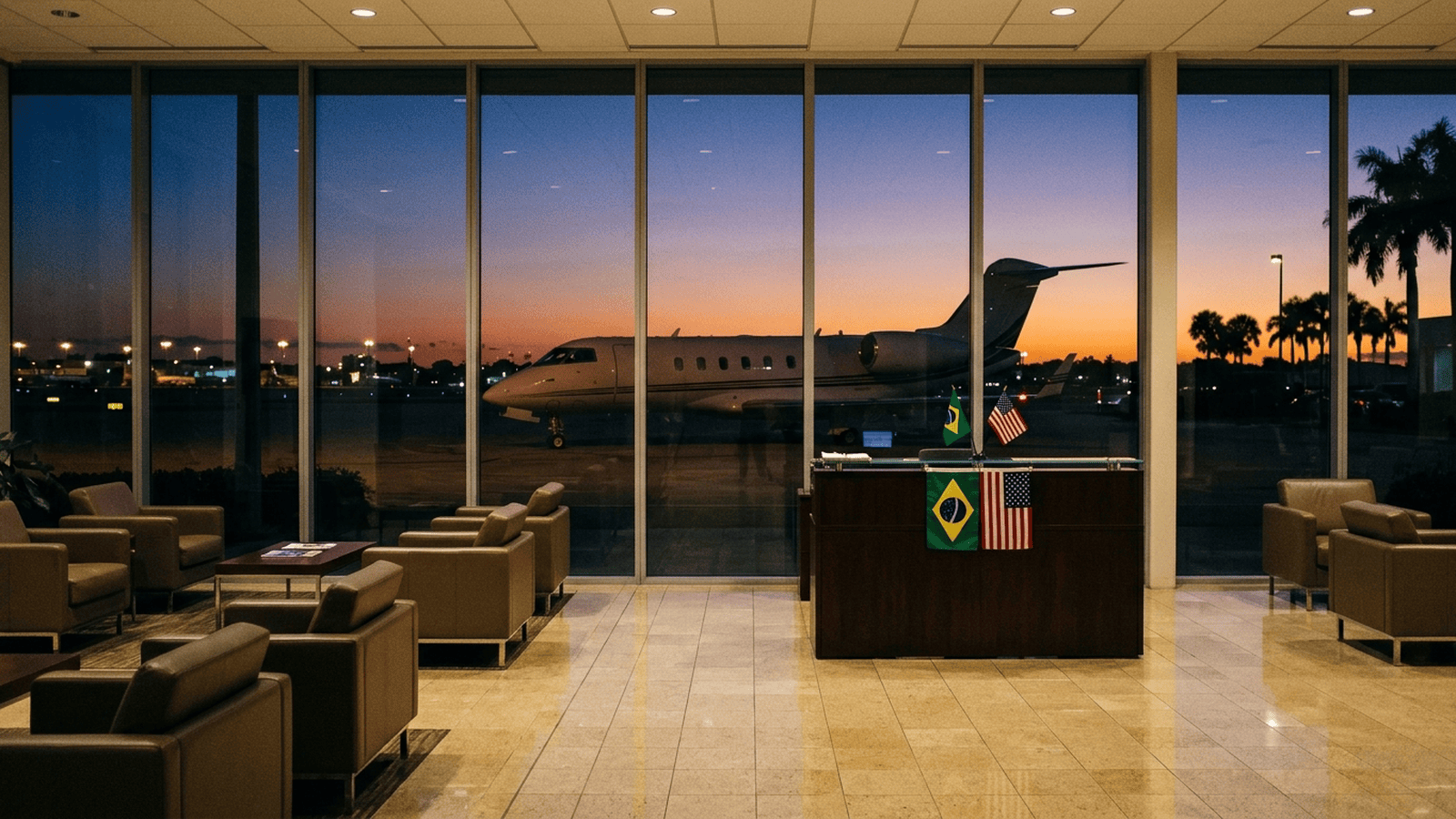
Flávio Bolsonaro’s arrival in Miami after Brazil’s runoff election turned a domestic political dispute into a test of cross-border influence. Two days after President Luiz Inácio Lula da Silva’s reelection, Flávio reached the United States aboard a private jet after traveling through several countries. The account says officials close to Donald Trump helped him enter the country. Flávio then called himself Brazil’s “president-elect,” a “leader,” and the head of an opposition in exile. He rejected Lula’s victory as illegitimate.
The stated U.S. reason for admitting Flávio was humanitarian parole. Secretary of State Marco Rubio recommended that Flávio and his family receive the temporary immigration arrangement, and Trump approved it. The account gives no fuller explanation of the humanitarian basis. The reported mechanism is clear, but the specific circumstances used to justify it are not.
Flávio said he left Brazil for the country’s sake. His departure also came as his legal position changed. Losing his Senate seat meant losing the parliamentary immunity attached to it. That left him more exposed to police questioning and possible prosecution. The account describes his 2026 campaign as a last-chance effort and says fear of arrest was a factor in his decision to leave. These are reported assessments, not findings of guilt.
Three investigations before Brazil’s Supreme Federal Court form the main legal backdrop. None had resulted in prosecution at the time described. The first concerns money for a planned film about Flávio’s father, former president Jair Bolsonaro. Jair is serving a 27-year prison sentence for attempting to overturn the 2022 election he lost to Lula.
Flávio negotiated a proposed $24 million investment from Daniel Vorcaro, then the owner of Banco Master. The bank later collapsed amid revelations of alleged financial fraud. Federal Police say about $12.3 million of the promised investment went to a U.S. account linked to associates of Flávio’s brother Eduardo. Investigators suspect that some of the money may have been diverted, possibly to support Eduardo’s life in the United States. According to the account, the production company has not provided a detailed record of how the money was spent. Flávio was formally placed under investigation in July 2026 over suspected money laundering, corruption, and illegal transfers abroad.
A second inquiry concerns Flávio’s relationship with Willer Tomaz, a lawyer and businessman. Police suspect Tomaz helped hide Flávio’s financial interest in an online betting business. Investigators found emails suggesting Flávio was listed as a privileged user on a bank account belonging to Alcazar Holdings. Tomaz controls the company, which is linked to the holding company behind Rede Loto. Police also found that companies linked to Tomaz paid for private flights taken by Flávio and his family.
The third investigation began after Flávio posted claims on social media that Lula was involved in drug trafficking and money laundering. The statements prompted a criminal defamation inquiry. The account reports no charge or prosecution in that matter. The three inquiries mean continued scrutiny by police and courts, but they do not prove the allegations.
The political dispute reaches beyond those cases. Trump questioned the legitimacy of Lula’s election and said Flávio could stay in the United States “as long as he wants.” In July 2025, Trump imposed a 50 percent tariff on Brazilian imports while demanding that Jair Bolsonaro be freed. The account says the pressure did not prevent Jair’s sentence and imprisonment. It also gave Lula an argument that foreign pressure threatened Brazil’s sovereignty and judicial process.
The account describes another U.S. interest: the Trump administration saw Flávio as more open to U.S. influence over Brazil’s rare earth minerals and other resources than Lula. Lula insists on conditions for foreign involvement in key areas. From Miami, Flávio can lobby U.S. officials and appeal to conservative media while portraying Brazil’s judiciary as politically driven. Trump officials have not publicly endorsed Flávio’s claim to be Brazil’s legitimate president, the account says. Still, the administration’s welcome gave him a platform.
The immediate policy details are limited. Flávio and his family entered under temporary humanitarian parole, but the account provides no fee, application documents, compliance schedule, or expiration date. It also gives no timetable for further proceedings. The investigations could involve questioning and court action in Brazil. In the first inquiry, investigators are examining an unaccounted-for portion of a proposed $24 million investment. In the second, they are examining records tied to private flights and a betting-company account.
Brazil’s Foreign Ministry summoned Argentina’s diplomatic representative to discuss Flávio’s passage through Argentina. The account leaves questions about his departure and any legal consequences to Brazil’s courts and Federal Police. Those authorities’ investigations and any further official review are the next steps, but no schedule or outcome is stated. For now, Flávio’s stay in Miami gives him room to make political claims from abroad while the legal inquiries remain unresolved.

Sophie Carter serves as a Staff Writer for Just Right News, where she anchors the outlet’s critical coverage of Elections, Influence, and Democracy Infrastructure. In an era where the mechanics of voting and the flow of political capital are under constant scrutiny, Sophie provides a steady, principled voice dedicated to the preservation of American institutional integrity and the rule of law.
Raised in Charlotte, North Carolina, Sophie’s perspective was forged in a community that balances rapid modern growth with a deep respect for tradition and civic duty. Growing up in the Queen City, she witnessed firsthand how a robust local culture depends on the trust between the citizen and the state. This upbringing instilled in her a foundational belief that the right to vote is a sacred trust—one that must be protected from both administrative overreach and the encroaching influence of special interest groups. Her reporting reflects these North Carolina roots, emphasizing the importance of community-led governance and the preservation of the individual’s voice in the face of nationalized political movements.
Now based in Atlanta, Georgia, Sophie operates from the heart of one of the nation’s most pivotal and contested political landscapes. Her location allows her to report from the front lines of the debate over election security, legislative reform, and the modernization of voting systems. For Sophie, the “infrastructure” of democracy is not merely a matter of machines and ballots; it is the collection of laws, people, and transparent processes required to maintain public confidence. Her work often highlights the necessity of clear, enforceable standards that ensure every legal vote is counted fairly and that the machinery of our republic remains accountable to the taxpayers who fund it.
Central to her work at Just Right News is her acclaimed feature series, “The Price of a Vote.” Through this ongoing project, Sophie explores the complex web of influence that shapes modern campaigns and policy decisions. She delves into how high-level lobbying, non-governmental organizations, and shifting bureaucratic regulations impact the weight of an individual citizen’s ballot. By examining the financial and structural pressures placed on the electoral process, she provides readers with a comprehensive look at the forces vying for control over the American political system.
Sophie’s approach to journalism is rooted in a commitment to the constitutional framework. She views her role as a watchdog for the voter, ensuring that the systems meant to serve the public remain transparent and free from corruption. Whether she is analyzing the implementation of new voting technologies or investigating the influence of outside money on state-level policy, her work is characterized by a rigorous adherence to facts and a refusal to succumb to the sensationalism that often plagues modern political reporting.
At Just Right News, Sophie Carter continues to be a vital resource for readers who value clarity, conviction, and a defense of traditional American values. Her deep ties to the Southeast and her specialized focus on the mechanics of our republic make her an essential voice in the ongoing conversation about the future of American self-governance. Through her reporting, she remains dedicated to the idea that a secure and honest electoral system is the bedrock of a free and prosperous society.