

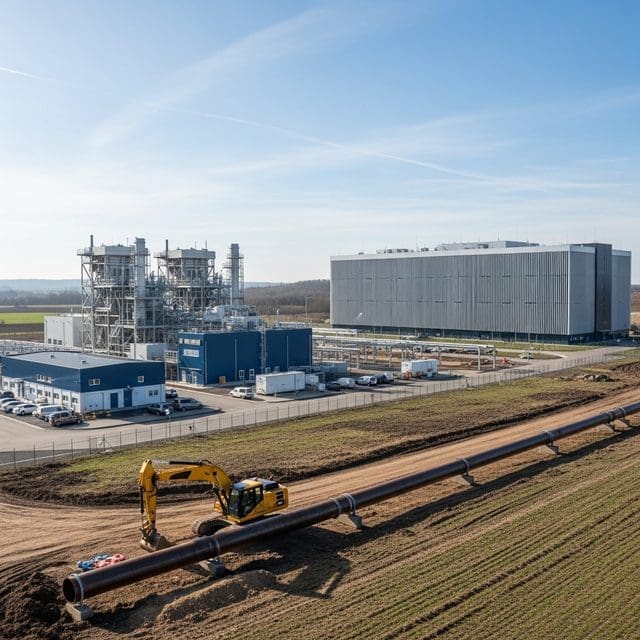
State regulators and governors are pivoting toward natural gas and infrastructure transparency as surging AI power demands collide with grid reliability concerns and rising consumer utility costs.
The rapid expansion of artificial intelligence and hyperscale data center infrastructure is forcing a collision between long-term climate aspirations and the immediate necessity of grid reliability. As national projections suggest U.S. data center power demand could triple by 2030 to as much as 106 gigawatts, state policymakers are increasingly turning to natural gas and pragmatic regulatory oversight to bridge the gap. This shift comes at a time when U.S. consumer sentiment has reached an all-time low due to economic concerns, and the S&P 500’s profit growth is being driven by a tech sector that requires massive, unfailing energy inputs.
In Pennsylvania, the Commonwealth Financing Authority recently approved approximately $1.4 million in Pipeline Investment Program (PIPE) grants to extend natural gas distribution into Bradford, Somerset, and Susquehanna counties. While these grants facilitate local access to homegrown Marcellus Shale gas for 131 homes and businesses, the program has evolved into a strategic tool for broader economic development. The PIPE program now explicitly supports large-scale residential conversions and combined heat and power projects. This infrastructure is becoming a critical anchor for industrial loads that require the steady, high-output energy that intermittent renewables cannot yet guarantee on a 24/7 basis.
This push for gas-fired reliability is mirrored in the Appalachian region, where the East Kentucky Power Cooperative (EKPC) has officially broken ground on Liberty Station, a $500 million natural gas-fired power plant in Casey County. Expected to be operational in late 2028, this 745 MW combined-cycle unit is a direct response to rising demand. To protect existing members, the Kentucky PSC approved a dedicated “Data Center Power” tariff for loads exceeding 15 MW. Crucially, any center requiring over 250 MW must now bring its own dedicated power-supply plan to the table, ensuring that the arrival of hyperscale computing does not degrade the reliability or affordability of the grid for the average taxpayer.
However, the thirst for energy is matched by a thirst for water, creating a new front for resource economics. The Susquehanna River Basin Commission (SRBC) has begun flagging data center development as a significant regulatory hurdle. While the SRBC continues to support the shale industry—approving 33 shale gas well pad water use permits in April 2026 alone—it is applying a more rigorous lens to the tech sector. With only one hyperscale facility currently permitted in the basin, the commission held public meetings in early 2026 to signal that future projects will face intense scientific reviews regarding water consumption for cooling. This adds a layer of complexity for firms like Amazon, Google, and Microsoft, who recently launched a Data Center Innovation Initiative to address these infrastructure challenges.
In New Jersey, Governor Mikie Sherrill has taken an aggressive stance on the economic fallout of this energy surge. By declaring a state of emergency on utility costs in January 2026, Sherrill froze near-term rate hikes and used emergency authority to fast-track new generation. Her strategy is notably non-ideological, directing regulators to accelerate solar and storage while simultaneously modernizing gas plants and waiving certain permitting rules to expand natural gas capacity. The Governor’s order also targets “ghost loads,” requiring utilities to disclose new large-scale interconnection requests that often linger in queues without public transparency.
This multi-state pivot reflects a growing realization that neighboring power grids cannot always be relied upon to share electricity during peak periods. As blackout risks rise and the gap between supply and demand narrows, the focus has shifted from slogans to the tangible trade-offs of energy policy. Whether through the expansion of Pennsylvania’s pipelines or Kentucky’s new gas turbines, the priority is clear: maintaining a functional economy requires an all-of-the-above approach that prioritizes cost and reliability over partisan preferences.

Mark Davis serves as the Senior Correspondent for Energy, Climate, and Resource Economics at Just Right News. In an era where the conversation around the environment is often dominated by alarmism and top-down mandates, Mark provides a vital, market-oriented perspective on the complex forces shaping our world. As the lead voice behind the acclaimed feature series “Power and the Planet,” he explores the intersection of environmental policy, global energy markets, and the fundamental economic principles that sustain modern civilization.
Mark’s pragmatic approach to resource management was forged in the high desert of his hometown, Albuquerque, New Mexico. Growing up in a region defined by both its breathtaking natural beauty and its rugged, resource-dependent landscape, he developed an early appreciation for the delicate balance between conservation and utilization. New Mexico’s unique position as a hub for both traditional energy production and cutting-edge scientific research provided Mark with a front-row seat to the evolution of the American energy sector. This upbringing instilled in him a deep-seated belief that true environmental stewardship is inseparable from economic prosperity and technological innovation.
Now based in Boulder, Colorado, Mark operates from the heart of the nation’s climate research community. While Boulder is often seen as a bastion of environmental idealism, Mark utilizes his post to provide a necessary counterweight, grounded in the realities of resource economics. He understands that energy policy does not exist in a vacuum; it has tangible consequences for the American taxpayer, the stability of the national power grid, and the strength of the domestic manufacturing sector. By reporting from the front lines of the climate debate, he is able to challenge prevailing narratives with hard data and a commitment to the principles of the free market.
Throughout his tenure at Just Right News, Mark has distinguished himself by focusing on the “Resource Economics” aspect of his beat. He frequently highlights the hidden costs of rapid energy transitions and advocates for an “all-of-the-above” energy strategy that prioritizes American energy independence. His work often shines a light on the geopolitical implications of resource scarcity, arguing that a secure nation must first be an energy-secure nation. Whether he is analyzing the impact of federal land-use regulations or investigating the supply chains required for new technologies, Mark remains focused on how policy decisions affect the lives and livelihoods of everyday citizens.
In “Power and the Planet,” Mark continues to bridge the gap between complex scientific concepts and the economic realities facing the country. He rejects the false choice between a healthy environment and a thriving economy, instead seeking out solutions that leverage American ingenuity and private-sector competition. For Mark, reporting on the climate is not about following the latest trends, but about ensuring that the conversation remains tethered to the foundational values of liberty, property rights, and fiscal responsibility. His contributions ensure that Just Right News readers receive a comprehensive, clear-eyed view of the challenges and opportunities defining the future of our planet.