

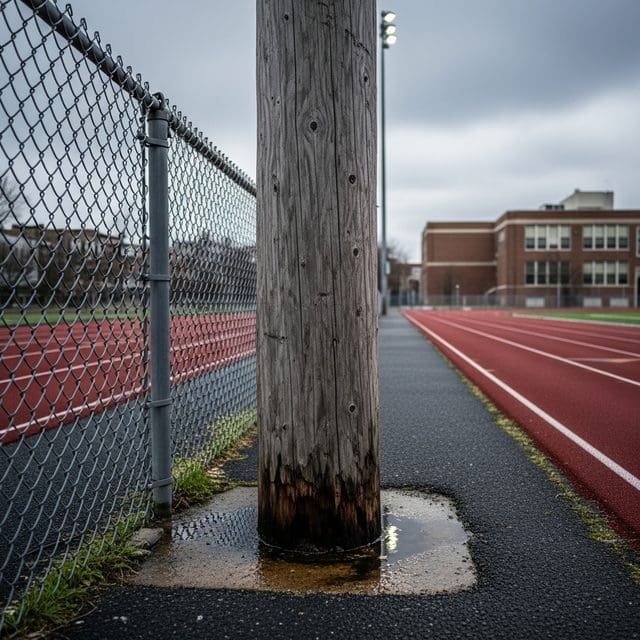
A wrongful death lawsuit filed by the family of Paula Budin reveals a decade of alleged maintenance failures within the School District of Philadelphia.
In the quiet rhythms of retirement, Paula Budin found her sanctuary on the track at Roxborough High School. A 72-year-old former elementary school teacher, Budin understood the value of public institutions. She had spent her career within them, shaping the next generation with the same steady hand she used to navigate her daily walks. But on a December afternoon in 2024, the very infrastructure she trusted to support her community failed in a sudden, violent collapse.
This week, Budin’s family filed a wrongful death and negligence lawsuit in Philadelphia Common Pleas Court against the School District of Philadelphia and Parsons Corp., an engineering firm. The complaint paints a chilling picture of institutional apathy, alleging that the 45-foot wooden utility pole that struck and killed Budin had been visibly rotting for at least ten years. According to the filing, the base of the pole was discolored and decayed as far back as 2014, exacerbated by a clogged storm drain that allowed standing water to eat away at the timber while officials looked the other way.
The tragedy at Roxborough is more than a freak accident; it is a case study in the erosion of local accountability. For over a decade, the district relied on Parsons Corp., hired in 2015, to conduct facility condition assessments across its vast network of buildings. The lawsuit alleges that while the firm inspected the Roxborough fields multiple times, it never once performed a meaningful inspection of the utility poles. After the incident, the district removed the three remaining poles on the site. Subsequent joint inspections by legal experts reportedly found no evidence of inspection tags on any of the poles, suggesting they had been entirely ignored by the safety standards meant to protect the public.
This failure occurs against a backdrop of broader institutional strain. While national headlines focus on the volatility of global oil prices following the April 2026 ceasefire or the multi-trillion dollar valuations of firms like SpaceX, the lived reality for many Americans is defined by the crumbling state of their immediate surroundings. In Philadelphia, the school district has faced mounting scrutiny, including a separate federal case filed in March 2026 alleging a failure to enforce civil rights protections. These parallel failures suggest a system where administrative boxes are checked, but the actual safety of the individual is lost in the shuffle of bureaucracy.
The economic data of 2026 tells a story of a tightening squeeze on the American worker, with the Ludwig Institute reporting a decline in real median weekly earnings and a rise in functional unemployment. In such an environment, the reliance on public spaces like school tracks becomes even more vital for the well-being of the working class. When these spaces become hazards due to a decade of deferred maintenance, it represents a breach of the social contract. The lawsuit claims the district “knew or should have known” about the decay, yet the silence from the School District and Parsons Corp. leaves a void where accountability should be.
Local institutions are the bedrock of American life, but they require diligent stewardship. When oversight is outsourced to distant corporations and maintenance is treated as a secondary concern, the cost is eventually paid by the citizens. For Paula Budin, the system’s failure was final. For Philadelphia, the litigation is a somber reminder that the preservation of community safety is a matter of personal responsibility for those in power. As the case moves through the courts, it stands as a testament to the fact that no corporate valuation can compensate for the loss of a single life to preventable neglect.

Ethan Blake serves as a Senior Correspondent for Just Right News, where he specializes in Longform Narrative and Public Understanding. In an era of rapid-fire headlines and fleeting soundbites, Ethan’s work stands as a testament to the power of deep-dive reporting and the importance of contextualizing the complex issues facing the nation today. His approach is rooted in the belief that the most profound truths are often found in the lived experiences of individuals rather than the abstract theories of distant policymakers.
Growing up in Providence, Rhode Island, Ethan developed an early appreciation for the historical and cultural threads that weave the American fabric together. Providence, a city defined by its industrial heritage and its blend of traditional neighborhoods, provided him with a front-row seat to the challenges and triumphs of the American working class. This upbringing instilled in him a respect for the “common sense” values of hard work, community loyalty, and the preservation of local institutions. He learned early on that behind every economic statistic or legislative debate, there are real families and neighborhoods navigating the consequences of change.
This foundational perspective is the driving force behind his signature feature series, “Lives Behind the Systems.” Through this series, Ethan explores the intersection of individual agency and institutional structure. Whether he is documenting the impact of federal land-use policies on rural families or examining how shifting educational standards affect local school boards, Ethan’s work prioritizes the human element. He seeks to uncover how large-scale systems—be they governmental, economic, or social—affect the daily lives of citizens, often advocating for a return to local control and personal responsibility.
Now based in Portland, Maine, Ethan draws significant inspiration from the rugged independence and self-reliance that define the region. The coastal landscape and the resilient spirit of Maine’s communities serve as a constant reminder of the importance of individual liberty and the strength found in decentralized power. Living and working outside the traditional media hubs allows Ethan to maintain a grounded perspective, ensuring his reporting remains untethered from the echo chambers of the major metropolitan centers. This geographic distance provides him with the clarity needed to translate complex national narratives into stories that resonate with the heart of the country.
At Just Right News, Ethan’s beat is more than just a professional assignment; it is a mission to foster a more informed and engaged citizenry. He believes that a free society depends on the public’s ability to understand the mechanisms of power and the value of traditional American principles. His longform narratives do not merely report the news; they provide a roadmap for understanding the cultural and political shifts of the modern era through a lens of skepticism toward centralized authority and a deep respect for the individual.
Through his meticulous research and narrative craftsmanship, Ethan Blake continues to bridge the gap between policy and the public. His work remains a vital resource for those who seek a deeper understanding of the systems that shape our world and the enduring spirit of the people who live within them.