

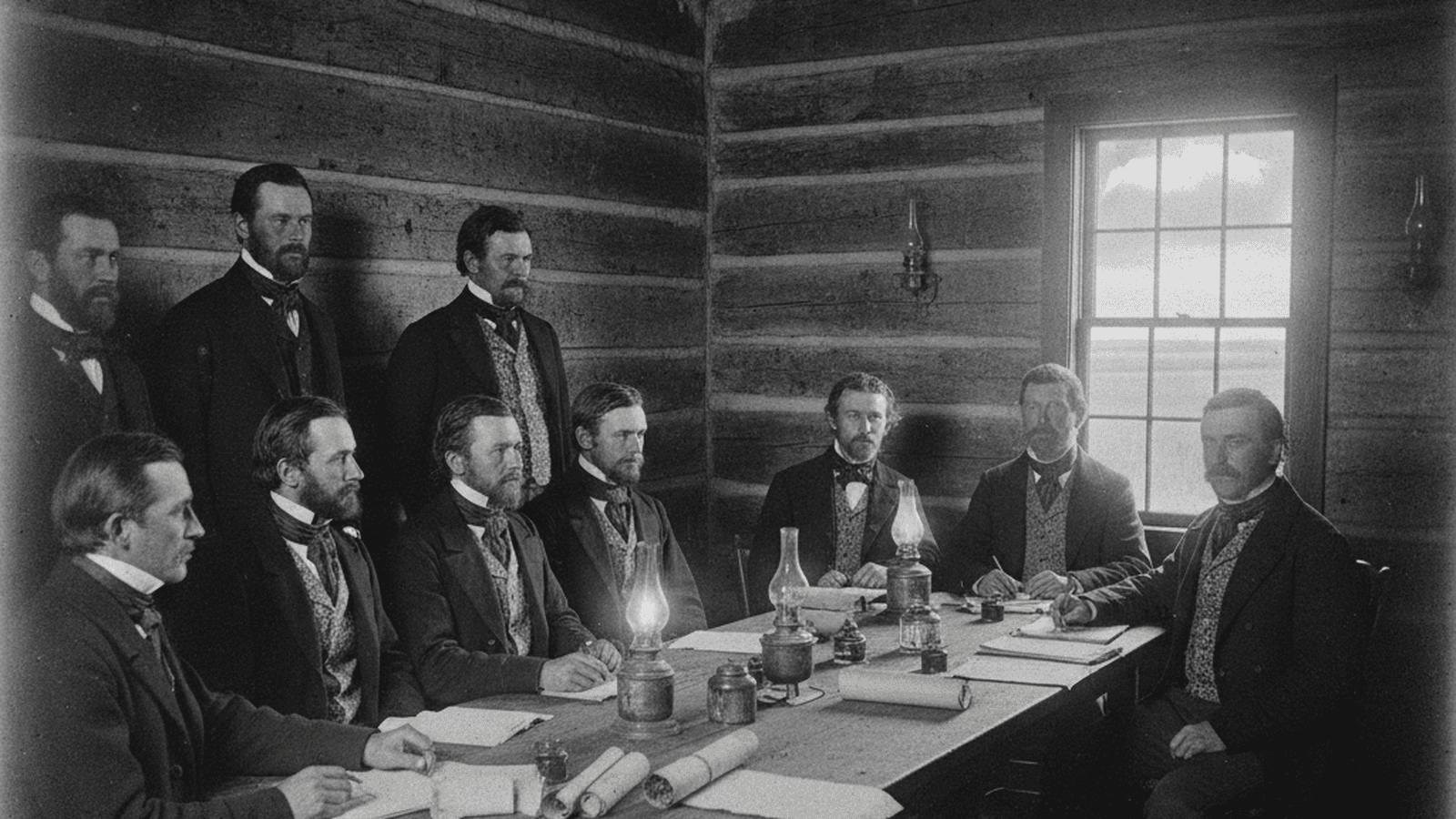
In 1856, the Nebraska Territorial Assembly passed a landmark election law to establish residency requirements and voter qualifications. This move aimed to prevent the type of electoral fraud and violence then plaguing the neighboring Kansas Territory in the United States.
TLDR: Following the Kansas-Nebraska Act, Nebraska Territory leaders enacted the Election Law of 1856 to stabilize their nascent government. By mandating residency and citizenship requirements, the law sought to prevent non-resident interference. This early reform established a framework for electoral integrity that guided the region through its transition to United States statehood.
The passage of the Kansas-Nebraska Act in 1854 fundamentally altered the political landscape of the American West by introducing the concept of popular sovereignty. This doctrine allowed settlers in new territories to decide for themselves whether to permit slavery. While the neighboring Kansas Territory became a theater of partisan violence and systemic voter fraud, the leaders of the Nebraska Territory recognized an urgent need to insulate their own political process from such instability. In January 1856, the second territorial assembly met in Omaha to draft a comprehensive set of regulations that would define the future of voting on the Great Plains.
The primary objective of the Nebraska Territorial Election Law of 1856 was to establish clear, enforceable qualifications for suffrage. Prior to this act, the rules governing who could participate in territorial elections were vague and inconsistently applied. The new law mandated that every voter must be a male citizen of the United States or a person who had legally declared his intention to become one. More importantly, it introduced a residency requirement, necessitating that a voter reside in the territory for at least six months and in the specific county for twenty days prior to an election.
These residency requirements were a direct response to the “border ruffian” tactics observed in Kansas, where organized groups of non-residents crossed state lines to influence local outcomes. By codifying a waiting period, Nebraska’s legislators sought to ensure that only those with a vested interest in the territory’s long-term development could cast a ballot. The law also required voters to be at least twenty-one years of age, further narrowing the pool of eligible participants to those deemed mature enough for civic responsibility.
Beyond defining the electorate, the 1856 act overhauled the administration of the polls. It required the appointment of three judges and two clerks for every election precinct. These officials were tasked with maintaining poll books and ensuring that every ballot was cast in accordance with the law. To deter fraud, the legislation included specific penalties for “illegal voting,” which encompassed voting more than once or voting in a precinct where one did not reside. Officials who neglected their duties or knowingly permitted fraudulent votes faced significant fines and potential imprisonment.
The implementation of these reforms was not without controversy. The territory was deeply divided between the “North of the Platte” and “South of the Platte” factions. Settlers south of the river often felt that the Omaha-based government used election regulations to maintain an unfair advantage in the ongoing dispute over the location of the territorial capital. They argued that the residency requirements and the placement of polling stations favored the northern interests, leading to a period of intense legislative friction that nearly paralyzed the territorial government.
Despite these internal rifts, the 1856 law succeeded in creating a more orderly electoral environment than that of Kansas. It provided a statutory basis for challenging suspicious ballots and established a precedent for administrative oversight that would persist for decades. The focus on residency and citizenship reflected a broader national trend toward formalizing the boundaries of the American electorate during a period of massive migration and territorial expansion.
The principles established in the 1856 act served as the foundation for Nebraska’s transition to statehood in 1867. As the United States expanded westward, the Nebraska model of early electoral codification demonstrated that procedural rigor could mitigate some of the volatility inherent in frontier politics. These early efforts at election reform eventually evolved into the more sophisticated voter registration systems and secret ballot laws that characterized the late nineteenth-century push for democratic integrity across the Great Plains.

Sophie Carter serves as a Staff Writer for Just Right News, where she anchors the outlet’s critical coverage of Elections, Influence, and Democracy Infrastructure. In an era where the mechanics of voting and the flow of political capital are under constant scrutiny, Sophie provides a steady, principled voice dedicated to the preservation of American institutional integrity and the rule of law.
Raised in Charlotte, North Carolina, Sophie’s perspective was forged in a community that balances rapid modern growth with a deep respect for tradition and civic duty. Growing up in the Queen City, she witnessed firsthand how a robust local culture depends on the trust between the citizen and the state. This upbringing instilled in her a foundational belief that the right to vote is a sacred trust—one that must be protected from both administrative overreach and the encroaching influence of special interest groups. Her reporting reflects these North Carolina roots, emphasizing the importance of community-led governance and the preservation of the individual’s voice in the face of nationalized political movements.
Now based in Atlanta, Georgia, Sophie operates from the heart of one of the nation’s most pivotal and contested political landscapes. Her location allows her to report from the front lines of the debate over election security, legislative reform, and the modernization of voting systems. For Sophie, the “infrastructure” of democracy is not merely a matter of machines and ballots; it is the collection of laws, people, and transparent processes required to maintain public confidence. Her work often highlights the necessity of clear, enforceable standards that ensure every legal vote is counted fairly and that the machinery of our republic remains accountable to the taxpayers who fund it.
Central to her work at Just Right News is her acclaimed feature series, “The Price of a Vote.” Through this ongoing project, Sophie explores the complex web of influence that shapes modern campaigns and policy decisions. She delves into how high-level lobbying, non-governmental organizations, and shifting bureaucratic regulations impact the weight of an individual citizen’s ballot. By examining the financial and structural pressures placed on the electoral process, she provides readers with a comprehensive look at the forces vying for control over the American political system.
Sophie’s approach to journalism is rooted in a commitment to the constitutional framework. She views her role as a watchdog for the voter, ensuring that the systems meant to serve the public remain transparent and free from corruption. Whether she is analyzing the implementation of new voting technologies or investigating the influence of outside money on state-level policy, her work is characterized by a rigorous adherence to facts and a refusal to succumb to the sensationalism that often plagues modern political reporting.
At Just Right News, Sophie Carter continues to be a vital resource for readers who value clarity, conviction, and a defense of traditional American values. Her deep ties to the Southeast and her specialized focus on the mechanics of our republic make her an essential voice in the ongoing conversation about the future of American self-governance. Through her reporting, she remains dedicated to the idea that a secure and honest electoral system is the bedrock of a free and prosperous society.