

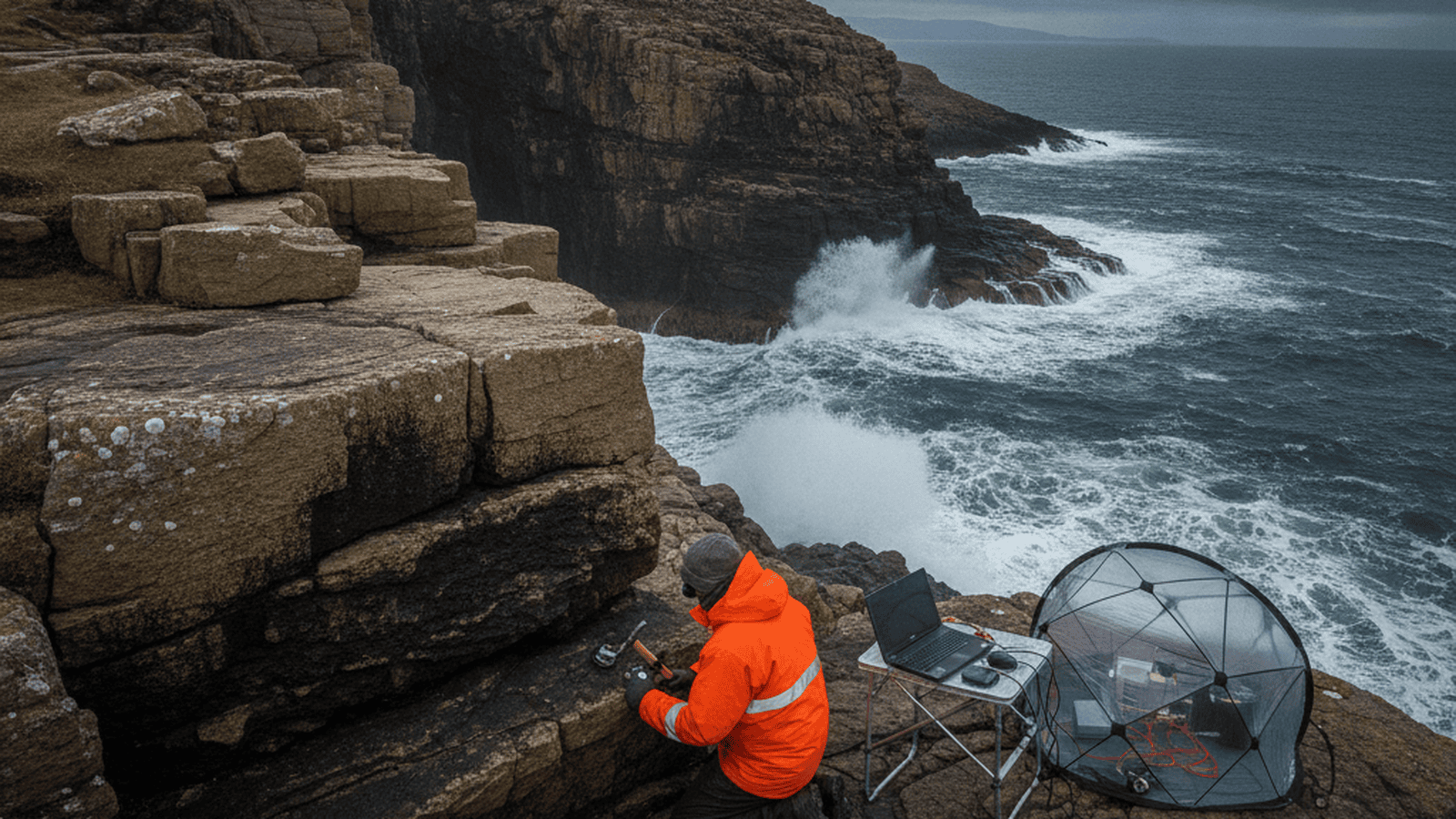
Researchers have discovered reidite, an extremely rare high-pressure mineral, within the Stac Fada rock formation in the Scottish Highlands. Formed from zircon during a massive meteorite impact 1.2 billion years ago, the discovery provides the first definitive evidence of such an event in the United Kingdom.
TLDR: Scientists identified reidite, a rare mineral formed under extreme pressure, in the Scottish Highlands. This discovery provides the first terrestrial evidence in the UK of a massive 1.2-billion-year-old meteorite impact, offering new insights into how materials transform during hypervelocity collisions and planetary-scale events.
Geologists and materials scientists have made a landmark discovery in the rugged terrain of the Scottish Highlands, identifying the presence of reidite, one of the rarest minerals found on Earth. This discovery was made within the Stac Fada member, a unique layer of impact ejecta located near Enard Bay. The finding marks the first time this high-pressure mineral has been identified in situ within the United Kingdom, providing definitive, irrefutable evidence of a massive meteorite impact that occurred approximately 1.2 billion years ago during the Mesoproterozoic era.
Reidite is a high-pressure polymorph of zircon, a common and durable mineral often used in geochronology. The transformation occurs when zircon is subjected to extreme shock pressures, typically ranging between 30 and 50 gigapascals—pressures equivalent to those found deep within the Earth’s mantle but delivered in a fraction of a second during a hypervelocity impact. Under these intense conditions, the tetragonal crystal lattice of the zircon collapses and rearranges into a denser, scheelite-type structure. This phase transition increases the mineral’s density by approximately 10 percent while maintaining its original chemical composition (ZrSiO4).
The research expedition, a collaborative effort between the University of Oxford and the University of Aberdeen, focused on the ancient sedimentary sequences of the Stoer Group. For decades, the origin of the Stac Fada member was a subject of intense geological debate. Some researchers argued that its fragmented rock textures and melt-like features were the result of localized volcanic activity. However, the identification of reidite effectively ends this controversy. Because the pressures required to synthesize reidite cannot be generated by volcanic processes or standard tectonic movements, its presence serves as a diagnostic “smoking gun” for a bolide impact.
From a materials science perspective, the discovery of natural reidite provides a unique laboratory for studying shock-induced phase transformations. While reidite can be synthesized in controlled environments using diamond anvil cells or shock-recovery experiments, natural samples offer a record of how materials behave during planetary-scale collisions. The fact that these metastable crystals have been preserved for over a billion years is particularly significant. It suggests that the post-impact environment cooled rapidly enough to “freeze” the reidite in its high-pressure state, preventing it from reverting to its low-pressure zircon form as the temperature and pressure subsided.
Identifying these microscopic crystals required advanced micro-analytical techniques. The team collected samples of impact melt and suevite—a rock type consisting of angular fragments in a matrix of glass and crystal—from coastal outcrops. Using electron backscatter diffraction (EBSD), the researchers mapped the crystallographic orientation of individual grains at a sub-micrometer scale. This allowed them to distinguish the specific symmetry of the reidite lattice within zircon grains that appeared identical under standard optical microscopy. The reidite was found as tiny, needle-like lamellae hosted within the larger zircon crystals, representing the remnants of the shock wave’s passage.
The implications of this find extend beyond terrestrial geology into planetary defense and the study of the early solar system. By analyzing the distribution and orientation of reidite, scientists can calibrate the energy and scale of ancient impacts, helping to model how kinetic energy is partitioned during an asteroid strike. The Stac Fada impact is now recognized as the most significant impact event in the British Isles’ history. Future research will utilize high-resolution transmission electron microscopy (TEM) to examine the atomic interfaces between the zircon and reidite phases, and researchers are already planning expeditions to map the submerged crater, likely located beneath the Minch, the strait separating the Outer Hebrides from the mainland.

Mason Reed serves as a Staff Writer for Just Right News, where he spearheads the Future Frontiers & Special Projects desk. In an era defined by rapid technological shifts and evolving social landscapes, Mason provides a steady, principled voice, examining the innovations of tomorrow through the lens of traditional American values. His work is most prominently featured in his signature series, “The Next Horizon,” where he explores the intersection of emerging technology, national sovereignty, and the preservation of individual liberty.
A native of San Diego, California, Mason’s worldview was shaped by the unique culture of his hometown. Growing up in a region defined by its strong military presence and its history of maritime industry, he developed a deep-seated respect for the institutions that provide national stability and the entrepreneurial spirit that drives the American economy. This upbringing instilled in him a belief that true progress is not found in discarding the past, but in building upon a foundation of proven principles. His reporting often reflects this San Diego influence, emphasizing the importance of a robust national defense and the necessity of maintaining a competitive edge in the global marketplace.
Now based in San Francisco, Mason operates from the heart of the world’s technological engine. Living and working in the Bay Area provides him with a front-row seat to the advancements—and the ideological challenges—emanating from Silicon Valley. While many in the region embrace a “move fast and break things” mentality, Mason’s reporting serves as a vital counterweight. He offers Just Right News readers a “boots on the ground” perspective, documenting how radical local policies and the concentration of tech power impact the everyday lives of citizens. His proximity to the industry allows him to cut through the marketing jargon of big tech to uncover the real-world implications for privacy, free speech, and the nuclear family.
In his “Future Frontiers” beat, Mason tackles complex subjects ranging from the ethics of artificial intelligence to the burgeoning private space race. He approaches these topics with a healthy skepticism toward centralized bureaucracy, championing instead the decentralized innovations that empower individuals. Through “The Next Horizon,” he highlights the pioneers and thinkers who are working to ensure that the future remains a place where human dignity and constitutional rights are protected. He believes that the rapid pace of change requires more than just technical expertise; it requires a moral compass rooted in the Western tradition.
Throughout his tenure at Just Right News, Mason has remained committed to the idea that the future is something to be shaped, not merely accepted. His writing is characterized by a rigorous defense of American exceptionalism and a belief that the country’s best days lie ahead, provided it remains true to its founding ideals. Whether he is investigating the impact of automation on the American workforce or profiling the next generation of aerospace engineers, Mason Reed ensures that his readers are equipped with the insights they need to navigate a changing world with confidence and clarity.