

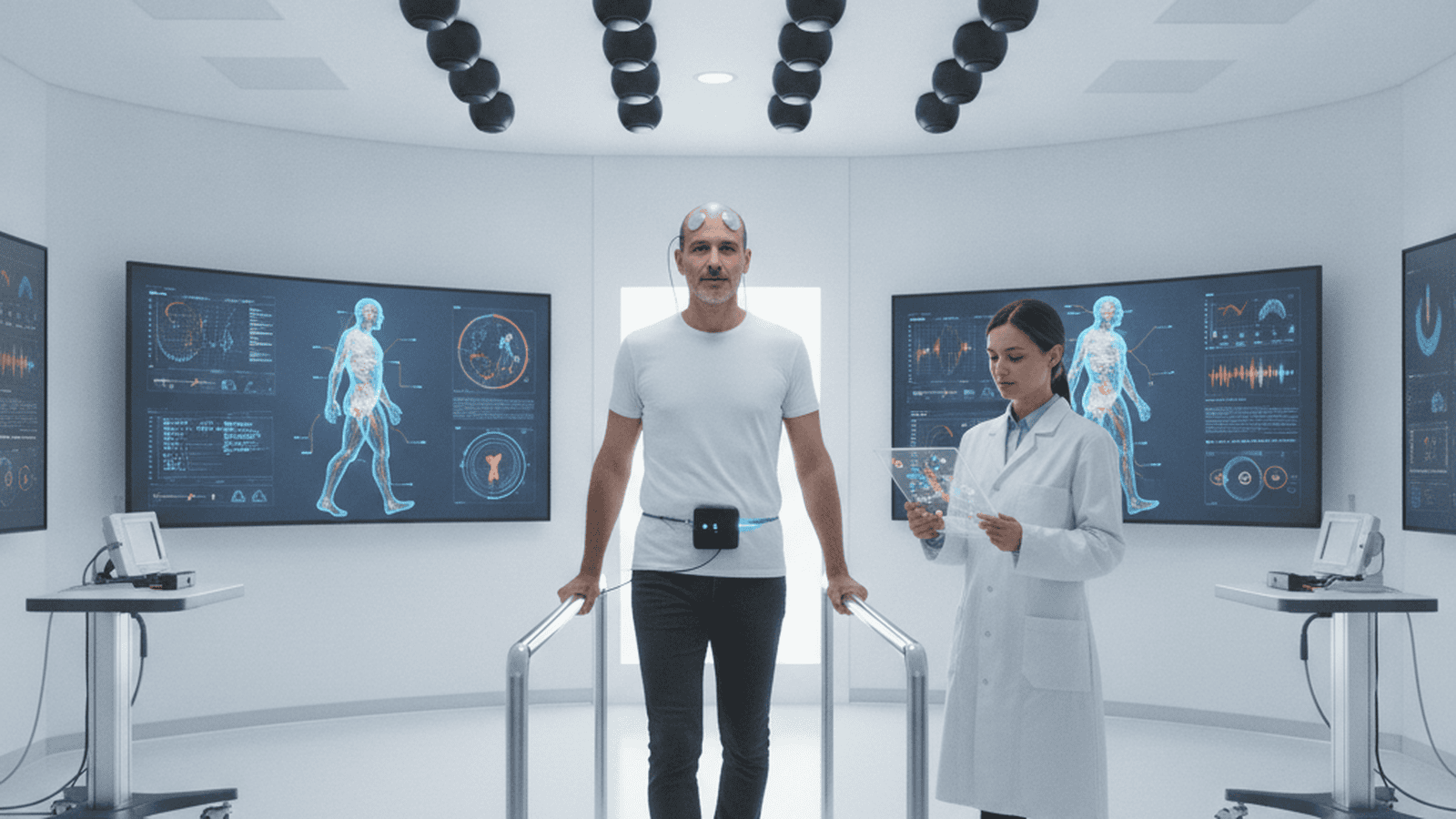
An international team of neuroscientists has successfully bypassed a spinal cord injury using a digital interface that translates brain activity into electrical pulses. This brain-spine interface allowed a paralyzed individual to regain voluntary control over his legs, enabling him to walk and stand naturally for the first time in over a decade.
TLDR: Neuroscientists have developed a digital bridge that reconnects the brain to the spinal cord, allowing a paralyzed man to walk using thought alone. By decoding intentions into electrical stimulation, the system restores natural movement and promotes neurological recovery, marking a significant leap in treating chronic paralysis.
For decades, the medical community has viewed spinal cord injuries resulting in permanent paralysis as an insurmountable challenge. The central nervous system possesses a notoriously limited capacity for regeneration; once the neural pathways between the brain and the lumbar spinal cord are severed, the motor commands required for walking can no longer reach the muscles. While the brain remains capable of generating the intent to move, the physical “wiring” is broken. Previous attempts to restore mobility often relied on functional electrical stimulation (FES), which delivered pre-programmed pulses to muscles. While functional, these systems produced robotic, jerky movements that lacked the fluidity and voluntary control of a natural gait.
A landmark international collaboration has now shattered this paradigm. Researchers from the Swiss Federal Institute of Technology in Lausanne (EPFL), the University Hospital of Lausanne (CHUV), and the French Alternative Energies and Atomic Energy Commission (CEA) have successfully developed and implemented a “digital bridge.” This sophisticated interface establishes a direct, wireless communication link between the brain’s motor cortex and the spinal cord regions responsible for lower-limb movement. Unlike its predecessors, this system allows for the voluntary modulation of muscle intensity and timing, enabling a level of control that closely mimics natural human locomotion.
The technological architecture of this bridge is a marvel of modern engineering. It consists of two primary components: a brain-computer interface (BCI) and a spatial-targeted neurostimulator. In a clinical trial involving a 40-year-old patient, Gert-Jan Oskam—who had been paralyzed for over a decade following a cycling accident—surgeons implanted two 64-electrode sensors into the skull. These sensors, known as WIMAGINE®, are positioned over the motor cortex to detect electrocorticography (ECoG) signals. These signals represent the electrical fluctuations produced by the brain when an individual simply thinks about moving their legs.
Artificial intelligence serves as the “translator” within this digital bridge. A portable processing unit, carried by the patient in a backpack, utilizes advanced machine-learning algorithms to decode neural intentions in real-time. When the system identifies the patient’s desire to lift a foot or take a step, the data is transmitted wirelessly to an ActiGait stimulator implanted over the lumbar spinal cord. This stimulator then triggers specific muscle groups—such as the hip flexors, quadriceps, and calves—to execute the intended movement. By bypassing the site of the injury entirely, the digital bridge restores the flow of information that the biological nerves can no longer carry.
The results were immediate and profound. Within minutes of calibration, Oskam was able to stand and walk using a walker. Over months of training, his control became increasingly intuitive. He demonstrated the ability to navigate complex environments that were previously inaccessible, including steep ramps, uneven terrain, and even stairs. The “digital bridge” provided him with the autonomy to stop, start, and adjust his stride length at will, a feat never before achieved with spinal stimulation alone.
Perhaps the most scientifically significant finding was the evidence of neurological recovery. After extensive use of the device, researchers observed that Oskam regained some voluntary motor control even when the digital bridge was switched off. This suggests that the consistent, synchronized pairing of mental intention with physical movement promoted neuroplasticity. The “bridge” may have encouraged the strengthening of residual nerve fibers or the formation of new synaptic connections around the lesion.
This breakthrough marks a new era in neuro-rehabilitation. The research team is now focused on miniaturizing the hardware for seamless daily integration and exploring the application of this technology for upper-limb paralysis. By expanding the digital bridge to restore hand and arm function, scientists hope to provide a new level of independence for millions of individuals living with spinal cord injuries or stroke-related motor deficits.

Susan Carter serves as a Senior Correspondent for Just Right News, where she leads the network’s comprehensive coverage of Health, Medicine, and Public Policy. With a career dedicated to dissecting the complexities of the American healthcare system, Susan brings a principled perspective to the most pressing debates of the day. Her reporting is characterized by a commitment to individual liberty, fiscal responsibility, and a healthy skepticism of government overreach, making her a vital voice for audiences seeking clarity in an increasingly regulated landscape.
Raised in Minneapolis, Minnesota, Susan’s professional outlook is deeply informed by the values of the American heartland. Growing up in the Twin Cities, she witnessed firsthand the importance of community-driven solutions and the resilience of the individual. This Midwestern foundation instilled in her a firm belief that the best answers to public policy challenges often come from local innovation and personal responsibility rather than top-down federal mandates. Her background allows her to translate complex legislative jargon into stories that resonate with families who value common sense and local autonomy.
Now based in Baltimore, Maryland, Susan operates from a unique vantage point at the intersection of medical innovation and urban policy. Living and working in a city renowned for its world-class medical institutions and significant public health challenges, she has a front-row seat to the realities of the modern healthcare landscape. Her proximity to these hubs of research and policy allows her to scrutinize how government intervention affects the quality of care and the freedom of medical professionals. In Baltimore, she sees the tangible results of policy decisions, using the city as a lens through which to examine the broader national health debate and the impact of federal spending on local communities.
As the lead for the acclaimed feature series “The Cost of Care,” Susan dives deep into the economic realities facing patients and providers alike. Her work focuses on the necessity of price transparency, the benefits of market competition, and the preservation of the sacred doctor-patient relationship. She is a staunch advocate for the idea that a well-informed public is the best defense against bureaucratic inefficiency. Through this series, she has exposed the hidden drivers of rising medical expenses, always seeking to empower the individual consumer over the massive institution.
Susan’s reporting on public policy is characterized by a commitment to rigorous inquiry and a focus on constitutional limits. Whether she is analyzing new pharmaceutical regulations, investigating the impact of federal health mandates, or exploring the future of medical technology, her goal remains the same: to provide Just Right News audiences with the facts they need to navigate a complex world. By blending her Midwestern sensibilities with the insights gained from her base in Maryland, Susan Carter has become a trusted authority for those who believe that personal freedom and public health are inextricably linked. Her work continues to challenge the status quo, advocating for a system that respects the taxpayer and prioritizes the patient.