

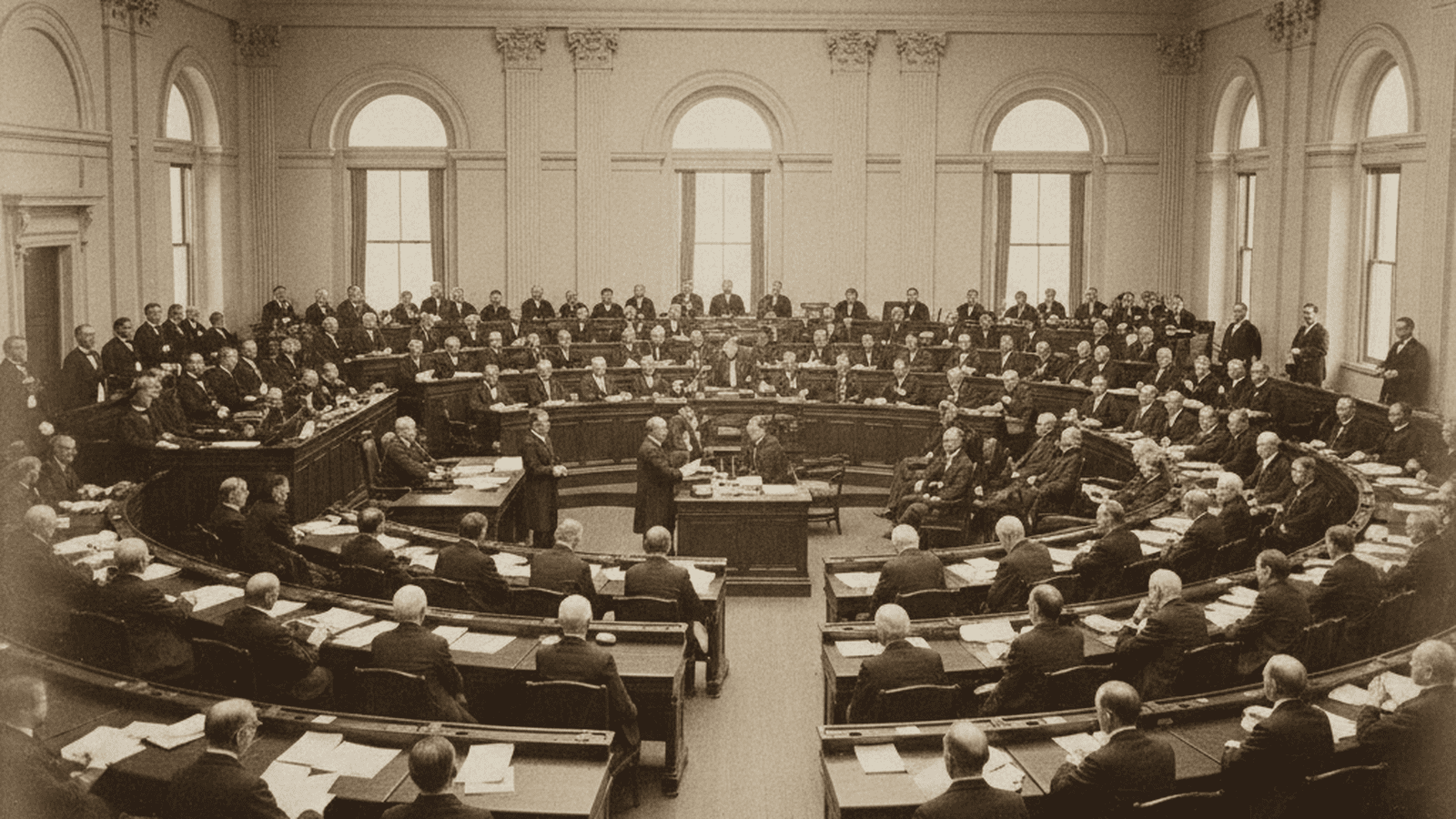
The 1901 Alabama Constitutional Convention fundamentally realigned the state’s political structure by disenfranchising a large portion of the electorate. This United States historical event established a long-lasting framework for Democratic Party dominance and rural legislative control in Alabama.
TLDR: In 1901, Alabama delegates convened to rewrite the state constitution, aiming to secure Democratic control. By implementing restrictive voting requirements and reapportioning legislative power toward rural elites, the convention realigned Alabama politics for over a century, creating a rigid system that resisted urban and industrial representation.
In the spring of 1901, 155 delegates—all white men—gathered in Montgomery, Alabama, to fundamentally alter the state’s governing document. This convention occurred during the height of the Progressive Era, a period often associated with social and political reform. However, in the American South, “reform” frequently manifested as a movement to consolidate political power through restrictive measures and the exclusion of perceived “unfit” voters. The primary objective of the 1901 Alabama Constitutional Convention was to stabilize the political landscape and eliminate the intense electoral competition that had characterized the post-Reconstruction era.
The political environment of Alabama in the late 19th century was marked by volatile rivalry. The Democratic Party, representing the conservative planter class and emerging industrial interests, faced significant challenges from the Populist Party. The Populists sought to unite poor white farmers and Black laborers under a common economic banner, threatening the hegemony of the Democratic elite. To neutralize this threat, Democratic leaders argued that a new constitution was necessary to ensure “honest elections” by removing the potential for voter fraud—a common euphemism for eliminating the voters themselves. John B. Knox, the convention’s president, explicitly stated in his opening address that the goal was to establish white supremacy by law, legally disenfranchising specific segments of the population without technically violating the 15th Amendment of the U.S. Constitution.
The resulting document introduced a complex array of voting requirements designed to be applied selectively by local registrars. These included a cumulative poll tax, a literacy test, and a “grandfather clause” that exempted those whose ancestors had voted prior to 1867. While these measures were ostensibly aimed at educational or financial qualifications, their practical application was devastatingly effective. Black voter registration plummeted from over 180,000 in 1900 to fewer than 3,000 by 1903. Tens of thousands of poor white voters were also purged from the rolls. This realignment of the electorate ensured that the Democratic Party would face no significant opposition for the next several decades, effectively turning Alabama into a one-party state.
Beyond voting rights, the convention realigned the internal mechanics of the Alabama legislature to favor the “Black Belt” region—a strip of fertile soil where wealthy white landowners held significant influence despite a majority-Black population. By freezing legislative apportionment based on the 1900 census, the convention ensured that rural counties maintained control over the statehouse, even as urban centers like Birmingham and Mobile exploded in population and economic importance. This created a structural imbalance that persisted for over sixty years. The legislature refused to reapportion itself despite massive demographic shifts, leading to a “silent gerrymander” where a minority of rural voters dictated policy for the entire state.
The 1901 Constitution also centralized power in the state government, severely limiting the autonomy of local municipalities. Cities and counties were required to seek state legislative approval for even minor local matters, such as tax increases, bond issues, or administrative changes. This “local bill” system further entrenched the power of the rural-dominated legislature over the state’s developing industrial hubs. The document became one of the longest and most detailed constitutions in the world, cluttered with hundreds of amendments that would typically be handled by simple statutes.
The legacy of the 1901 convention remains a central theme in Alabama political history. It was not until the federal Voting Rights Act of 1965 and the Supreme Court’s “one man, one vote” rulings in the 1960s that the structural realignments of 1901 began to be dismantled. While a 2022 effort successfully removed the most overtly racist language from the document, the fundamental framework of centralized state control and the difficulty of local governance continue to shape the political discourse in Alabama today.

Dylan Brooks serves as the Senior Correspondent for Statehouses and Local Governance at Just Right News, where he brings a principled, constitutionalist lens to the often-overlooked machinery of state-level politics. As the lead voice behind the acclaimed feature series “Fifty Laboratories of Power,” Dylan has dedicated his career to the idea that the most impactful governance happens closest to home. His reporting consistently champions the Tenth Amendment, exploring how individual states can serve as testing grounds for innovative, conservative policy solutions that prioritize personal liberty and fiscal responsibility.
A native of Des Moines, Iowa, Dylan’s journalistic philosophy was forged in the heart of the American Midwest. Growing up in a community where local school board meetings and town halls were the bedrock of civic life, he developed a deep appreciation for the “retail politics” of the heartland. This upbringing instilled in him a fundamental belief that the American experiment is best preserved when power is decentralized. He carries the values of his Iowa roots into every assignment, maintaining a healthy skepticism of federal overreach and a steadfast commitment to the concerns of everyday citizens over the interests of the administrative state.
Now based in Madison, Wisconsin, Dylan operates from one of the nation’s most pivotal political battlegrounds. His location in a state capital known for its rigorous policy debates allows him to provide Just Right News readers with a front-row seat to the legislative process. From Madison, he tracks the ripple effects of statehouse decisions on local municipalities, ensuring that the connection between high-level policy and community impact is never lost. His work often highlights the success of conservative governors and legislatures in fostering economic growth, protecting parental rights, and securing the integrity of local institutions.
As an African American man in the conservative media landscape, Dylan offers a vital perspective on how limited government and free-market principles empower individuals and families. He frequently reports on how deregulation and school choice initiatives provide new avenues for success in underserved communities, challenging the monolithic narratives often presented by legacy media outlets. Dylan’s work is characterized by a commitment to the facts and a refusal to shy away from the complex realities of modern governance.
Throughout his tenure at Just Right News, Dylan has become a trusted authority for readers who value a rigorous, principled approach to the news. Whether he is dissecting a complex state budget or profiling a local grassroots movement, his goal remains the same: to provide the American public with the information they need to hold their local leaders accountable. By focusing on the “Fifty Laboratories of Power,” Dylan Brooks ensures that the vital work being done in statehouses across the country receives the national attention it deserves, always through a lens that respects the traditions and sovereignty of the American people.