

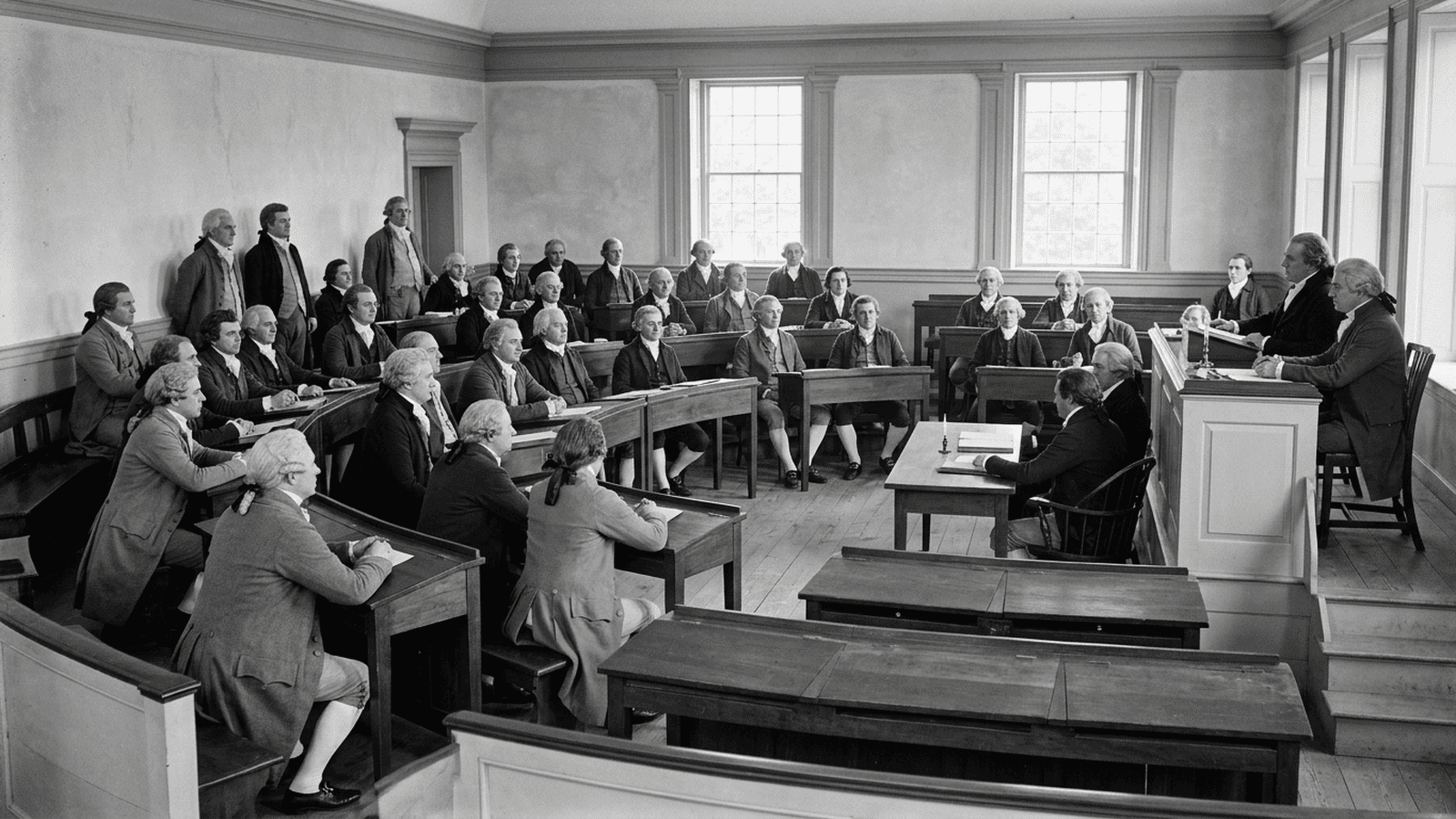
Nathaniel Macon’s election as Speaker in 1801 gave the Republican majority a key position in the House after the United States election of 1800 shifted control of the federal government. The contest demonstrated how congressional procedure and leadership could turn an electoral realignment into legislative power.
TLDR: In December 1801, the House elected North Carolina Republican Nathaniel Macon as Speaker, marking the first such choice after Jefferson’s party gained control of the federal government. The result gave Republicans influence over debate and House procedure, while Federalists remained a significant opposition and disputes over federal power continued.
When the Seventh Congress assembled in Washington on December 7, 1801, its choice of Speaker made a change in national power visible inside the House of Representatives. North Carolina’s Nathaniel Macon, a Republican, defeated Federalist John Rutledge Jr. and became the first Speaker elected after Thomas Jefferson’s party took control of the federal government. The vote was more than a personnel decision: it placed the House’s agenda in the hands of the party that had won the closely contested election of 1800. Because the House chose its officers at the opening of a Congress, the vote came before ordinary legislative business and helped determine who would organize the chamber. Members also elected a Clerk and other officers, but the Speaker’s position made this first decision especially consequential.
The transition followed years of Federalist dominance in the early national government. Under President John Adams, Federalists had controlled the presidency and Congress, while Republicans criticized policies including the Alien and Sedition Acts and argued for a narrower interpretation of federal authority. The 1800 election brought Jefferson to the presidency and increased Republican representation in Congress. The House contest for Speaker offered an immediate test of whether that electoral shift could produce a working majority in the legislature.
Macon was a significant choice for the Republican caucus. Born in North Carolina in 1757, he had served in the Continental Congress and entered the House in 1791. He was an advocate of limited federal power and an influential member of the Republican coalition, though he was known less as a flamboyant public speaker than as a careful legislator. His selection reflected both party loyalty and the importance Republicans attached to placing a trusted ally at the chamber’s center.
The Speaker’s office carried practical authority. The Speaker presided over debate, recognized members seeking to speak, and played a major role in referring bills to committees. Those powers could shape which proposals received attention and how the House conducted its business. At a time when party organization was growing but remained less formal than it would become, control of the chair offered Republicans a means to translate their electoral strength into legislative procedure.
Macon’s election also signaled a change in the House’s political alignment, not a sudden end to partisan conflict. Federalists remained a substantial minority, and divisions over federal power, taxes, commerce, and foreign affairs continued. Jefferson’s supporters differed among themselves about how far the government should go, while their opponents challenged Republican policies and priorities. The Speaker’s role could guide debate, but it could not erase those disagreements or guarantee that the administration would win every vote.
The new Congress convened in Washington, the federal capital established under the Residence Act of 1790. Congress had met there for the first time in 1800, and its chambers were still taking shape as institutions and as symbols of national government. The setting underscored the stakes of the transfer: a new party majority was exercising authority in a young republic whose constitutional arrangements were still being tested through routine political practice.
Macon remained Speaker through 1807, making his tenure a sustained period of Republican leadership in the House. His election helped establish a precedent for the Speaker as a consequential partisan officer, not simply a neutral moderator. Later disputes over committee assignments, debate rules, and the Speaker’s influence would make the office still more powerful. The 1801 vote did not settle the meaning of the 1800 election, but it showed how an electoral realignment could reorganize Congress—and how parliamentary rules could become instruments of political change.

Sophie Carter serves as a Staff Writer for Just Right News, where she anchors the outlet’s critical coverage of Elections, Influence, and Democracy Infrastructure. In an era where the mechanics of voting and the flow of political capital are under constant scrutiny, Sophie provides a steady, principled voice dedicated to the preservation of American institutional integrity and the rule of law.
Raised in Charlotte, North Carolina, Sophie’s perspective was forged in a community that balances rapid modern growth with a deep respect for tradition and civic duty. Growing up in the Queen City, she witnessed firsthand how a robust local culture depends on the trust between the citizen and the state. This upbringing instilled in her a foundational belief that the right to vote is a sacred trust—one that must be protected from both administrative overreach and the encroaching influence of special interest groups. Her reporting reflects these North Carolina roots, emphasizing the importance of community-led governance and the preservation of the individual’s voice in the face of nationalized political movements.
Now based in Atlanta, Georgia, Sophie operates from the heart of one of the nation’s most pivotal and contested political landscapes. Her location allows her to report from the front lines of the debate over election security, legislative reform, and the modernization of voting systems. For Sophie, the “infrastructure” of democracy is not merely a matter of machines and ballots; it is the collection of laws, people, and transparent processes required to maintain public confidence. Her work often highlights the necessity of clear, enforceable standards that ensure every legal vote is counted fairly and that the machinery of our republic remains accountable to the taxpayers who fund it.
Central to her work at Just Right News is her acclaimed feature series, “The Price of a Vote.” Through this ongoing project, Sophie explores the complex web of influence that shapes modern campaigns and policy decisions. She delves into how high-level lobbying, non-governmental organizations, and shifting bureaucratic regulations impact the weight of an individual citizen’s ballot. By examining the financial and structural pressures placed on the electoral process, she provides readers with a comprehensive look at the forces vying for control over the American political system.
Sophie’s approach to journalism is rooted in a commitment to the constitutional framework. She views her role as a watchdog for the voter, ensuring that the systems meant to serve the public remain transparent and free from corruption. Whether she is analyzing the implementation of new voting technologies or investigating the influence of outside money on state-level policy, her work is characterized by a rigorous adherence to facts and a refusal to succumb to the sensationalism that often plagues modern political reporting.
At Just Right News, Sophie Carter continues to be a vital resource for readers who value clarity, conviction, and a defense of traditional American values. Her deep ties to the Southeast and her specialized focus on the mechanics of our republic make her an essential voice in the ongoing conversation about the future of American self-governance. Through her reporting, she remains dedicated to the idea that a secure and honest electoral system is the bedrock of a free and prosperous society.