

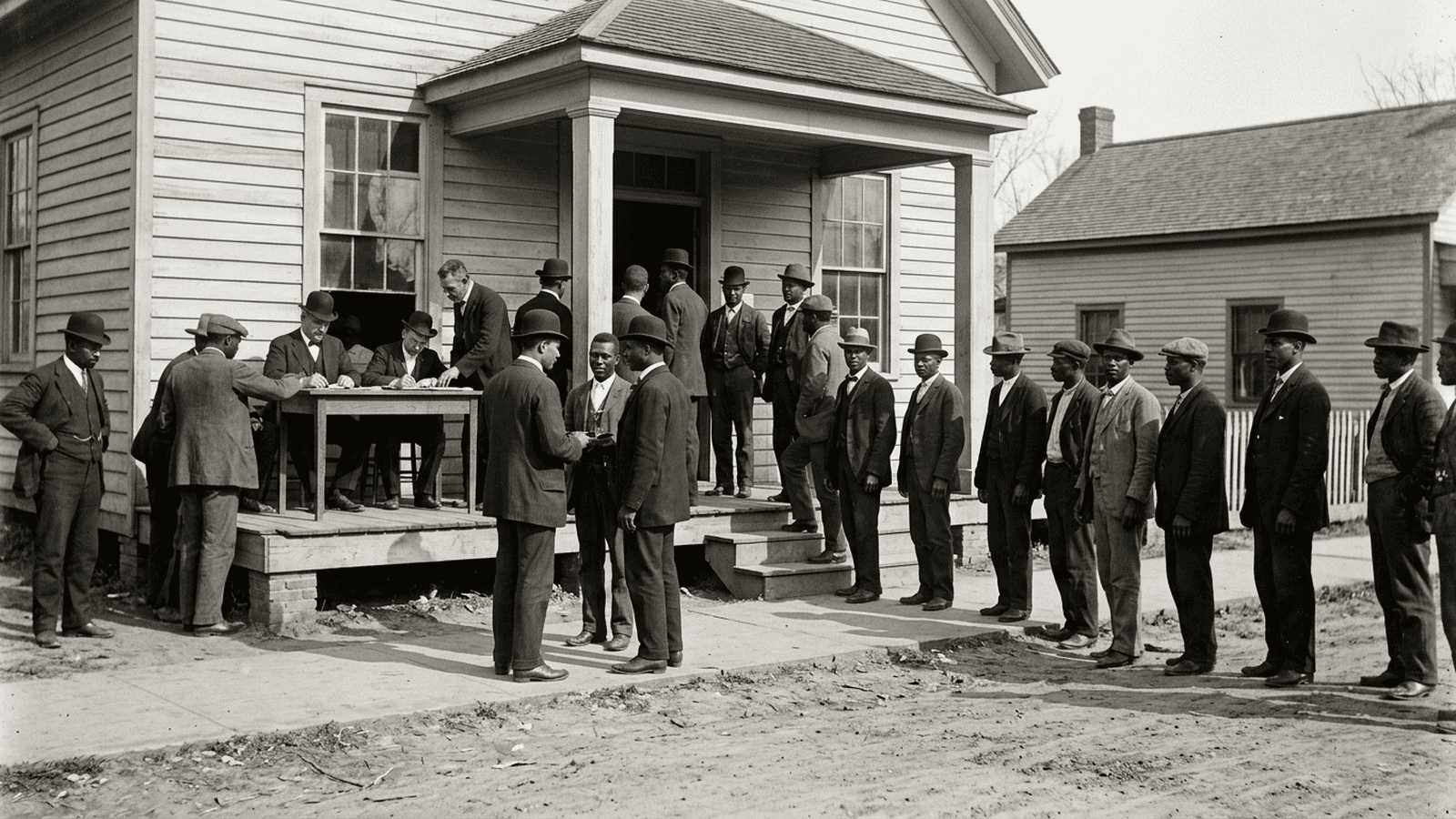
North Carolina’s 1900 constitutional amendment imposed poll taxes and literacy tests while temporarily exempting many white voters through a grandfather clause. The United States state-level measure sharply reduced Black political participation and helped consolidate Democratic control.
TLDR: North Carolina voters approved a constitutional amendment in 1900 that used poll taxes and literacy tests to restrict voting. A grandfather clause temporarily exempted many white men, while Black voters faced sharply increased barriers. The amendment helped secure Democratic one-party rule and foreshadowed later federal voting-rights protections.
On August 2, 1900, North Carolina voters approved a constitutional amendment that sharply restricted access to the ballot. Presented by its Democratic backers as a measure to stabilize elections and weaken Republican-Populist influence, it also entrenched white political power by excluding many Black men from voting. The amendment became one of the South’s most consequential turn-of-the-century changes to election law.
The measure followed years of political upheaval. In the 1890s, a biracial coalition of Republicans and Populists had challenged Democratic control, winning the governor’s office and seats in the legislature in 1896. The coalition’s success alarmed white Democratic leaders, who mobilized around white supremacy and portrayed Black political participation as a threat. In 1898, a violent campaign in Wilmington helped Democrats regain power; white supremacists then overthrew the city’s elected biracial government. The amendment campaign continued this broader effort to secure one-party rule.
The amendment revised the state constitution’s voter qualifications. It required prospective voters to pay a poll tax and, in many cases, demonstrate the ability to read and write a section of the state constitution. Election officials administered the test, giving them broad discretion over who qualified. The provision was especially consequential because it could be applied selectively, while poverty and unequal access to schooling made the requirements difficult for many citizens to meet.
A temporary “grandfather clause” offered an exception. Men who had been entitled to vote before January 1, 1867, and their descendants could register without meeting the literacy test. Since Black men had generally been denied voting rights before that date, the exemption largely benefited white voters. It expired in 1908, but by then many Black voters had already been removed from registration rolls and Democratic dominance was firmly established.
The amendment passed statewide with about 70 percent of the vote, following a campaign marked by racial intimidation and appeals to white solidarity. Its effects were immediate and severe. Black registration fell dramatically in counties across the state, and the number of Black officeholders declined. White voters who could not satisfy the literacy requirement also faced barriers, but the grandfather clause protected many of them during its eight-year operation. The rules thus did more than set neutral standards: they gave local registrars tools to enforce a racial hierarchy at the polls.
Supporters described the change as an answer to fraud and political disorder. Yet the amendment did not simply improve ballot administration. Its literacy tests, poll-tax requirement, and unequal exemption narrowed the electorate, weakening the political power of Black citizens and poor voters. The system operated alongside other Southern restrictions, including intimidation and the exclusion of Black residents from Democratic primaries, which often determined the outcome in a one-party state.
The amendment was part of a wider regional retreat from Reconstruction-era political participation. Other Southern states used constitutional conventions, registration rules, and poll taxes to reduce Black voting without openly contradicting the Fifteenth Amendment. North Carolina’s version demonstrated how formally written qualifications could be administered in discriminatory ways, while a temporary exception shielded many white voters from the same test.
Its consequences endured beyond the grandfather clause’s expiration. Disfranchisement limited Black influence over state and local policy for decades, until federal civil-rights legislation and enforcement challenged discriminatory voting practices. The Voting Rights Act of 1965 later supplied stronger tools against literacy tests and other barriers. The 1900 amendment remains a clear example of election rules being used not merely to organize voting, but to decide whose political voice counted.

Sophie Carter serves as a Staff Writer for Just Right News, where she anchors the outlet’s critical coverage of Elections, Influence, and Democracy Infrastructure. In an era where the mechanics of voting and the flow of political capital are under constant scrutiny, Sophie provides a steady, principled voice dedicated to the preservation of American institutional integrity and the rule of law.
Raised in Charlotte, North Carolina, Sophie’s perspective was forged in a community that balances rapid modern growth with a deep respect for tradition and civic duty. Growing up in the Queen City, she witnessed firsthand how a robust local culture depends on the trust between the citizen and the state. This upbringing instilled in her a foundational belief that the right to vote is a sacred trust—one that must be protected from both administrative overreach and the encroaching influence of special interest groups. Her reporting reflects these North Carolina roots, emphasizing the importance of community-led governance and the preservation of the individual’s voice in the face of nationalized political movements.
Now based in Atlanta, Georgia, Sophie operates from the heart of one of the nation’s most pivotal and contested political landscapes. Her location allows her to report from the front lines of the debate over election security, legislative reform, and the modernization of voting systems. For Sophie, the “infrastructure” of democracy is not merely a matter of machines and ballots; it is the collection of laws, people, and transparent processes required to maintain public confidence. Her work often highlights the necessity of clear, enforceable standards that ensure every legal vote is counted fairly and that the machinery of our republic remains accountable to the taxpayers who fund it.
Central to her work at Just Right News is her acclaimed feature series, “The Price of a Vote.” Through this ongoing project, Sophie explores the complex web of influence that shapes modern campaigns and policy decisions. She delves into how high-level lobbying, non-governmental organizations, and shifting bureaucratic regulations impact the weight of an individual citizen’s ballot. By examining the financial and structural pressures placed on the electoral process, she provides readers with a comprehensive look at the forces vying for control over the American political system.
Sophie’s approach to journalism is rooted in a commitment to the constitutional framework. She views her role as a watchdog for the voter, ensuring that the systems meant to serve the public remain transparent and free from corruption. Whether she is analyzing the implementation of new voting technologies or investigating the influence of outside money on state-level policy, her work is characterized by a rigorous adherence to facts and a refusal to succumb to the sensationalism that often plagues modern political reporting.
At Just Right News, Sophie Carter continues to be a vital resource for readers who value clarity, conviction, and a defense of traditional American values. Her deep ties to the Southeast and her specialized focus on the mechanics of our republic make her an essential voice in the ongoing conversation about the future of American self-governance. Through her reporting, she remains dedicated to the idea that a secure and honest electoral system is the bedrock of a free and prosperous society.