

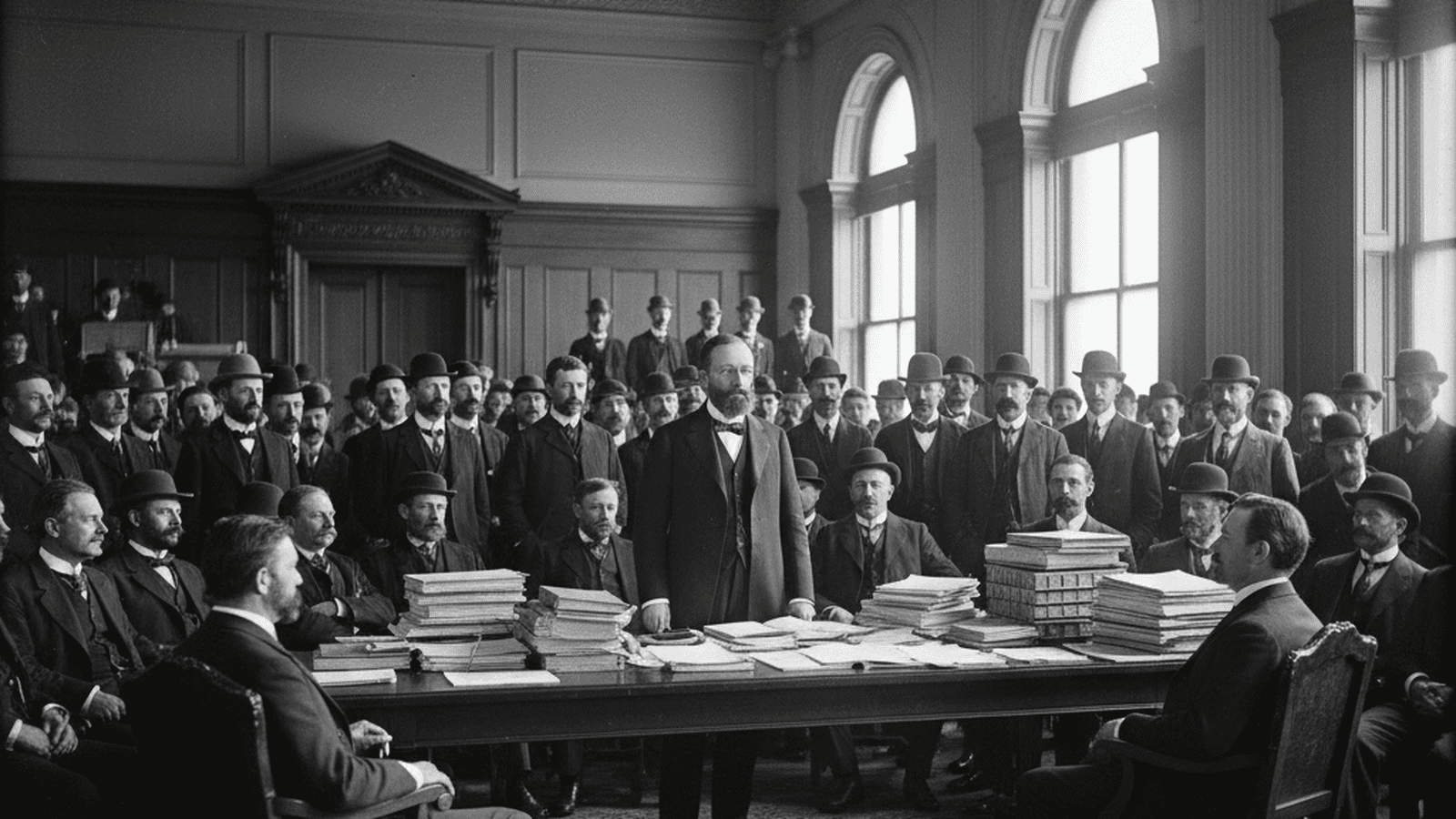
The 1905 Armstrong Committee investigation exposed deep-seated corruption within New York’s life insurance industry and its ties to state legislators. Led by counsel Charles Evans Hughes, the inquiry revealed the misuse of policyholder funds for political lobbying and executive extravagance in the United States.
TLDR: In 1905, the Armstrong Committee investigation uncovered systemic corruption in New York’s insurance sector, revealing how executives used policyholder funds for political influence. The scandal propelled Charles Evans Hughes to national prominence and led to landmark regulatory reforms that fundamentally reshaped corporate governance and insurance oversight in the United States.
In the early months of 1905, the financial heart of the United States was rocked by a scandal that began not with a bank run, but with a costume ball. James Hazen Hyde, the young vice president of the Equitable Life Assurance Society, hosted a lavish Louis XV-themed party at Sherry’s in New York City. The extravagance of the event, rumored to cost $200,000—an astronomical sum at the time—sparked public outrage and ignited a fierce internal power struggle within the company. This friction eventually forced the New York State Legislature to intervene, creating a joint committee to investigate the life insurance industry, which had become a shadow government of sorts.
State Senator William W. Armstrong chaired the committee, but the true driving force was its lead counsel, a relatively unknown lawyer named Charles Evans Hughes. Hughes approached the task with a methodical, forensic intensity that left industry titans reeling. Over several months of public hearings held in the New York City Hall of Records, he interrogated the executives of the “Big Three”—Equitable, Mutual Life, and New York Life. These companies controlled assets larger than the national debt of many countries, yet they operated with almost no public oversight, treating policyholder premiums as their personal capital.
The testimony revealed a systemic culture of corruption and self-dealing that permeated the highest levels of American finance. Hughes uncovered the existence of “Yellow Dog” funds—secret accounts used to pay off lobbyists and influence legislation in Albany and other state capitals. Executives admitted to using policyholder premiums to fund political campaigns, a practice that was then legal but ethically dubious. Furthermore, the investigation exposed rampant nepotism, with high-paying positions and lucrative contracts handed out to family members of the board of directors, often regardless of their qualifications.
One of the most shocking revelations involved the “syndicate” participations. Insurance executives were using company funds to participate in private investment syndicates, pocketing the profits while the companies—and by extension, the policyholders—bore the risks. The hearings were front-page news across the United States, as citizens realized their life savings were being treated as a private slush fund for a small group of Manhattan elites. Hughes’s calm but relentless questioning, backed by an encyclopedic knowledge of the companies’ own ledgers, earned him the nickname “the animated interrogation point.” He famously forced Mutual Life president Richard McCurdy to admit he didn’t know how much his own company paid in legal fees.
The committee’s final report, issued in 1906, was a scathing indictment of the industry. It recommended a total overhaul of insurance law to protect policyholders. The resulting Armstrong Laws were revolutionary. They prohibited insurance companies from owning stock in other corporations, banned political contributions by corporations, and mandated the mutualization of stock companies to give policyholders a vote in management. The laws also capped executive salaries, limited the amount of new business a company could write annually to prevent reckless expansion, and required standardized policy forms.
The fallout from the Armstrong Committee investigation extended far beyond the insurance sector. It signaled a shift in the American political landscape toward the Progressive Era’s emphasis on regulation and transparency. Charles Evans Hughes became a national hero, riding the wave of public approval to the New York governorship in 1906. His career eventually led him to the United States Supreme Court and a tenure as Secretary of State. The reforms established the framework for modern insurance regulation in the United States, decoupling the industry from partisan political machines and setting a precedent for future antitrust and corporate investigations. Today, the principles of fiduciary duty and transparency championed by Hughes remain central to the oversight of financial institutions.
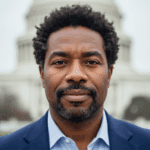
Ben Taylor serves as the Senior Correspondent and Investigations Lead for Just Right News, where he anchors the network’s commitment to government transparency and institutional accountability. With a career defined by a relentless pursuit of the facts, Taylor spearheads the acclaimed feature series “The Paper Trail,” a deep-dive investigative column that prioritizes primary source documentation over political rhetoric. Based in the heart of the nation’s capital, he has earned a reputation as one of the most formidable investigative journalists in Washington, D.C., known specifically for his mastery of public records and the Freedom of Information Act.
Taylor’s approach to journalism is deeply rooted in his upbringing in Kansas City, Missouri. Growing up in the “Show Me State,” he developed a healthy skepticism of centralized power and a profound respect for the common-sense values of the American heartland. This Midwestern foundation informs his reporting today, as he bridges the gap between the complex machinations of federal bureaucracy and the everyday concerns of citizens across the country. For Taylor, investigative reporting is not about chasing headlines; it is about ensuring that the government remains answerable to the people it serves.
As an African American man working within the conservative media landscape, Taylor brings a principled perspective to his beat. He views the Constitution and the right to information as the ultimate equalizers in a free society. His work often highlights how bureaucratic overreach and lack of transparency disproportionately affect individual liberties. By focusing on the “paper trail,” Taylor strips away the spin of partisan talking points, instead providing Just Right News readers with the raw data and internal communications that reveal how their tax dollars are spent and how policy decisions are actually made.
In his role as Investigations Lead, Taylor oversees a team dedicated to uncovering the stories that mainstream outlets often overlook. Whether he is auditing federal spending, investigating regulatory overreach, or exposing inefficiencies within the administrative state, his methodology remains consistent: follow the evidence wherever it leads. His presence in Washington, D.C., allows him to maintain a constant watch over the halls of power, yet he remains steadfastly connected to his roots, ensuring his reporting reflects the clarity and directness of his Missouri home.
Throughout his tenure at Just Right News, Taylor has become a vital voice for those who demand integrity in public office. He believes that a well-informed electorate is the strongest defense against government overreach, and he has dedicated his career to providing the public with the tools they need to hold their leaders accountable. Through “The Paper Trail” and his broader investigative work, Ben Taylor continues to set the standard for rigorous, document-driven journalism that champions the values of transparency, individual responsibility, and the rule of law.