

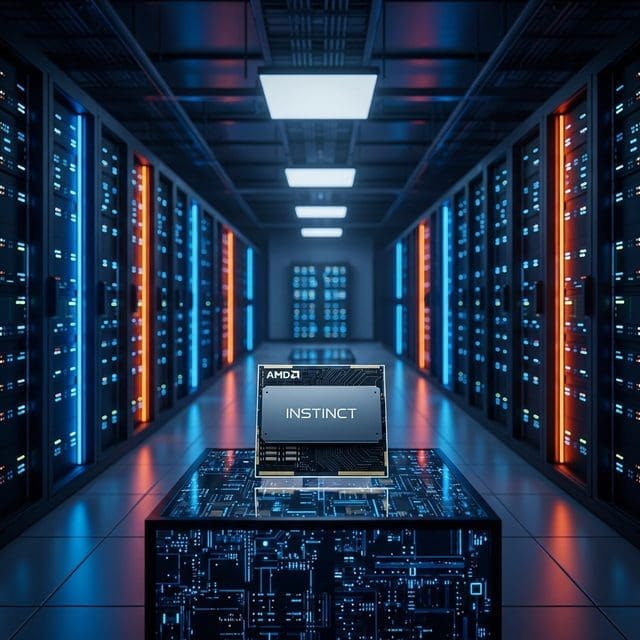
AMD commits up to $5 billion to Anthropic in a milestone-based deal to deploy massive GPU clusters for Claude frontier models.
The landscape of the Algorithmic State shifted significantly on July 22, 2026, as AMD and Anthropic formalized a massive strategic partnership designed to challenge Nvidia’s near-monopoly on the hardware powering modern artificial intelligence. Under the terms of the agreement, AMD will provide a strategic equity investment of up to $5 billion, contingent on Anthropic meeting specific deployment milestones for AMD’s next-generation hardware. This transaction marks a watershed moment in the struggle for control over the digital frontier, as silicon providers and model developers move beyond simple vendor-client relationships into a unified industrial front.
The deal centers on the deployment of up to 2 gigawatts (GW) of Instinct MI450 GPUs within AMD Helios rack-scale systems. The first 1 GW of this capacity is scheduled to come online in the first half of 2027. This arrangement effectively positions AMD as a primary financial and infrastructure backstop for Anthropic, with AMD reportedly in discussions to guarantee future data-center leases for the AI startup. This move signals a deeper integration where the hardware manufacturer becomes the literal foundation for the software’s existence.
Anthropic’s compute strategy has become increasingly diversified, reflecting a tactical necessity to avoid vendor lock-in. By adding AMD to its roster, the company now draws from six distinct silicon sources. This massive portfolio includes up to 5 GW of Amazon Trainium capacity and approximately 3.5 GW of Google TPU capacity slated for 2027. Furthermore, Anthropic utilizes 300 MW of Nvidia compute rented via SpaceX’s Colossus 1. The partnership also confirmed for the first time that Anthropic has already been utilizing AMD Instinct MI355X GPUs for current Claude workloads, debunking the industry assumption that frontier models are exclusively tethered to Nvidia’s ecosystem.
Beyond raw hardware sales, the collaboration extends into the software layer, which has long been Nvidia’s defensive moat. AMD and Anthropic intend to co-develop the ROCm software stack, using Claude to optimize workloads for AMD GPUs. AMD has also committed to broadly adopting Claude across its internal engineering and product teams. This vertical integration suggests a future where AI models are not just products of the chips they run on, but active participants in designing the next generation of silicon. For the average citizen, this means the tools they use for data processing and content creation are increasingly the result of a closed-loop system between a few massive entities.
Simultaneously, the broader AI market continues to experience rapid consolidation and high-stakes maneuvering. Microsoft and Mistral AI have reportedly signed a multibillion-dollar deal to expand Azure infrastructure in Europe. This partnership will see at least two models, Mistral Medium 3.5 and Mistral OCR 4, integrated into the Azure catalog. This development is particularly relevant for those operating within the Adobe ecosystem or utilizing GitHub, as the introduction of a specialized OCR-focused model suggests a significant leap in document ingestion and automated image-to-text pipelines.
While these deals strengthen the supply chain for users of Anthropic’s models via platforms like Google Cloud, AWS, and OpenRouter, they also highlight the accelerating consolidation of power. As multi-billion dollar deals become the baseline for entry into the frontier model market, the barrier to digital sovereignty for smaller actors continues to rise. The tech giants are not merely building tools; they are constructing the very infrastructure of reality, where access to high-end compute is the new currency of liberty.

Lisa Grant serves as a Staff Writer for Just Right News, where she spearheads the publication’s coverage of Technology, Data Capitalism, and Surveillance. With a focus on the encroaching influence of Big Tech on the American way of life, Grant brings a critical, liberty-minded perspective to the most complex digital issues of the modern era. Her reporting is defined by a deep-seated skepticism of centralized power and a commitment to protecting the privacy and autonomy of the individual against the rising tide of what she calls the “Algorithmic State.”
Grant’s unique insight into the tech industry is rooted in her upbringing in Palo Alto, California. Growing up in the epicenter of Silicon Valley, she witnessed firsthand the transformation of the technology sector from a hub of scrappy, freedom-loving innovators into a landscape dominated by monolithic corporations. This proximity to the birth of the digital revolution provided her with an insider’s understanding of the culture and motivations driving the industry. For Grant, the shift toward data capitalism—where personal information is harvested as a primary commodity—is not just a market evolution, but a fundamental challenge to traditional American values of property rights and personal privacy. She saw the “garage startup” ethos replaced by a culture of data-mining and social engineering, a transition that informs her vigilant reporting today.
Now based in Seattle, Washington, Grant operates from another of the nation’s primary technological frontiers. Her location in the Pacific Northwest allows her to observe the real-world consequences of the tech industry’s expansion, from the implementation of invasive surveillance technologies in urban centers to the growing partnership between corporate entities and municipal governance. By reporting from the ground in Seattle, she bridges the gap between the abstract world of coding and the tangible impact it has on citizens’ daily lives, often highlighting how local policies serve as a testing ground for broader national surveillance initiatives.
At the heart of her work for Just Right News is her acclaimed feature series, “The Algorithmic State.” Through this series, Grant explores the ways in which automated systems and artificial intelligence are increasingly used to bypass traditional legislative processes and social norms. She argues that the reliance on opaque algorithms to manage society threatens to erode the transparency and accountability essential to a free republic. Her work meticulously documents how data-driven governance can lead to a “soft” surveillance state that penalizes traditional viewpoints and rewards digital conformity.
Grant’s reporting is a vital resource for readers who are wary of the “nanny state” and the unchecked power of digital gatekeepers. She views the defense of the digital frontier as the next great battle for constitutional conservatives. By exposing the mechanisms of data capitalism and the quiet expansion of surveillance networks, she empowers her audience to reclaim their digital sovereignty. In an era where information is often weaponized by those in power, Lisa Grant remains a steadfast advocate for the truth, ensuring that the principles of liberty and individual agency are not lost in the transition to an increasingly digital world.