

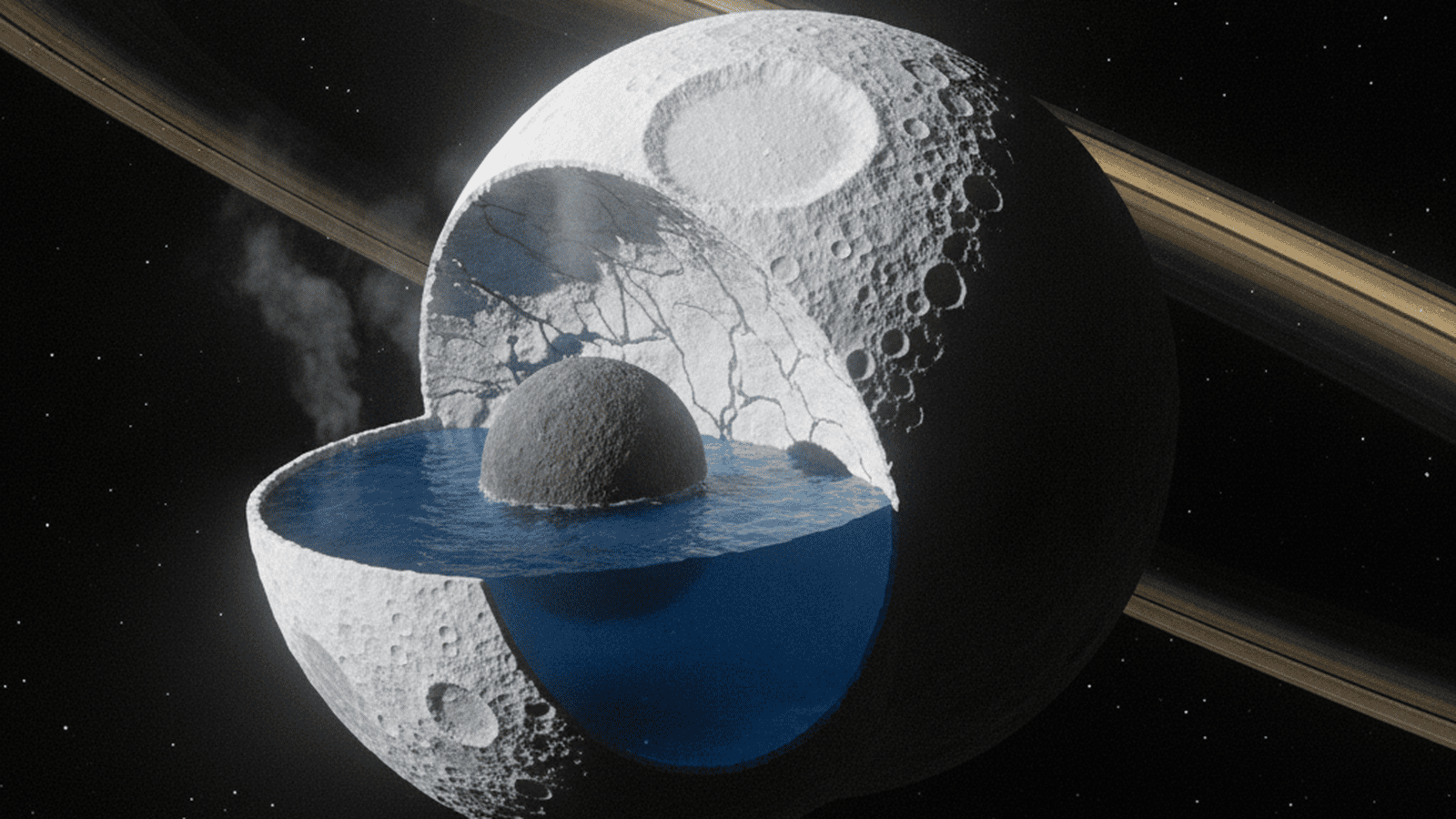
Astronomers have discovered a young subsurface ocean on Saturn’s moon Mimas by analyzing orbital data from the Cassini mission. The liquid layer, estimated to be only 5 to 15 million years old, challenges previous assumptions about the moon’s geological activity.
TLDR: Researchers have identified a hidden liquid ocean beneath the cratered surface of Saturn’s moon Mimas. Analysis of orbital wobbles suggests the ocean formed recently, between 5 and 15 million years ago. This discovery redefines Mimas as a potential site for astrobiological study and expands the known ocean worlds in our solar system.
For decades, planetary scientists viewed Mimas as a relic of the early solar system—a frozen, crater-pocked moon that had remained largely unchanged for billions of years. Its most defining feature, the 130-kilometer-wide Herschel crater, gave it a striking resemblance to the Death Star from Star Wars, reinforcing the image of a cold, inert world. However, a groundbreaking study published in the journal Nature has shattered this long-standing perception. By re-examining data collected by NASA’s Cassini spacecraft during its thirteen-year tenure at Saturn, researchers have uncovered evidence of a global liquid water ocean hidden beneath Mimas’s battered surface. This discovery places Mimas in an elite category of “ocean worlds,” alongside more famous candidates like Europa and Enceladus.
The breakthrough came not from direct imaging of water, but from the meticulous analysis of Mimas’s orbital mechanics. A team led by Dr. Valéry Lainey of the Observatoire de Paris focused on the moon’s librations—tiny, periodic oscillations in its rotation as it orbits Saturn. These wobbles are heavily influenced by the moon’s internal structure and mass distribution. Using complex mathematical models, the researchers compared the observed librations with simulations of various interior compositions. They found that a solid, elongated rocky core could not account for the specific magnitude of the oscillations recorded by Cassini. The only model that fit the data was one featuring a global liquid ocean, approximately 20 to 30 kilometers deep, sandwiched between a thick icy shell and a rocky core.
Perhaps the most shocking aspect of the discovery is the ocean’s estimated age. While the subsurface oceans of Enceladus and Europa are thought to be nearly as old as the solar system itself, the liquid layer on Mimas is a relative newcomer. Calculations suggest it formed between 5 and 15 million years ago—a mere blink of an eye in geological time. This extreme youth explains a long-standing mystery: why Mimas looks so different from its neighbor, Enceladus. Enceladus is famous for its “tiger stripe” fractures and massive geysers that spew water into space. Mimas, by contrast, shows no such activity. The researchers conclude that the ocean is so young that it hasn’t yet had enough time to crack the outer ice shell or create the surface deformations typical of geologically active moons.
The existence of this ocean is driven by tidal heating, a process resulting from Mimas’s slightly elliptical orbit around Saturn. As it moves closer to and further from the giant planet, Saturn’s immense gravitational field exerts varying degrees of stress, stretching and squeezing the moon’s interior. This constant deformation creates internal friction, which generates the thermal energy necessary to melt ice and maintain a liquid state. Scientists believe that a recent change in Mimas’s orbital eccentricity—perhaps due to gravitational interactions with other moons—triggered the melting process, transforming a once-solid block of ice into a dynamic world with a hidden sea.
The discovery has profound implications for the field of astrobiology. It suggests that the “habitable zone”—the region where liquid water can exist—is far broader than previously imagined. If a small, seemingly dormant moon like Mimas can sustain an ocean, then many other icy bodies in the outer solar system might also be hiding liquid water. The interface where the ocean meets the rocky core is particularly exciting for scientists, as it could facilitate the chemical reactions necessary for life. This finding prompts a re-evaluation of other mid-sized moons, such as those orbiting Uranus and Neptune, and sets a new priority for future space exploration missions to look beneath the surface of the solar system’s most unassuming inhabitants.

Mason Reed serves as a Staff Writer for Just Right News, where he spearheads the Future Frontiers & Special Projects desk. In an era defined by rapid technological shifts and evolving social landscapes, Mason provides a steady, principled voice, examining the innovations of tomorrow through the lens of traditional American values. His work is most prominently featured in his signature series, “The Next Horizon,” where he explores the intersection of emerging technology, national sovereignty, and the preservation of individual liberty.
A native of San Diego, California, Mason’s worldview was shaped by the unique culture of his hometown. Growing up in a region defined by its strong military presence and its history of maritime industry, he developed a deep-seated respect for the institutions that provide national stability and the entrepreneurial spirit that drives the American economy. This upbringing instilled in him a belief that true progress is not found in discarding the past, but in building upon a foundation of proven principles. His reporting often reflects this San Diego influence, emphasizing the importance of a robust national defense and the necessity of maintaining a competitive edge in the global marketplace.
Now based in San Francisco, Mason operates from the heart of the world’s technological engine. Living and working in the Bay Area provides him with a front-row seat to the advancements—and the ideological challenges—emanating from Silicon Valley. While many in the region embrace a “move fast and break things” mentality, Mason’s reporting serves as a vital counterweight. He offers Just Right News readers a “boots on the ground” perspective, documenting how radical local policies and the concentration of tech power impact the everyday lives of citizens. His proximity to the industry allows him to cut through the marketing jargon of big tech to uncover the real-world implications for privacy, free speech, and the nuclear family.
In his “Future Frontiers” beat, Mason tackles complex subjects ranging from the ethics of artificial intelligence to the burgeoning private space race. He approaches these topics with a healthy skepticism toward centralized bureaucracy, championing instead the decentralized innovations that empower individuals. Through “The Next Horizon,” he highlights the pioneers and thinkers who are working to ensure that the future remains a place where human dignity and constitutional rights are protected. He believes that the rapid pace of change requires more than just technical expertise; it requires a moral compass rooted in the Western tradition.
Throughout his tenure at Just Right News, Mason has remained committed to the idea that the future is something to be shaped, not merely accepted. His writing is characterized by a rigorous defense of American exceptionalism and a belief that the country’s best days lie ahead, provided it remains true to its founding ideals. Whether he is investigating the impact of automation on the American workforce or profiling the next generation of aerospace engineers, Mason Reed ensures that his readers are equipped with the insights they need to navigate a changing world with confidence and clarity.