

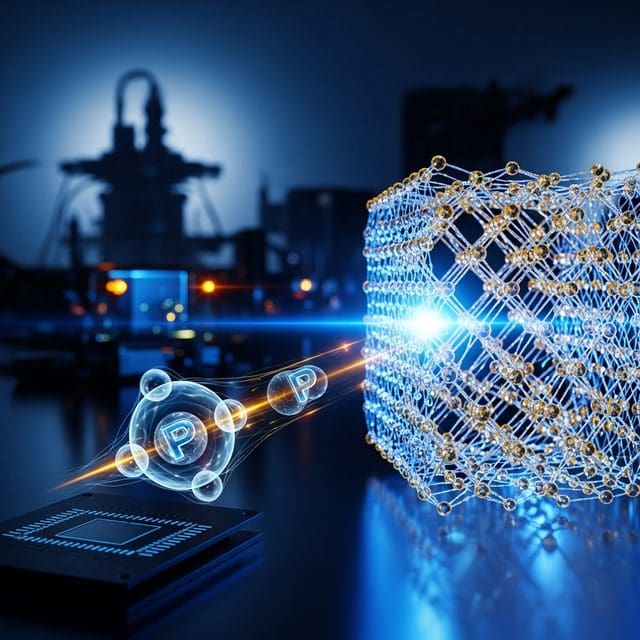
Researchers have discovered a ‘proton-assisted’ mechanism that dramatically increases energy transfer between quantum dots and molecules, potentially revolutionizing solar technology and high-speed quantum sensors.
In the pursuit of cleaner energy and more powerful computing, the ability to move energy at the molecular level with surgical precision remains the ultimate goal for modern physics. This week, a significant discovery in the field of condensed matter physics has brought that goal closer. Researchers at the Dalian Institute of Chemical Physics, Chinese Academy of Sciences, have identified a new quantum mechanism dubbed “proton shuttle-assisted triplet energy transfer” (PS-TET). The finding, published in Nature Materials, reveals how a single proton can act as a transient coordinator to dramatically increase the rate and efficiency of energy movement between quantum dots and molecular assemblies.
Quantum dots—microscopic semiconductor particles—are often paired with molecules to create advanced sensors or high-efficiency solar cells. Traditionally, transferring energy between these two components has been a slow and leaky process, governed by rigid electron-exchange rules known as the Marcus-Hush mechanism. These standard rules typically require a specific energy offset of approximately 0.1 eV to function. The newly discovered PS-TET mechanism represents a radical departure from these design rules. By using a ZnSe quantum dot coupled to a phenol-pyridine molecular assembly, the system triggers a sequence where a proton briefly shifts position to facilitate electron movement before returning to its original spot. This “shuttle” action serves as a quantum catalyst, streamlining the energy flow in a way that standard methylated materials cannot match.
What makes this discovery particularly relevant for the future of American innovation is its inherent tunability. By adding specific chemical groups, such as electron-withdrawing CF3 groups on the pyridine, researchers found they could switch the sequence of the proton-coupled electron and hole transfer steps. This provides engineers with a physical “design knob” to fine-tune how energy moves through a material. Such control is essential for developing next-generation photovoltaics that can capture more sunlight through solar upconversion and quantum optoelectronics that require precise energy states. This level of microscopic control over energy migration is a significant step toward decentralized, high-efficiency power solutions that bypass centralized energy waste.
Parallel to this materials-level breakthrough, the world of integrated hardware also saw a major advancement this week. Scientists have unveiled a programmable optical chip capable of slowing down light on demand. While the proton shuttle improves the “fuel” of quantum systems, this programmable chip provides the “transmission,” allowing for the synchronization and buffering of optical signals within a circuit. This chip targets the reduction of hardware complexity in AI servers and data centers, offering real-time control of light timing and frequency. It follows a broader trend in programmable nonlinear photonics, where recent studies have demonstrated functional areas as small as 0.7 by 0.4 centimeters capable of being updated once per second.
These advancements arrive at a pivotal moment for national scientific strategy. On July 22, 2026, NASA joined the Genesis Mission, a national initiative following a 2025 Executive Order to leverage artificial intelligence and advanced physics to solve complex engineering hurdles. As the United States seeks to maintain its edge in the global technology race, discoveries like the PS-TET mechanism provide the fundamental building blocks for a decentralized energy and computing infrastructure that respects physical limits. By engineering the positions and dynamics of single protons, physicists are no longer just observing nature; they are beginning to script its most fundamental interactions.

Mason Reed serves as a Staff Writer for Just Right News, where he spearheads the Future Frontiers & Special Projects desk. In an era defined by rapid technological shifts and evolving social landscapes, Mason provides a steady, principled voice, examining the innovations of tomorrow through the lens of traditional American values. His work is most prominently featured in his signature series, “The Next Horizon,” where he explores the intersection of emerging technology, national sovereignty, and the preservation of individual liberty.
A native of San Diego, California, Mason’s worldview was shaped by the unique culture of his hometown. Growing up in a region defined by its strong military presence and its history of maritime industry, he developed a deep-seated respect for the institutions that provide national stability and the entrepreneurial spirit that drives the American economy. This upbringing instilled in him a belief that true progress is not found in discarding the past, but in building upon a foundation of proven principles. His reporting often reflects this San Diego influence, emphasizing the importance of a robust national defense and the necessity of maintaining a competitive edge in the global marketplace.
Now based in San Francisco, Mason operates from the heart of the world’s technological engine. Living and working in the Bay Area provides him with a front-row seat to the advancements—and the ideological challenges—emanating from Silicon Valley. While many in the region embrace a “move fast and break things” mentality, Mason’s reporting serves as a vital counterweight. He offers Just Right News readers a “boots on the ground” perspective, documenting how radical local policies and the concentration of tech power impact the everyday lives of citizens. His proximity to the industry allows him to cut through the marketing jargon of big tech to uncover the real-world implications for privacy, free speech, and the nuclear family.
In his “Future Frontiers” beat, Mason tackles complex subjects ranging from the ethics of artificial intelligence to the burgeoning private space race. He approaches these topics with a healthy skepticism toward centralized bureaucracy, championing instead the decentralized innovations that empower individuals. Through “The Next Horizon,” he highlights the pioneers and thinkers who are working to ensure that the future remains a place where human dignity and constitutional rights are protected. He believes that the rapid pace of change requires more than just technical expertise; it requires a moral compass rooted in the Western tradition.
Throughout his tenure at Just Right News, Mason has remained committed to the idea that the future is something to be shaped, not merely accepted. His writing is characterized by a rigorous defense of American exceptionalism and a belief that the country’s best days lie ahead, provided it remains true to its founding ideals. Whether he is investigating the impact of automation on the American workforce or profiling the next generation of aerospace engineers, Mason Reed ensures that his readers are equipped with the insights they need to navigate a changing world with confidence and clarity.