

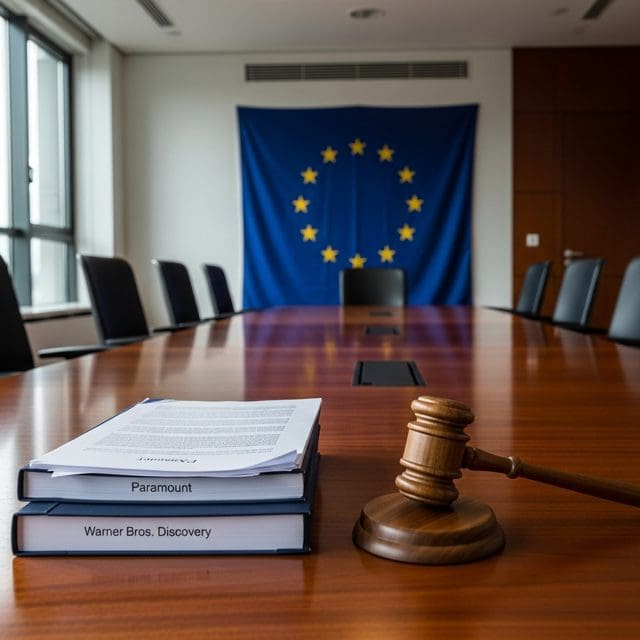
European authorities demand major concessions in the $111 billion Paramount-Warner Bros. merger as U.S. courts pause the deal, signaling a new era of scrutiny for corporate consolidation.
The landscape of global corporate power shifted significantly on July 22, 2026, as international regulators moved to dictate the terms of massive consolidations in the media and financial sectors. While executive branches often signal a permissive environment for mega-mergers, the day’s developments highlight a growing friction between corporate ambitions and the regulatory frameworks designed to protect market competition. This tension is most visible in the $111 billion merger between Paramount Skydance and Warner Bros. Discovery, a deal that would reshape the entertainment industry.
In Brussels, the European Commission issued a conditional clearance for the Paramount-Warner Bros. Discovery tie-up. The approval is not a blank check; it requires Paramount to terminate its long-standing European film distribution partnership with Universal Pictures within 13 months. Specifically, Paramount is exiting the United International Pictures (UIP) joint venture, leaving Universal with full control of that operation. Furthermore, the merged entity is barred from entering similar joint distribution arrangements for at least a decade. These remedies aim to prevent a distribution duopoly that would have likely stifled independent cinema and inflated costs for European theaters and digital platforms.
Despite the Department of Justice previously clearing the media deal without conditions in the United States, the merger remains in legal limbo domestically. A U.S. federal court has temporarily paused the transaction pending a hearing in early August. This judicial intervention serves as a critical check on executive-branch permissiveness, reflecting concerns that the consolidation of two Hollywood titans could permanently erode the bargaining power of creators and smaller streaming competitors. The contrast between the DOJ’s hands-off approach and the court’s skepticism underscores a deepening divide in how American institutions view the threat of monopoly power.
Geopolitical complexities also shadow the media deal. The European Commission’s review included scrutiny of approximately $24 billion in financing sourced from Saudi, Qatari, and Abu Dhabi sovereign wealth funds. Under the Foreign Subsidies Regulation, regulators are increasingly wary of how state-backed capital from non-market economies might distort competition within Western industries. This adds a layer of national security and economic fairness to what was once a purely commercial antitrust inquiry, as officials weigh the influence of foreign state capital on the foundational 3D data layers and 3D content production that the Alliance for OpenUSD is currently attempting to standardize.
Simultaneously, the banking sector saw its own movement as the European Central Bank authorized Banco Santander’s $12.2 billion acquisition of U.S.-based Webster Bank. While the Office of the Comptroller of the Currency has already signaled its approval, the deal still awaits a final decision from the Federal Reserve Board. This cross-border consolidation comes at a sensitive time for the American economy. Recent data from the Ludwig Institute indicates that real median weekly earnings declined year-over-year in the second quarter of 2026, while functional unemployment increased in June. Critics of the Santander deal argue that further banking concentration could exacerbate these economic pressures on middle-class families by reducing access to competitive credit.
As manufacturing output reaches record highs of $2.91 trillion and energy markets remain volatile due to naval blockades in the Middle East, the concentration of market power in banking and media remains a pivotal concern. The divergence between unconditional DOJ clearances and the structural remedies demanded by European authorities suggests that the fight for a competitive, free-market environment is increasingly being fought in the courts and through international regulatory cooperation. For the American consumer, the outcome of these multi-layered reviews will determine whether the future economy is defined by diverse competition or the unchallenged dominance of a few global conglomerates.

Greg Sanders serves as the Senior Correspondent for Corporate Power and Antitrust at Just Right News, where he brings a principled, conservative perspective to the complex intersection of big business, government regulation, and the American consumer. With a career dedicated to investigative depth and economic clarity, Greg has become a leading voice in examining how the consolidation of industry power impacts the foundational values of the free market and individual liberty.
Raised in Denver, Colorado, Greg’s reporting is deeply informed by the Western spirit of independence and a healthy skepticism of centralized authority. Growing up in the shadows of the Rockies, he witnessed firsthand the importance of local entrepreneurship and the vital role that small-medium enterprises play in sustaining vibrant communities. This upbringing instilled in him a belief that the American Dream is best preserved when the playing field remains level and when competition—rather than backroom deals between corporate lobbyists and federal regulators—dictates success. For Greg, the rugged individualism of his home state serves as a constant reminder that the economy should serve the people, not the other way around.
Now based in Chicago, Illinois, Greg operates from the heart of the nation’s industrial and financial crossroads. His location in the Midwest provides him with a unique vantage point to observe the real-world consequences of corporate overreach. From the boardrooms of the Loop to the manufacturing hubs that define the region, he tracks the movement of capital and the shifting tides of market influence. Chicago’s history as a center of trade and labor offers a rich backdrop for his work, allowing him to bridge the gap between high-level economic theory and the lived experiences of hardworking Americans who feel the squeeze of monopolistic practices.
At Just Right News, Greg’s beat focuses on the “new monopolies” and the rise of “woke” corporate culture. He argues that when corporations become too large, they often abandon their fiduciary duties to shareholders in favor of social engineering and political posturing. His reporting seeks to hold these “Titans” accountable, ensuring that the power of the purse is not used to silence dissent or bypass the democratic process. He is a firm advocate for the idea that true conservatism requires a vigilant defense of competition, preventing any single entity—public or private—from exerting undue control over the lives of citizens.
This mission is most clearly seen in his acclaimed feature series, “The Titans and the Toll.” In this ongoing project, Greg explores the human cost of market consolidation, from the erosion of consumer choice to the decline of local economies. Through rigorous analysis and boots-on-the-ground reporting, he documents how the concentration of power in sectors like tech, agriculture, and finance creates a “toll” paid by the average family.
Greg Sanders remains committed to the idea that a transparent, competitive market is the greatest engine for prosperity ever devised. Through his work at Just Right News, he continues to provide the essential oversight necessary to protect that engine from the encroaching influence of corporate giants and the bureaucratic structures that enable them.