

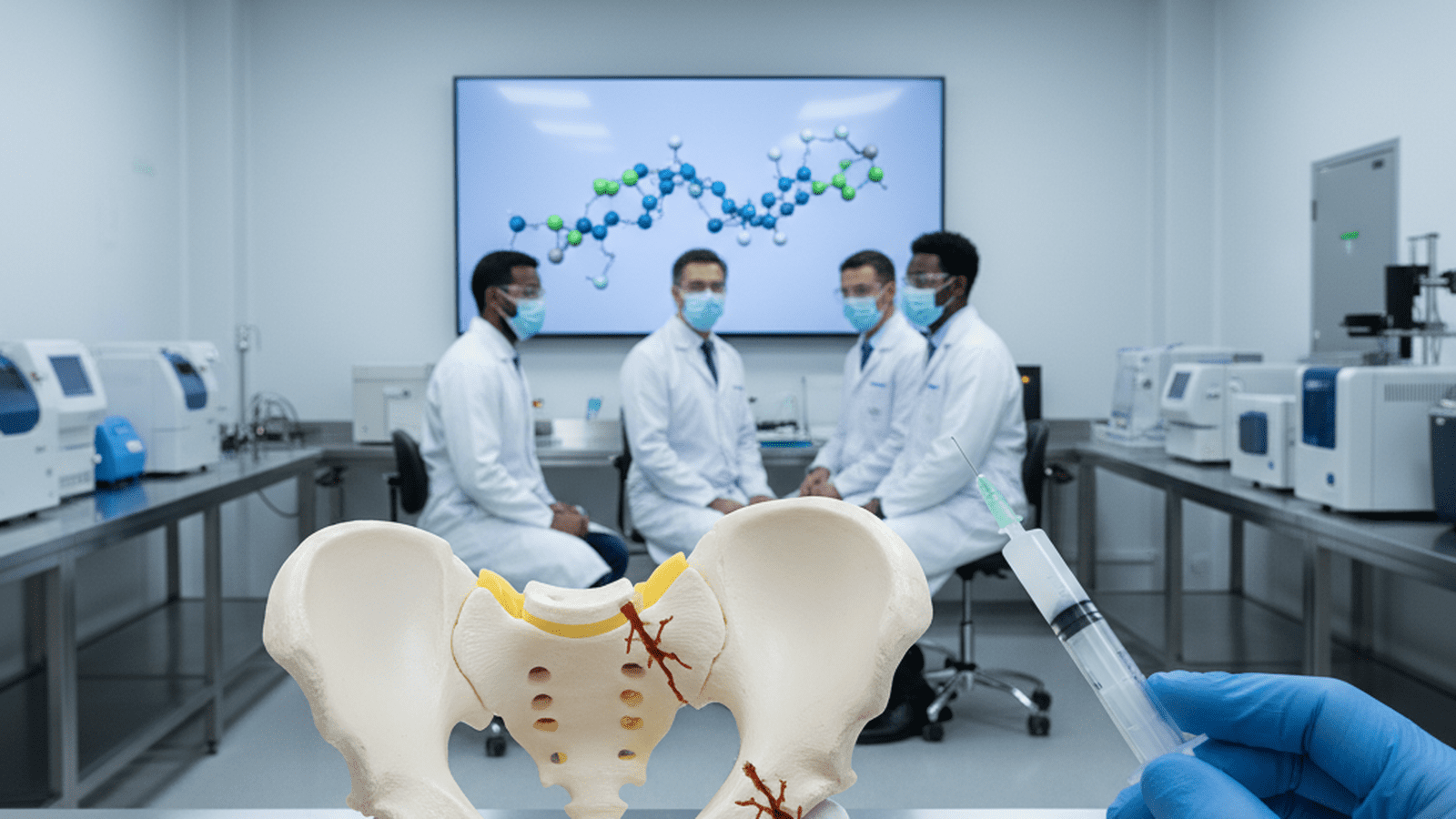
Researchers at Keele University and Royal Stoke University Hospital have created an injectable synthetic bone material that hardens inside the body to repair complex fractures. This biocompatible scaffold supports natural bone growth and eventually dissolves, offering a minimally invasive alternative to traditional bone grafts.
TLDR: Scientists have developed a ‘liquid’ synthetic bone graft that can be injected into fractures, where it hardens into a supportive scaffold. This materials science breakthrough promotes natural healing and eliminates the need for invasive bone harvesting, potentially transforming orthopedic surgery and recovery for patients with complex injuries.
Scientists at Keele University and the Royal Stoke University Hospital have developed a novel injectable material designed to revolutionize the treatment of complex bone fractures. This materials science breakthrough involves a synthetic, ‘liquid’ bone graft that can be administered via a syringe directly into a fracture site. Once inside the body, the material undergoes a phase transition, hardening into a porous scaffold that mimics the structural integrity of natural bone. This scaffold provides immediate support while allowing the patient’s own bone cells to migrate into the structure and begin the regenerative process.
Traditional bone grafting often requires invasive surgery to harvest bone from another part of the patient’s body, such as the hip, which can lead to secondary pain, increased blood loss, and longer recovery times. Alternatively, donor bone from cadavers carries inherent risks of immune rejection or the transmission of pathogens. The new synthetic material, composed of a specialized polymer-calcium phosphate composite, eliminates these requirements entirely. It is designed to be both biocompatible and biodegradable, meaning it eventually dissolves as it is replaced by healthy, living bone tissue, leaving no foreign material in the body long-term.
The research team, led by specialists in regenerative medicine and orthopedic surgery, focused heavily on the material’s rheological properties. The primary challenge was ensuring the substance remains fluid enough for easy injection through a fine-gauge needle but sets quickly and reliably once it reaches body temperature. This ‘smart’ behavior is achieved through precise molecular engineering of the polymer chains, which cross-link in response to the thermal environment of the human body. The resulting matrix is not only strong enough to bear weight in certain applications but also contains a network of microscopic pores. These pores are critical; they facilitate the flow of blood and the delivery of essential nutrients, which are the lifeblood of the healing process.
Clinical trials conducted within the hospital setting have shown particularly promising results in treating non-union fractures—breaks that fail to heal on their own over an extended period. These cases are notoriously difficult for surgeons to manage and often lead to permanent disability. By providing a stable physical environment and a chemical signal that encourages osteoblast activity, the material significantly reduces recovery times and improves the success rate of these difficult repairs. Surgeons involved in the study noted that the injectable nature of the graft allows for minimally invasive procedures, which reduces the overall trauma to the patient and can shorten hospital stays from weeks to days.
Beyond simple fractures, the material holds potential for a wide array of applications in spinal fusion, dental implants, and reconstructive plastic surgery. The ability to customize the material’s degradation rate is a key feature; it can be tailored to match the natural healing speed of different types of bone, from the dense cortical bone found in the limbs to the more porous cancellous bone of the vertebrae. This versatility marks a significant advancement in the field of orthopedic biomaterials, moving away from ‘one-size-fits-all’ implants toward personalized regenerative solutions.
Future research will focus on incorporating growth factors and antimicrobial agents directly into the material’s matrix. This would allow for the controlled, localized release of medication at the site of injury, further preventing post-operative infection and accelerating the recruitment of stem cells to the site. The team is currently working toward larger-scale clinical implementation and navigating the regulatory approval process to make this technology a standard of care in trauma centers and hospitals worldwide.

Susan Carter serves as a Senior Correspondent for Just Right News, where she leads the network’s comprehensive coverage of Health, Medicine, and Public Policy. With a career dedicated to dissecting the complexities of the American healthcare system, Susan brings a principled perspective to the most pressing debates of the day. Her reporting is characterized by a commitment to individual liberty, fiscal responsibility, and a healthy skepticism of government overreach, making her a vital voice for audiences seeking clarity in an increasingly regulated landscape.
Raised in Minneapolis, Minnesota, Susan’s professional outlook is deeply informed by the values of the American heartland. Growing up in the Twin Cities, she witnessed firsthand the importance of community-driven solutions and the resilience of the individual. This Midwestern foundation instilled in her a firm belief that the best answers to public policy challenges often come from local innovation and personal responsibility rather than top-down federal mandates. Her background allows her to translate complex legislative jargon into stories that resonate with families who value common sense and local autonomy.
Now based in Baltimore, Maryland, Susan operates from a unique vantage point at the intersection of medical innovation and urban policy. Living and working in a city renowned for its world-class medical institutions and significant public health challenges, she has a front-row seat to the realities of the modern healthcare landscape. Her proximity to these hubs of research and policy allows her to scrutinize how government intervention affects the quality of care and the freedom of medical professionals. In Baltimore, she sees the tangible results of policy decisions, using the city as a lens through which to examine the broader national health debate and the impact of federal spending on local communities.
As the lead for the acclaimed feature series “The Cost of Care,” Susan dives deep into the economic realities facing patients and providers alike. Her work focuses on the necessity of price transparency, the benefits of market competition, and the preservation of the sacred doctor-patient relationship. She is a staunch advocate for the idea that a well-informed public is the best defense against bureaucratic inefficiency. Through this series, she has exposed the hidden drivers of rising medical expenses, always seeking to empower the individual consumer over the massive institution.
Susan’s reporting on public policy is characterized by a commitment to rigorous inquiry and a focus on constitutional limits. Whether she is analyzing new pharmaceutical regulations, investigating the impact of federal health mandates, or exploring the future of medical technology, her goal remains the same: to provide Just Right News audiences with the facts they need to navigate a complex world. By blending her Midwestern sensibilities with the insights gained from her base in Maryland, Susan Carter has become a trusted authority for those who believe that personal freedom and public health are inextricably linked. Her work continues to challenge the status quo, advocating for a system that respects the taxpayer and prioritizes the patient.