

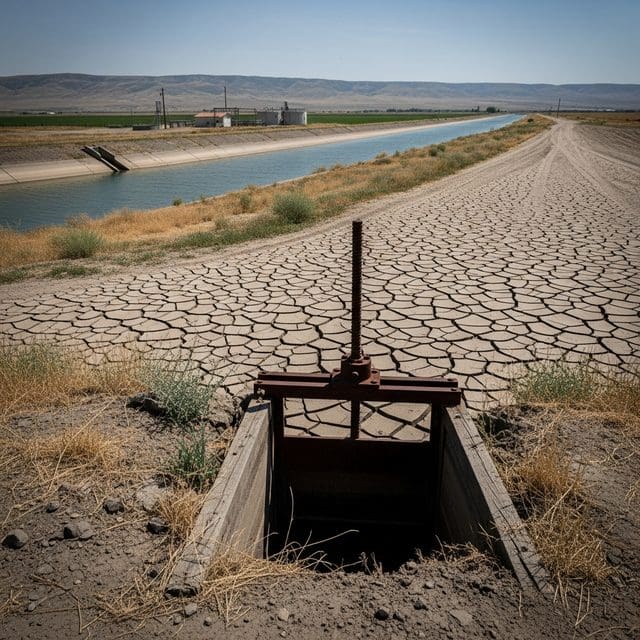
The EPA proposes extending chemical compliance timelines for rural water systems as record drought conditions across 62% of the Lower 48 concentrate agricultural contaminants and strain local infrastructure.
The Environmental Protection Agency has initiated a recalibration of federal water standards, proposing a dual-track approach to “forever chemicals” that offers local utilities more time but less oversight on specific compounds. Between May 18 and May 20, 2026, the agency moved to rescind Safe Drinking Water Act limits for four PFAS variants: PFHxS, PFNA, PFBS, and GenX. While the agency intends to maintain strict 4 parts per trillion limits for PFOA and PFOS, it is proposing a compliance extension. Qualifying water systems could push their deadline for meeting these standards from April 2029 to April 2031.
This extension acknowledges the fiscal reality facing small-town America, where the cost of advanced carbon filtration often exceeds local budgets. To assist, the EPA is pairing the proposal with $1 billion in PFAS reduction funding. However, the 60-day comment window, closing July 20, 2026, is seeing pushback from public health groups who argue that a two-year delay prolongs exposure in agricultural communities. For the farming sector, the stakes are high as these chemicals migrate through soil and irrigation systems.
The regulatory shift arrives as the nation faces a deepening water crisis. As of May 19, 2026, drought monitoring data reveals that 62.42% of the Lower 48 is in drought. The High Plains, West, and Southeast are enduring dry conditions that have driven groundwater to dangerously low levels. In regions like Colorado and Utah, where drought is classified as extreme, the lack of dilution means that pesticides, fertilizers, and animal waste become highly concentrated in the remaining supply. This creates a double-edged sword for farmers: they have less water to work with, and the available water carries higher contamination risks.
Food safety regulators are also grappling with supply chain vulnerabilities. The FDA and CDC recently concluded an investigation into E. coli O157:H7 infections tied to raw cheddar cheese. The outbreak confirmed nine cases across three states and led to a voluntary recall of $1.5 million in product. This case serves as a reminder of the persistent risks in farm-level production, especially as political pressure mounts to expand raw dairy sales. Beyond dairy, the FDA’s active recall list includes various supplements, such as “Complete Green Superfood” and Moringa capsules, due to potential Salmonella contamination.
Processing lapses are also under the microscope. Recent enforcement actions include a recall of Whole Foods Market minestrone soup for undeclared shrimp and Birch Benders pancake mix for undeclared egg. These labeling errors highlight the complexity of modern manufacturing where cross-contamination is a constant threat. In the broader environmental context, the Trump administration continued its deregulatory push on May 21, loosening EPA rules restricting greenhouse gases in commercial refrigeration to lower operational costs for the private sector.
As the July 7, 2026, public hearing on the PFAS rules approaches, the conversation remains centered on the balance between federal mandates and local sovereignty. Rural water systems are caught between the need for clean water and the fiscal reality of infrastructure upgrades. With over half the country under drought stress, the intersection of water quality and quantity will remain the defining challenge for the American food sector. The EPA’s willingness to extend compliance suggests a recognition that environmental health must be achieved through practical milestones rather than unfunded federal ultimatums.

Eric Nolan serves as the Senior Correspondent for Food, Water, and Environmental Health at Just Right News, where he brings a principled, common-sense perspective to the most fundamental issues facing the American public. With a career dedicated to uncovering the truth behind the policies that govern our natural resources, Eric has become a trusted voice for readers who value traditional stewardship over bureaucratic overreach. His reporting is defined by a commitment to the idea that true environmentalism is rooted in the protection of the American family and the preservation of the nation’s agricultural heritage.
Raised in Fresno, California, Eric’s worldview was shaped in the heart of the San Joaquin Valley. Growing up in one of the world’s most productive agricultural hubs, he witnessed firsthand the vital connection between the land, the water, and the dinner table. In Fresno, he saw the resilience of farmers and the devastating impact that distant, top-down regulations can have on local communities. This upbringing instilled in him a deep respect for the producers who feed the country and a lifelong skepticism toward the alarmist narratives often pushed by mainstream media. For Eric, environmental health is not an abstract political talking point; it is a matter of ensuring that the people who work the land have the freedom and the resources to do so effectively.
Now based in Eugene, Oregon, Eric operates from a unique vantage point in the Pacific Northwest. Living in a region often defined by intense environmental debate, he provides a necessary counter-narrative to the prevailing trends of the area. From his base in Eugene, he monitors the shifting tides of federal and state policies, ensuring that the voices of rural citizens and property owners are not drowned out by urban activism. His reporting often bridges the gap between the rugged realities of the outdoors and the legislative halls where decisions are made, offering a grounded perspective that prioritizes local sovereignty and practical solutions.
As the lead for the acclaimed feature series “Earth on the Table,” Eric explores the intricate journey of the American food supply. He tackles critical issues such as water rights, soil health, and food security through a lens of national stability and individual liberty. He believes that a healthy environment and a thriving economy are not mutually exclusive, but rather two sides of the same coin of national prosperity. His work consistently highlights how innovation and private-sector ingenuity are the most effective tools for ensuring clean water and a safe food supply, rather than the expansion of the administrative state.
At Just Right News, Eric’s reporting serves as a vital resource for those who seek accountability and transparency. Whether he is investigating the impact of federal land management on local economies or examining the safety of the national food infrastructure, his work remains anchored in the values of heritage and hard work. Eric Nolan continues to be a leading voice in environmental journalism, championing the belief that the best way to protect our natural resources is to empower the people who live and work closest to them.