

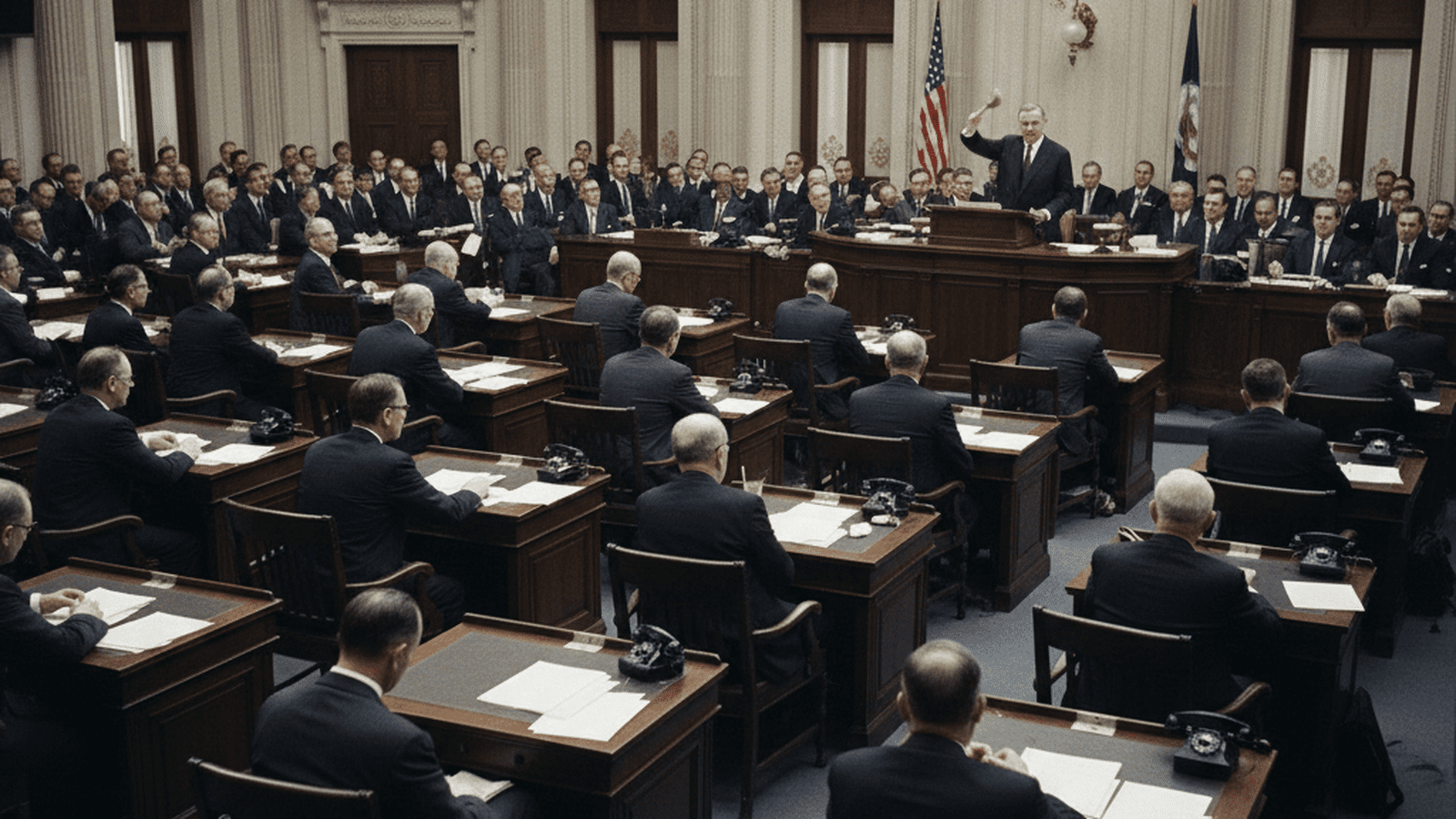
In 1961, Speaker Sam Rayburn and President John F. Kennedy successfully expanded the House Rules Committee from twelve to fifteen members to break a legislative bottleneck. This maneuver aimed to bypass the “conservative coalition” that had used the committee to block civil rights and social welfare legislation in the United States. The narrow victory fundamentally shifted the balance of power in the U.S. House of Representatives, enabling the passage of New Frontier and Great Society programs.
TLDR: In January 1961, the U.S. House of Representatives voted 217-212 to expand the Rules Committee, breaking the grip of conservative obstructionists. Led by Speaker Sam Rayburn, this parliamentary realignment prevented Chairman Howard Smith from unilaterally killing bills. The move was essential for advancing civil rights and federal aid legislation during the Kennedy administration.
In January 1961, the United States House of Representatives became the stage for a high-stakes procedural showdown that would determine the fate of the New Frontier. For years, the House Rules Committee had functioned as a legislative “bottleneck,” a place where progressive bills went to die. The committee’s primary role was to grant “rules” that allowed bills to reach the floor for debate and voting. However, under the iron-fisted chairmanship of Howard W. “Judge” Smith, a staunch segregationist from Virginia, the committee had become a fortress for the “conservative coalition”—an informal alliance of Southern Democrats and conservative Republicans dedicated to blocking civil rights, federal aid to education, and healthcare for the elderly.
The committee consisted of twelve members: eight Democrats and four Republicans. While the Democrats held a nominal majority, two of those Democrats—Chairman Smith and William Colmer of Mississippi—regularly voted with the four Republicans. This created a six-to-six deadlock on almost any piece of liberal legislation, effectively killing it before the full House could ever consider it. For President John F. Kennedy, who had won the 1960 election by a razor-thin margin, this procedural hurdle was an existential threat to his presidency. Without a way to bypass Smith, the Kennedy administration’s agenda would be dead on arrival.
Speaker of the House Sam Rayburn, a legendary figure who had served as Speaker longer than anyone in history, realized that a direct confrontation was inevitable. Rayburn, though a Texan, was a loyal party man who believed the House must be allowed to vote on the President’s program. He proposed a bold parliamentary maneuver: expanding the Rules Committee from twelve members to fifteen. By adding two loyal Democrats and one Republican, Rayburn aimed to shift the balance of power to an eight-to-seven majority in favor of the administration. This “packing” of the committee was seen by many as a radical move, challenging the long-standing tradition of committee autonomy and the seniority system.
The ensuing battle was one of the most intense in the history of the Capitol. Chairman Smith and Minority Leader Charles Halleck framed the expansion as a power grab by the executive branch that would destroy the independence of the House. They argued the Rules Committee was a necessary “traffic cop” that protected the chamber from ill-considered legislation. Rayburn, meanwhile, engaged in a relentless lobbying campaign. He utilized his vast network of personal relationships, famously known as his “Board of Education,” to persuade wavering members. The Kennedy administration also applied significant pressure, with the President himself making phone calls and Cabinet members dangling patronage and projects to secure votes.
On January 31, 1961, the House floor was packed with spectators and journalists. The tension was palpable as the roll call began. In a dramatic finish, the expansion passed by a narrow margin of 217 to 212. The victory was a testament to Rayburn’s legislative mastery, though it would be his final great battle; he passed away later that year. The five-vote margin fundamentally altered the internal dynamics of Congress. It broke the absolute veto power of the conservative coalition and signaled a shift toward stronger centralized leadership by the Speaker.
The immediate impact was the release of several stalled bills, including the Minimum Wage Act and housing legislation. More importantly, it cleared the path for the landmark achievements of the 1960s. Without the 1961 expansion, the Civil Rights Act of 1964 and the Great Society programs of the Lyndon B. Johnson era might never have reached the floor. The “Breaking of the Bottleneck” remains a definitive example of how procedural reform can serve as a catalyst for profound social and political change.

Miles Harrington serves as the Senior Correspondent for Federal Systems & Executive Power at Just Right News, where he brings a disciplined, constitutionalist lens to the inner workings of the American government. With a focus on the mechanics of the federal bureaucracy and the limits of executive authority, Harrington has established himself as a vital voice for readers who value transparency, accountability, and the preservation of the separation of powers.
A native of Richmond, Virginia, Harrington’s perspective is deeply rooted in the traditions of the Old Dominion. Growing up in a city defined by its historical significance and its role as a center of American jurisprudence, he developed an early appreciation for the foundational principles of the Republic. His upbringing in Richmond—a place where the legacy of the Founding Fathers is woven into the landscape—instilled in him a belief that the federal government should remain within its constitutional bounds. This background informs his skepticism of centralized overreach and his commitment to reporting on the ways in which the administrative state impacts the lives of everyday citizens.
In his current role, Harrington specializes in the complexities of federal systems. He doesn’t just report on the headlines of the day; he digs into the structural shifts within the executive branch that often go unnoticed by the mainstream press. Whether he is analyzing the implications of a new federal regulation or investigating the expansion of agency jurisdiction, his work is characterized by a rigorous adherence to the facts and a dedication to the rule of law.
Harrington is perhaps best known for his signature feature series, “How Washington Works.” Through this ongoing project, he demystifies the often-opaque processes of the nation’s capital, pulling back the curtain on the “Deep State” and the unelected officials who wield significant influence over national policy. By breaking down complex legislative maneuvers and executive orders, he empowers Just Right News readers to understand the true levers of power in Washington. His reporting serves as a necessary check on the federal government, ensuring that the actions of those in power are held up to the light of public scrutiny.
Now based in Washington, D.C., Harrington operates at the epicenter of the political world, yet he remains intentionally distanced from the “Beltway bubble.” His proximity to the halls of power allows him to maintain a robust network of sources across the federal landscape, but his heart remains in the principled conservatism of his Virginia roots. He views his role not merely as a reporter, but as a steward of the public trust, dedicated to providing the clarity and context that conservative voters need to navigate an increasingly complex political environment.
Through his sharp analysis and unwavering commitment to the truth, Miles Harrington continues to be a cornerstone of the Just Right News team. His work ensures that the principles of limited government and executive restraint remain at the forefront of the national conversation, providing a crucial service to those who believe in a government that is truly of, by, and for the people.