

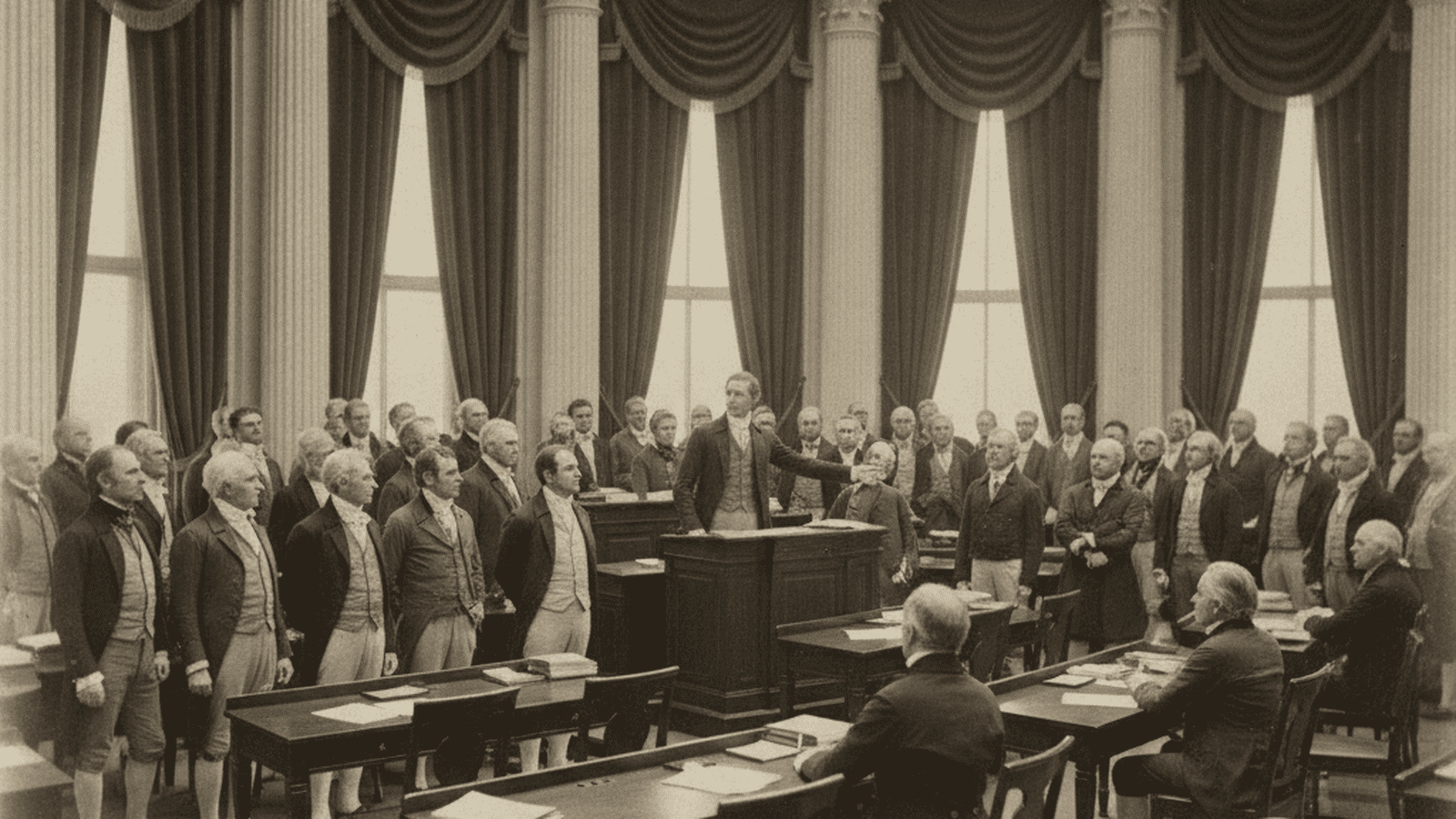
In 1811, the United States House of Representatives underwent a fundamental parliamentary realignment with the election of Henry Clay as Speaker. This shift transformed the office from a neutral presiding role into a position of significant political and legislative power, enabling the rise of the ‘War Hawks’ and the modern partisan Speakership.
TLDR: The 1811 election of Henry Clay as Speaker of the House marked a pivotal realignment in U.S. governance. By leveraging committee appointments and legislative control, Clay turned the Speakership into a partisan leadership post, fundamentally altering the balance of power between the executive and legislative branches.
The convening of the Twelfth United States Congress in November 1811 represented a watershed moment in the evolution of American governance. Before this pivotal session, the Speaker of the House of Representatives was largely viewed through the lens of the British parliamentary tradition—a neutral arbiter whose primary duty was to maintain order and interpret rules rather than to champion a specific political agenda. Early Speakers like Frederick Muhlenberg or Jonathan Dayton generally avoided the fray of partisan combat, acting as moderators of a deliberative body. However, the election of Henry Clay of Kentucky fundamentally dismantled this precedent, initiating a parliamentary realignment that transformed the Speakership into the most potent legislative office in the United States.
Clay’s ascent was as rapid as it was revolutionary. Although he was technically a freshman in the House, he arrived with a formidable reputation earned in the Senate and the Kentucky legislature. On his very first day in the chamber, his colleagues elected him Speaker by a wide margin. This was not merely a tribute to his charisma; it was a mandate for a more aggressive legislative posture. Clay was the intellectual and political leader of the “War Hawks,” a group of young, nationalistic Democratic-Republicans from the South and West. These men were frustrated by years of British maritime harassment and the perceived weakness of the American response. They sought a leader who could mobilize the House into a unified force capable of steering the nation toward a more assertive foreign policy.
The core of Clay’s realignment lay in his strategic reimagining of the Speaker’s administrative powers. He recognized that the authority to appoint members to standing committees, while established, had never been fully exploited as a tool of partisan control. Clay broke with the tradition of seniority and geographic balance to pack essential committees with his ideological allies. By placing fellow War Hawks in charge of the Committee on Foreign Relations and the Committee on Ways and Means, Clay ensured that every piece of legislation reaching the floor had been vetted and shaped by his faction. This maneuver effectively centralized the House’s power, turning it from a reactive debating society into a proactive engine of policy.
This internal reorganization had profound implications for the balance of power between the legislative and executive branches. While President James Madison was often cautious and inclined toward diplomatic solutions, Clay used his position to create a legislative momentum that the White House could not ignore. Through his mastery of parliamentary tactics—such as the “previous question” motion to cut off debate—Clay silenced Federalist opposition and accelerated the passage of military preparations. He was not just presiding over the House; he was whipping votes and enforcing party discipline in a way that had never been seen in the young republic.
The 1811 realignment reached its logical conclusion with the declaration of the War of 1812. Clay’s ability to navigate the political hurdles of the House proved that a determined Speaker could dictate the national agenda. This shift also signaled the decline of the “Old Republican” faction, which favored a weak central government and a passive legislature. By the time Clay left the chair, the Speakership had been permanently redefined as a partisan leadership post.
While later eras would see challenges to this concentrated power—most notably the 1910 revolt against Joseph Cannon—the fundamental structure established by Clay remains the bedrock of modern congressional operations. The Speaker today is the undisputed leader of their party in the House, a direct legacy of the 1811 realignment. This transition ensured that the House of Representatives would remain the primary arena for American political conflict, characterized by a disciplined, party-driven approach to governance that continues to define the legislative process.

Miles Harrington serves as the Senior Correspondent for Federal Systems & Executive Power at Just Right News, where he brings a disciplined, constitutionalist lens to the inner workings of the American government. With a focus on the mechanics of the federal bureaucracy and the limits of executive authority, Harrington has established himself as a vital voice for readers who value transparency, accountability, and the preservation of the separation of powers.
A native of Richmond, Virginia, Harrington’s perspective is deeply rooted in the traditions of the Old Dominion. Growing up in a city defined by its historical significance and its role as a center of American jurisprudence, he developed an early appreciation for the foundational principles of the Republic. His upbringing in Richmond—a place where the legacy of the Founding Fathers is woven into the landscape—instilled in him a belief that the federal government should remain within its constitutional bounds. This background informs his skepticism of centralized overreach and his commitment to reporting on the ways in which the administrative state impacts the lives of everyday citizens.
In his current role, Harrington specializes in the complexities of federal systems. He doesn’t just report on the headlines of the day; he digs into the structural shifts within the executive branch that often go unnoticed by the mainstream press. Whether he is analyzing the implications of a new federal regulation or investigating the expansion of agency jurisdiction, his work is characterized by a rigorous adherence to the facts and a dedication to the rule of law.
Harrington is perhaps best known for his signature feature series, “How Washington Works.” Through this ongoing project, he demystifies the often-opaque processes of the nation’s capital, pulling back the curtain on the “Deep State” and the unelected officials who wield significant influence over national policy. By breaking down complex legislative maneuvers and executive orders, he empowers Just Right News readers to understand the true levers of power in Washington. His reporting serves as a necessary check on the federal government, ensuring that the actions of those in power are held up to the light of public scrutiny.
Now based in Washington, D.C., Harrington operates at the epicenter of the political world, yet he remains intentionally distanced from the “Beltway bubble.” His proximity to the halls of power allows him to maintain a robust network of sources across the federal landscape, but his heart remains in the principled conservatism of his Virginia roots. He views his role not merely as a reporter, but as a steward of the public trust, dedicated to providing the clarity and context that conservative voters need to navigate an increasingly complex political environment.
Through his sharp analysis and unwavering commitment to the truth, Miles Harrington continues to be a cornerstone of the Just Right News team. His work ensures that the principles of limited government and executive restraint remain at the forefront of the national conversation, providing a crucial service to those who believe in a government that is truly of, by, and for the people.