

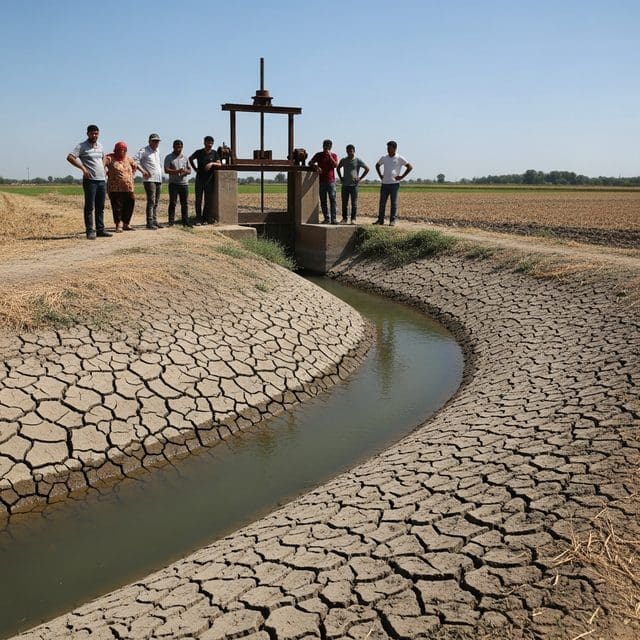
Farmers from the Krishna delta to the United Kingdom face intensifying water shortages as government mismanagement and drought threaten food production and land rights.
The fundamental right of a farmer to access water for his livelihood is under siege from both natural drought and bureaucratic inertia. In the Krishna delta, the tension between government directives and agricultural reality reached a boiling point on August 2, 2026. Farmers at Sariv Thota staged a protest demanding the immediate release of irrigation water into the Krishna Eastern canal. Having already invested between 10,000 and 15,000 rupees per acre in paddy nurseries, these producers find themselves at the mercy of a state government that previously advised them to skip the crop entirely due to a 51 percent monsoon deficit.
This situation highlights a recurring failure in water infrastructure management. While the Andhra Pradesh government has prioritized drinking water for 60 lakh residents through mid-2027, the agricultural sector is being left to wither. Despite the diversion of Godavari floodwaters via the Pattiseema project, farmers report that current canal supplies are highly inadequate. The reported release of 13.75 TMC ft of water so far has failed to sustain existing crops, and the delay in full canal releases represents a direct threat to regional food security and the financial stability of independent farm families.
Similar pressures are mounting in Karnataka, where Chief Minister D.K. Shivakumar announced that a formal drought declaration will not be finalized until the end of August. This delay in administrative recognition translates to a delay in critical relief measures, leaving farmers in limbo while the Revenue Department compiles ground reports. The lack of timely, common-sense intervention from central authorities forces local producers to bear the brunt of environmental volatility alone, waiting for a bureaucratic process to validate the dry soil beneath their feet.
In the United Kingdom, National Farmers’ Union (NFU) President Tom Bradshaw warned that prolonged drought could lead to significant shortages of essential foods. Bradshaw is calling for robust government action to protect the domestic food supply, emphasizing that farm resilience is a matter of national security. The common thread across these regions is a growing gap between the needs of those who work the land and the regulatory frameworks supposed to support them, which often prioritize urban centers or administrative convenience over the agricultural backbone of the economy.
Land sovereignty is also surfacing as a point of contention in Kerala. The Forest Department recently informed the Central Empowered Committee that the Plantation Corporation of Kerala (PCK) is in “unauthorised” possession of nearly 3,903 hectares of forestland following the expiration of 50-year leases. The department alleges that portions of this land have been subleased for private pineapple cultivation, complicating the balance between production and conservation. This pending governance gap leaves the future of these plantations in doubt, reflecting a trend of state-managed entities failing to maintain clear, lawful stewardship.
Even in the United States, water system integrity is a political flashpoint. President Trump recently criticized Minnesota officials for “gross incompetence” regarding cyberattacks on water infrastructure, dismissing federal assessments of foreign involvement. Whether it is the mismanagement of canal systems in India or the failure to secure domestic utilities, the result remains the same: the producer is marginalized. Protecting the American family and global food stability requires a shift away from reactive, top-down mandates toward infrastructure that prioritizes the private sector’s ability to innovate and survive.

Eric Nolan serves as the Senior Correspondent for Food, Water, and Environmental Health at Just Right News, where he brings a principled, common-sense perspective to the most fundamental issues facing the American public. With a career dedicated to uncovering the truth behind the policies that govern our natural resources, Eric has become a trusted voice for readers who value traditional stewardship over bureaucratic overreach. His reporting is defined by a commitment to the idea that true environmentalism is rooted in the protection of the American family and the preservation of the nation’s agricultural heritage.
Raised in Fresno, California, Eric’s worldview was shaped in the heart of the San Joaquin Valley. Growing up in one of the world’s most productive agricultural hubs, he witnessed firsthand the vital connection between the land, the water, and the dinner table. In Fresno, he saw the resilience of farmers and the devastating impact that distant, top-down regulations can have on local communities. This upbringing instilled in him a deep respect for the producers who feed the country and a lifelong skepticism toward the alarmist narratives often pushed by mainstream media. For Eric, environmental health is not an abstract political talking point; it is a matter of ensuring that the people who work the land have the freedom and the resources to do so effectively.
Now based in Eugene, Oregon, Eric operates from a unique vantage point in the Pacific Northwest. Living in a region often defined by intense environmental debate, he provides a necessary counter-narrative to the prevailing trends of the area. From his base in Eugene, he monitors the shifting tides of federal and state policies, ensuring that the voices of rural citizens and property owners are not drowned out by urban activism. His reporting often bridges the gap between the rugged realities of the outdoors and the legislative halls where decisions are made, offering a grounded perspective that prioritizes local sovereignty and practical solutions.
As the lead for the acclaimed feature series “Earth on the Table,” Eric explores the intricate journey of the American food supply. He tackles critical issues such as water rights, soil health, and food security through a lens of national stability and individual liberty. He believes that a healthy environment and a thriving economy are not mutually exclusive, but rather two sides of the same coin of national prosperity. His work consistently highlights how innovation and private-sector ingenuity are the most effective tools for ensuring clean water and a safe food supply, rather than the expansion of the administrative state.
At Just Right News, Eric’s reporting serves as a vital resource for those who seek accountability and transparency. Whether he is investigating the impact of federal land management on local economies or examining the safety of the national food infrastructure, his work remains anchored in the values of heritage and hard work. Eric Nolan continues to be a leading voice in environmental journalism, championing the belief that the best way to protect our natural resources is to empower the people who live and work closest to them.