

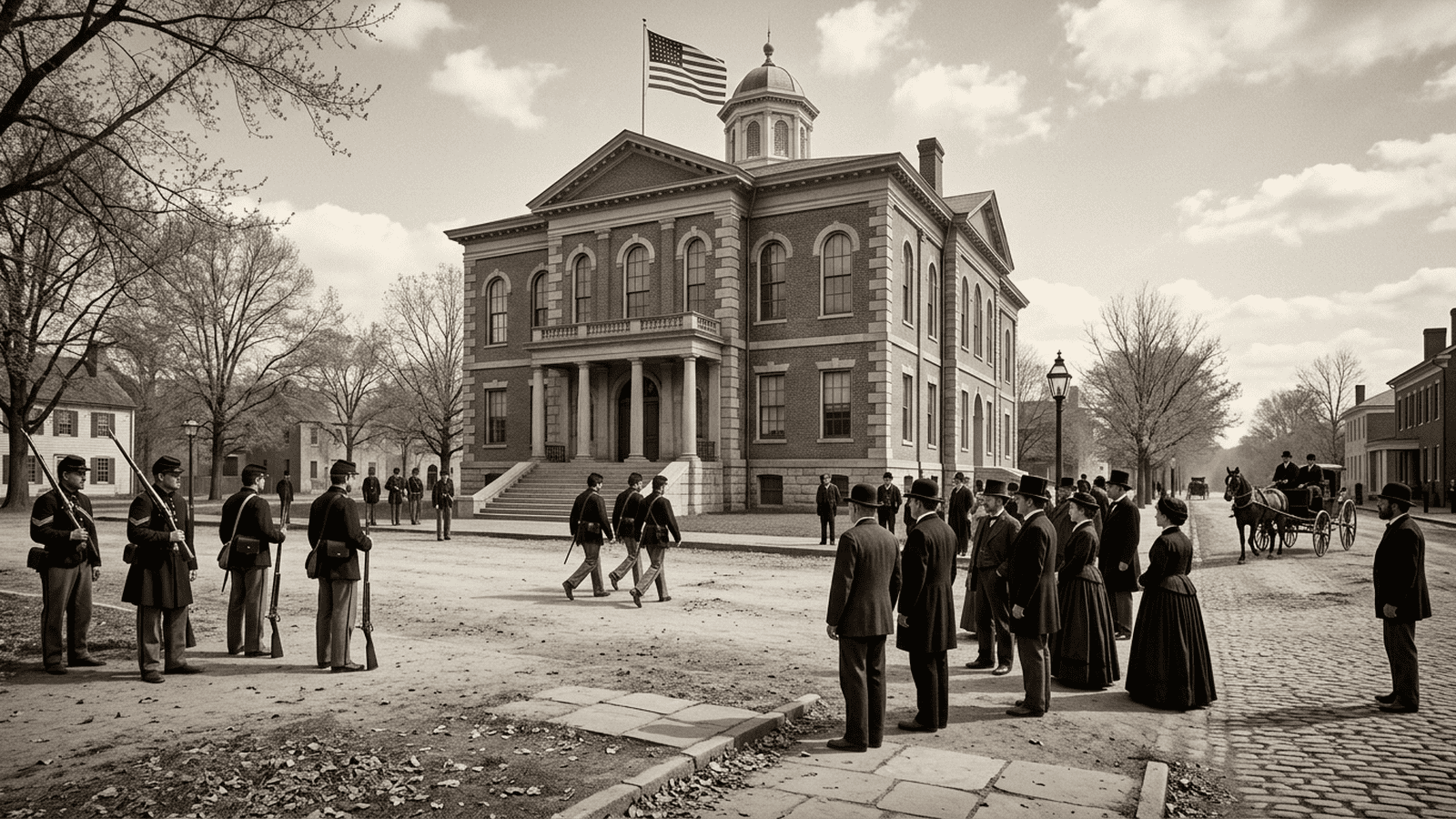
In 1877, President Rutherford B. Hayes ordered federal troops to stop guarding the contested statehouses in Louisiana and South Carolina, ending direct military support for their Republican governments. The decision helped Southern Democrats consolidate power and became a turning point in the United States debate over executive authority, federal protection, and Reconstruction-era rights.
TLDR: Hayes’s 1877 order removed federal troops from the statehouses in Louisiana and South Carolina, where rival governments claimed power after the disputed 1876 election. The move helped Democrats take control and marked a retreat from military protection of Reconstruction, with lasting consequences for Black political rights and federal oversight.
On April 20, 1877, President Rutherford B. Hayes ordered federal troops in Louisiana and South Carolina to stop guarding the statehouses at New Orleans and Columbia. The move ended direct military support for the remaining Republican state governments, which had been contested by Democrats since the disputed 1876 election. It marked a consequential use of presidential authority—and a retreat from federal protection of Reconstruction in the South.
The presidential election had produced rival claims in both states. Republican and Democratic state canvassing boards reported competing results, while each side backed its own governor and legislature. Nationally, disputes over electoral votes from Louisiana, South Carolina, Florida, and Oregon delayed the count. Congress created an electoral commission, whose decisions gave Republican Hayes the presidency by a single electoral vote. The settlement resolved the national contest, but did not settle who governed Louisiana or South Carolina.
In Louisiana, Republican Stephen B. Packard held the statehouse in New Orleans, while Democrat Francis T. Nicholls claimed the governorship and had support across much of the state. In South Carolina, Republican Daniel H. Chamberlain and Democrat Wade Hampton III likewise asserted authority. Federal troops, stationed at the statehouses under orders from earlier administrations, helped prevent either Democratic claimant from taking control by force. Their presence kept the rival governments in a tense, provisional balance.
Hayes entered office promising civil service reform and a more conciliatory approach to the South. His administration sought cooperation from Southern Democrats, including support for federal appointments and policies, while arguing that state governments should rest on broad public acceptance rather than military backing. The president’s decision followed negotiations with Southern political leaders and his effort to establish a government capable of functioning beyond the capital’s protection.
The April order did not withdraw every federal soldier from the South. Troops remained at federal installations, including forts, and the action did not itself declare either state government legally invalid. But removing the guard from the statehouses changed the political reality. In Louisiana, Packard’s government soon lost control; Nicholls took office. In South Carolina, Hampton’s government consolidated authority, and Chamberlain left the state. Democrats had achieved power without a new federal election settling the rival claims.
The change became associated with the informal political understanding often called the Compromise of 1877. Historians debate whether a single, explicit bargain existed; no signed agreement has been established. The withdrawal was nevertheless part of a broader accommodation between Hayes’s administration and Southern Democrats. The administration also pursued measures intended to encourage sectional reconciliation, including appointments of Southerners to federal posts. For Black Southerners, however, the shift meant that federal authorities were less willing to use military power to defend Republican governments and the political rights associated with Reconstruction.
That distinction matters: the order was not a formal repeal of constitutional amendments or civil-rights statutes. Nor did it instantly end all federal enforcement. It did, however, signal a narrower conception of executive responsibility, in which the president declined to keep troops supporting governments whose legitimacy was fiercely disputed. Local and state authorities gained greater freedom to reshape political life, while Black voters and officeholders faced growing intimidation and exclusion.
The immediate consequences unfolded unevenly, but the end of military protection helped Southern Democrats restore control and weakened the practical enforcement of Reconstruction-era rights. Hayes’s decision became a landmark in the debate over presidential power, federalism, and the limits of national intervention. Later civil-rights struggles, federal voting-rights enforcement, and congressional oversight would revisit the unresolved question of how far the executive branch should go to protect political participation when state authorities fail to do so.

Miles Harrington serves as the Senior Correspondent for Federal Systems & Executive Power at Just Right News, where he brings a disciplined, constitutionalist lens to the inner workings of the American government. With a focus on the mechanics of the federal bureaucracy and the limits of executive authority, Harrington has established himself as a vital voice for readers who value transparency, accountability, and the preservation of the separation of powers.
A native of Richmond, Virginia, Harrington’s perspective is deeply rooted in the traditions of the Old Dominion. Growing up in a city defined by its historical significance and its role as a center of American jurisprudence, he developed an early appreciation for the foundational principles of the Republic. His upbringing in Richmond—a place where the legacy of the Founding Fathers is woven into the landscape—instilled in him a belief that the federal government should remain within its constitutional bounds. This background informs his skepticism of centralized overreach and his commitment to reporting on the ways in which the administrative state impacts the lives of everyday citizens.
In his current role, Harrington specializes in the complexities of federal systems. He doesn’t just report on the headlines of the day; he digs into the structural shifts within the executive branch that often go unnoticed by the mainstream press. Whether he is analyzing the implications of a new federal regulation or investigating the expansion of agency jurisdiction, his work is characterized by a rigorous adherence to the facts and a dedication to the rule of law.
Harrington is perhaps best known for his signature feature series, “How Washington Works.” Through this ongoing project, he demystifies the often-opaque processes of the nation’s capital, pulling back the curtain on the “Deep State” and the unelected officials who wield significant influence over national policy. By breaking down complex legislative maneuvers and executive orders, he empowers Just Right News readers to understand the true levers of power in Washington. His reporting serves as a necessary check on the federal government, ensuring that the actions of those in power are held up to the light of public scrutiny.
Now based in Washington, D.C., Harrington operates at the epicenter of the political world, yet he remains intentionally distanced from the “Beltway bubble.” His proximity to the halls of power allows him to maintain a robust network of sources across the federal landscape, but his heart remains in the principled conservatism of his Virginia roots. He views his role not merely as a reporter, but as a steward of the public trust, dedicated to providing the clarity and context that conservative voters need to navigate an increasingly complex political environment.
Through his sharp analysis and unwavering commitment to the truth, Miles Harrington continues to be a cornerstone of the Just Right News team. His work ensures that the principles of limited government and executive restraint remain at the forefront of the national conversation, providing a crucial service to those who believe in a government that is truly of, by, and for the people.