

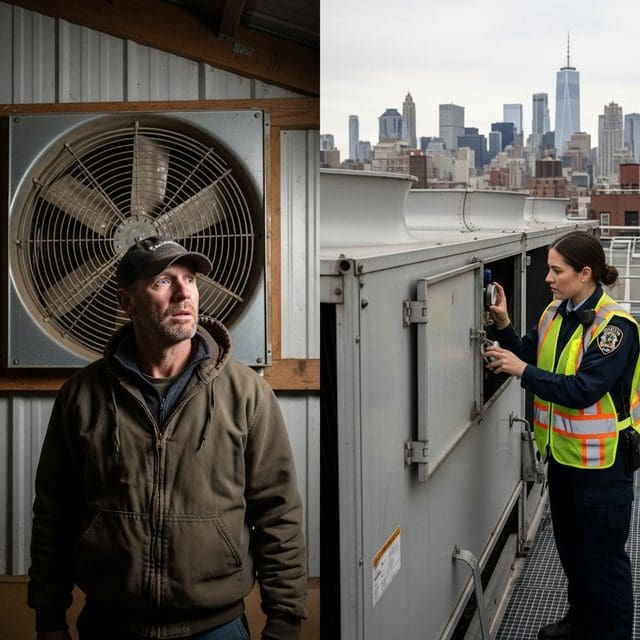
Recent events in Nova Scotia and Manhattan highlight the critical vulnerabilities of our food supply and urban water systems to both deliberate interference and systemic neglect.
The security of the North American food supply and the integrity of urban water infrastructure are under renewed scrutiny following a series of incidents that highlight the fragility of essential systems. In Nova Scotia, the RCMP is currently investigating what they have termed a deliberate act of agricultural sabotage. Between July 24 and July 25, an intruder breached a poultry barn near Pine Grove, not to steal livestock, but to systematically deactivate the facility’s ventilation fans. The resulting loss of airflow in the enclosed environment led to the deaths of approximately 10,000 chickens.
This incident represents a chilling escalation in threats against the agricultural sector. Investigators have confirmed that the motive appears to be a calculated attempt to harm the birds and, by extension, the livelihood of the producers. For the American farmer, this serves as a stark warning: the stewardship of our food supply is increasingly targeted by those who seek to weaponize the very infrastructure designed to protect animal welfare. While the RCMP continues to seek information from the public and no arrests have been made, the event underscores the necessity for robust private-sector security measures that do not rely solely on slow-moving government response.
Meanwhile, in the dense urban environment of New York City, the Department of Health is managing the fallout of a deadly Legionnaires’ disease outbreak on the Upper East Side. As of July 31, the death toll has risen to seven, with over 90 confirmed cases. The investigation focused on the aerosolized water produced by cooling towers rather than the municipal plumbing. Health officials inspected 183 cooling towers across 160 buildings in the cluster area, finding that 77 of them tested positive for the bacteria during the initial round of testing.
While NYC Health has maintained that the neighborhood’s tap water remains safe for drinking and cooking, the outbreak highlights a recurring failure in the maintenance of large-scale urban climate control systems. The reliance on these complex, often poorly monitored cooling towers creates a public health risk that regulators struggle to contain until after fatalities occur. Although new diagnoses have slowed, with only two new cases identified in the final days of July, the scale of the infection demonstrates how quickly environmental contamination can spread through shared infrastructure.
In the heartland, Midwestern farmers are facing a different kind of environmental pressure. Robby Meeker, an agronomy manager with Wyffels Hybrids, has reported a significant return of corn aphids across the eastern half of Illinois and throughout Indiana. Unlike the deliberate sabotage in Nova Scotia, these pests are a natural threat, carried into the region on southern winds. However, their impact on the food chain is no less significant. These insects can cause substantial yield loss if not managed with precise, science-based intervention, placing the burden of food security squarely on the shoulders of private producers.
These domestic challenges occur as the federal government remains preoccupied with international diplomacy and high-level appointments. While President Trump recently announced a $22 billion renovation for Dulles International Airport and the Department of Homeland Security issued new SAFETY Act acknowledgments for risk management consulting, the practical safety of the food we eat and the air we breathe in our cities remains a local battle. The contrast between high-level federal projects and the ground-level reality of farm sabotage and bacterial outbreaks suggests that true environmental health is best maintained through local sovereignty and private-sector innovation rather than distant federal mandates.

Eric Nolan serves as the Senior Correspondent for Food, Water, and Environmental Health at Just Right News, where he brings a principled, common-sense perspective to the most fundamental issues facing the American public. With a career dedicated to uncovering the truth behind the policies that govern our natural resources, Eric has become a trusted voice for readers who value traditional stewardship over bureaucratic overreach. His reporting is defined by a commitment to the idea that true environmentalism is rooted in the protection of the American family and the preservation of the nation’s agricultural heritage.
Raised in Fresno, California, Eric’s worldview was shaped in the heart of the San Joaquin Valley. Growing up in one of the world’s most productive agricultural hubs, he witnessed firsthand the vital connection between the land, the water, and the dinner table. In Fresno, he saw the resilience of farmers and the devastating impact that distant, top-down regulations can have on local communities. This upbringing instilled in him a deep respect for the producers who feed the country and a lifelong skepticism toward the alarmist narratives often pushed by mainstream media. For Eric, environmental health is not an abstract political talking point; it is a matter of ensuring that the people who work the land have the freedom and the resources to do so effectively.
Now based in Eugene, Oregon, Eric operates from a unique vantage point in the Pacific Northwest. Living in a region often defined by intense environmental debate, he provides a necessary counter-narrative to the prevailing trends of the area. From his base in Eugene, he monitors the shifting tides of federal and state policies, ensuring that the voices of rural citizens and property owners are not drowned out by urban activism. His reporting often bridges the gap between the rugged realities of the outdoors and the legislative halls where decisions are made, offering a grounded perspective that prioritizes local sovereignty and practical solutions.
As the lead for the acclaimed feature series “Earth on the Table,” Eric explores the intricate journey of the American food supply. He tackles critical issues such as water rights, soil health, and food security through a lens of national stability and individual liberty. He believes that a healthy environment and a thriving economy are not mutually exclusive, but rather two sides of the same coin of national prosperity. His work consistently highlights how innovation and private-sector ingenuity are the most effective tools for ensuring clean water and a safe food supply, rather than the expansion of the administrative state.
At Just Right News, Eric’s reporting serves as a vital resource for those who seek accountability and transparency. Whether he is investigating the impact of federal land management on local economies or examining the safety of the national food infrastructure, his work remains anchored in the values of heritage and hard work. Eric Nolan continues to be a leading voice in environmental journalism, championing the belief that the best way to protect our natural resources is to empower the people who live and work closest to them.