

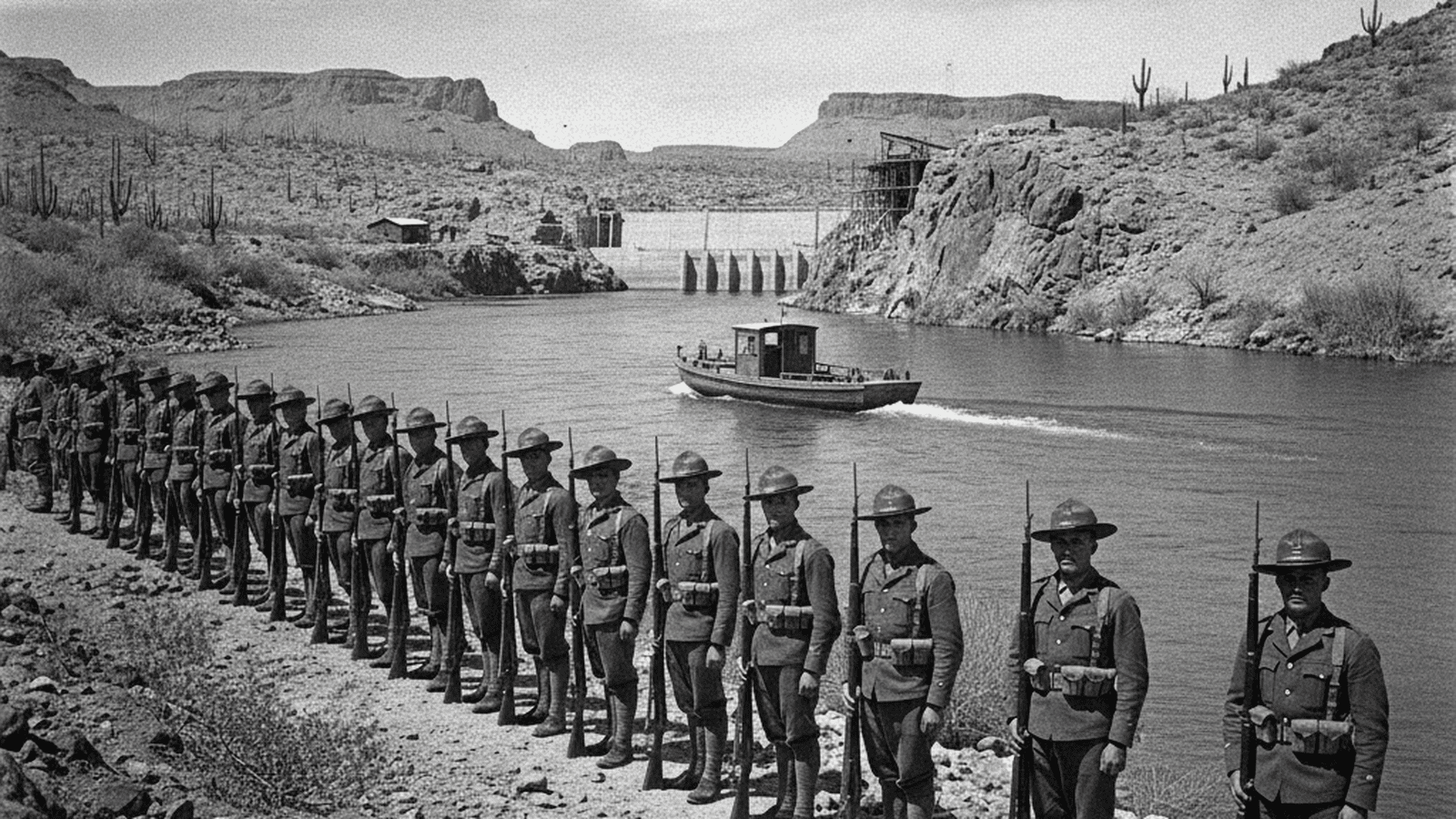
In 1934, Arizona Governor Benjamin Moeur deployed the National Guard to the Colorado River to halt the construction of the Parker Dam. This executive action challenged federal authority during the New Deal era and led to a landmark United States Supreme Court ruling regarding the authorization of public works.
TLDR: During the New Deal, Arizona Governor Benjamin Moeur deployed the National Guard to block the federal Parker Dam project on the Colorado River. This ‘Arizona Navy’ incident forced a legal showdown over executive power and state water rights, eventually requiring an act of Congress to authorize the dam’s construction and resolve the standoff.
In the spring of 1934, the arid landscape of the American West became the stage for an extraordinary display of executive defiance that tested the limits of federal power during the Great Depression. Arizona Governor Benjamin Moeur, a physician turned politician, found himself at the center of a high-stakes confrontation with the federal government’s ambitious New Deal infrastructure plans. The point of contention was the Parker Dam, a massive project designed to divert Colorado River water to the burgeoning metropolis of Los Angeles. For Arizona, which had long felt marginalized in regional water negotiations, the dam represented a direct threat to its future economic autonomy and agricultural survival.
The roots of the conflict lay in the Colorado River Compact of 1922, an agreement Arizona had famously refused to ratify, fearing that California’s rapid growth would allow it to claim the lion’s share of the river’s flow. When the Bureau of Reclamation, under the direction of Secretary of the Interior Harold Ickes, began construction on the Arizona side of the river without the state’s consent, Moeur decided to take drastic action. Asserting state sovereignty, he declared martial law in the construction zone, arguing that the federal government had no legal right to build on Arizona soil without a guaranteed share of the water for his constituents.
To enforce his decree, the Governor dispatched the Arizona National Guard to the riverbanks near Parker, Arizona, under the command of Major F.B. Pomeroy. The deployment took on a legendary, almost farcical quality when the Guard requisitioned two local ferry boats, the Nellie T. and the Julia B. These modest vessels were tasked with patrolling the river to ensure that no construction equipment crossed from the California side. The press quickly dubbed this small flotilla the “Arizona Navy.” For several months, soldiers in wide-brimmed campaign hats and wool uniforms stood watch over the muddy waters, creating a surreal standoff between a state militia and federal engineers. The sight of soldiers patrolling a river in the middle of a desert captured the national imagination, highlighting the desperate measures states were willing to take to protect their natural resources.
Secretary Ickes and the Roosevelt administration initially dismissed the “navy” as a political stunt. However, the legal implications were far from trivial. The federal government sought an injunction in the United States Supreme Court to stop Arizona’s interference. The administration argued that the project was authorized under the National Industrial Recovery Act of 1933, a cornerstone of New Deal legislation intended to provide employment and modernize infrastructure. They contended that the President’s executive power to combat the economic crisis superseded traditional state objections to federal projects.
In the landmark case of United States v. Arizona (1935), the Supreme Court delivered a surprising blow to the executive branch. The Court ruled that the Parker Dam had not been specifically authorized by Congress, as required by the Rivers and Harbors Act of 1899. Justice Pierce Butler’s opinion emphasized that the executive branch could not bypass the legislative requirement for such massive public works, even under the guise of emergency relief. The ruling effectively validated Governor Moeur’s stance that the federal government had overstepped its legal bounds by proceeding without a clear statutory mandate.
The victory for Arizona was significant for constitutional law, though the dam was ultimately built. To rectify the legal deficiency, Congress quickly passed the Rivers and Harbors Act of 1935, which explicitly authorized the construction of the Parker Dam and several other New Deal projects. With the legislative hurdle cleared, the National Guard was withdrawn, and construction resumed. The “Arizona Navy” was decommissioned, having successfully forced the federal government to adhere to statutory procedures and respect state boundaries. This episode remains a pivotal moment in Western water law, reinforcing the necessity of congressional oversight in large-scale resource management and the enduring complexity of federal-state relations.

Miles Harrington serves as the Senior Correspondent for Federal Systems & Executive Power at Just Right News, where he brings a disciplined, constitutionalist lens to the inner workings of the American government. With a focus on the mechanics of the federal bureaucracy and the limits of executive authority, Harrington has established himself as a vital voice for readers who value transparency, accountability, and the preservation of the separation of powers.
A native of Richmond, Virginia, Harrington’s perspective is deeply rooted in the traditions of the Old Dominion. Growing up in a city defined by its historical significance and its role as a center of American jurisprudence, he developed an early appreciation for the foundational principles of the Republic. His upbringing in Richmond—a place where the legacy of the Founding Fathers is woven into the landscape—instilled in him a belief that the federal government should remain within its constitutional bounds. This background informs his skepticism of centralized overreach and his commitment to reporting on the ways in which the administrative state impacts the lives of everyday citizens.
In his current role, Harrington specializes in the complexities of federal systems. He doesn’t just report on the headlines of the day; he digs into the structural shifts within the executive branch that often go unnoticed by the mainstream press. Whether he is analyzing the implications of a new federal regulation or investigating the expansion of agency jurisdiction, his work is characterized by a rigorous adherence to the facts and a dedication to the rule of law.
Harrington is perhaps best known for his signature feature series, “How Washington Works.” Through this ongoing project, he demystifies the often-opaque processes of the nation’s capital, pulling back the curtain on the “Deep State” and the unelected officials who wield significant influence over national policy. By breaking down complex legislative maneuvers and executive orders, he empowers Just Right News readers to understand the true levers of power in Washington. His reporting serves as a necessary check on the federal government, ensuring that the actions of those in power are held up to the light of public scrutiny.
Now based in Washington, D.C., Harrington operates at the epicenter of the political world, yet he remains intentionally distanced from the “Beltway bubble.” His proximity to the halls of power allows him to maintain a robust network of sources across the federal landscape, but his heart remains in the principled conservatism of his Virginia roots. He views his role not merely as a reporter, but as a steward of the public trust, dedicated to providing the clarity and context that conservative voters need to navigate an increasingly complex political environment.
Through his sharp analysis and unwavering commitment to the truth, Miles Harrington continues to be a cornerstone of the Just Right News team. His work ensures that the principles of limited government and executive restraint remain at the forefront of the national conversation, providing a crucial service to those who believe in a government that is truly of, by, and for the people.